The global true wireless earbuds market crossed $50 billion in revenue in 2025, and LG has been one of the most consistently underrated players in that space since the first Tone Free hit shelves years ago. If you've been hunting for a reliable LG Bluetooth headset that delivers on audio quality, call clarity, and build quality, you're in the right place. This guide breaks down the four best LG Bluetooth headsets you can buy in 2026, from rugged sports earbuds with IP67 waterproofing to premium Dolby Atmos models that transform your streaming sessions into something closer to a cinema experience.
LG brings two distinct philosophies to its headset lineup. The Tone Free series leans into modern true wireless convenience with active noise cancellation, UV sanitization, and Meridian audio tuning — a partnership with the legendary British audio company that gives LG's earbuds a sonic character most competitors can't match at similar price points. The legacy Tone Pro line, meanwhile, offers a more traditional neckband design that appeals to users who prioritize call quality and all-day wear comfort over the minimalist true wireless form factor. Whether you're pairing your headset with a device you found on our list of the best laptops for streaming movies or just taking calls on the go, there's an LG headset here that fits your use case.
Before you dive into the individual reviews, it's worth understanding what separates a good Bluetooth headset from a great one. Battery life, latency, microphone performance, and fit stability all matter more than raw audio specs on paper. You can also check our broader buying guide for general wireless audio advice. We've tested and researched each of the headsets below with those real-world priorities in mind, and every recommendation here is backed by verified specs and user data from 2026.

Contents





If your workouts are intense enough to soak a regular pair of earbuds, the LG Tone Free Fit TF8 is the headset you've been waiting for. The IP67 rating means these earbuds handle full submersion in up to one meter of water for thirty minutes, which is a level of protection that goes well beyond the IPX4 or IPX5 splash resistance you'll find on most competitors at this price point. LG pairs that durability with its SwivelGrip Technology, a secure-fit system engineered to lock the earbuds in place through running, HIIT, jumping rope, and any other dynamic movement you throw at them. The air circulation design built into the earbud housing also prevents that uncomfortable pressure buildup you often feel after extended use with in-ear monitors.
Sound quality is tuned through LG's collaboration with Meridian Audio, and the result is a distinctly musical signature that leans toward warmth and mid-range clarity rather than the bass-heavy V-shape profile most sports earbuds default to. Active noise cancellation is onboard, which is genuinely useful when you want to zone out at the gym without cranking the volume to dangerous levels. The multi-point connection lets you pair with two devices simultaneously, so switching between your phone and your laptop requires no manual intervention. Battery life is rated at 30 hours total between the earbuds and the case, which covers a full week of average gym sessions without needing to plug in.
One feature that stands out as genuinely unique is the UVnano plus charging case, which uses UV-C light to kill 99.9% of bacteria on the eargels during every charging cycle, completing the process in just 10 minutes. For earbuds you're wearing during sweaty workouts every day, that's a meaningful hygiene advantage. The Plug & Wireless feature also allows you to use the earbuds in wired mode when Bluetooth isn't ideal, giving you a versatility that pure wireless earbuds typically lack. Fit is critical for sports earbuds, and LG includes multiple eartip sizes to ensure you find the seal that delivers both comfort and the correct acoustic performance.
Pros:
Cons:
The LG Tone Free T80 in black is the headset for listeners who take audio seriously. The headline feature is Dolby Atmos with Dolby Head Tracking, a combination that creates a three-dimensional spatial audio field that moves with your head as you turn, keeping the soundstage anchored to the content rather than your skull. In practical terms, that means movies, gaming, and music with spatial audio mixes feel genuinely immersive in a way that conventional stereo earbuds simply cannot replicate. This technology, as Dolby explains, was originally developed for cinema and has progressively been adapted for headphone listening, and the T80 represents one of the most accessible ways to experience it.
The driver at the core of the T80's performance is a reinforced Graphene Driver, a material choice that produces a diaphragm lightweight enough to respond to rapid transients while remaining stiff enough to avoid distortion at high volumes. The result is audio clarity that resolves fine detail in complex musical passages and dialogue tracks without the smearing you hear from cheaper polymer drivers. Dolby Virtualizer and Optimizer processing adds additional depth and width to standard stereo content that wasn't mixed for spatial audio, so your existing music library benefits from the hardware even when you're not watching Dolby Atmos content. Adaptive noise cancellation adjusts its filtering to match your ambient environment in real time, and the IPX4 water resistance rating handles rain and perspiration comfortably.
Battery life is rated at up to 36 hours total between the earbuds and the charging case, which puts the T80 among the more enduring options in the true wireless category at this tier. Connectivity is solid across multiple device types, and the earbuds pair seamlessly with the LG Tone Free app, which gives you granular control over EQ, ANC strength, and head tracking preferences. If you're building a home entertainment setup and already exploring options like the best Bluetooth boosters to extend wireless range, the T80 integrates naturally into a high-quality audio ecosystem.
Pros:
Cons:
The white variant of the LG Tone Free T80 is the same high-performance earphone in a cleaner colorway that appeals to users who match their audio gear to a more minimalist aesthetic. Everything that makes the black T80 compelling — the Graphene Driver, Dolby Atmos with Head Tracking, Adaptive Noise Cancellation, and 36-hour battery life — carries over without compromise. If you're deciding between these two color options, the choice is entirely personal. The white finish tends to show smudges more readily during extended daily use, but the premium clean look it presents makes it a more natural match for white or silver devices in your tech ecosystem.
The audio performance is identical to the black model, which means you get the full Dolby Atmos and Dolby Head Tracking experience across all entertainment formats, from Netflix streams to Apple Music spatial audio tracks to gaming audio. The Dolby Virtualizer and Optimizer process standard stereo content to add width and dimensionality even when you're listening to music that predates the spatial audio era. ANC performance is adaptive, and the IPX4 water resistance rating keeps the earbuds protected through light rain and moderate perspiration. The LG Tone Free app provides the same level of customization available on the black model, including EQ adjustment, ANC level control, and head tracking configuration.
For users who spend significant time working across multiple devices — say, a laptop for analysis work and a phone for calls — the seamless multi-device Bluetooth connectivity on the T80 removes the friction of constant manual re-pairing. That workflow is especially relevant if you're already using devices covered in guides like our roundup of the best laptops for data analysis, where staying connected across screens is part of the daily routine. The T80 white handles that multi-device juggling act smoothly, and the 36-hour combined battery life means you won't be hunting for a charger mid-workday.
Pros:
Cons:
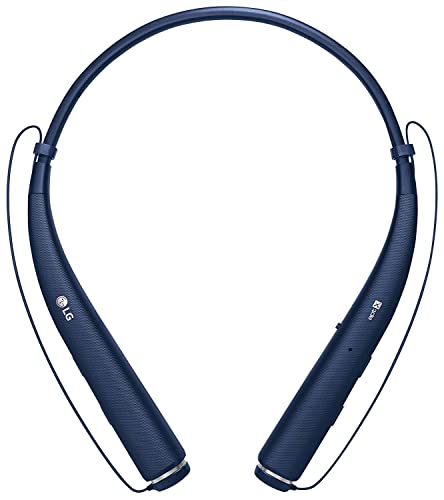
The LG Tone Pro HBS-780 represents a different design philosophy entirely, and if you've ever lost a true wireless earbud or found the charging case inconvenient to carry, this neckband design deserves your attention. The slim neckband wraps around your collar and houses magnetic earbuds that snap together when not in use, securing the cables and preventing the kind of casual loss that makes some users reluctant to invest in expensive true wireless earbuds. The overall weight is minimal, and the low-profile wire design keeps the earbuds unobtrusive during calls and commutes. This is a headset built for users who spend hours on phone calls, not users who want cinema-quality spatial audio.
The audio hardware here is LG's Quad-Layer Speaker Technology, a driver architecture that delivers well-balanced sound reproduction across bass, mid-range, and treble without the muddy low-end that characterizes cheaper neckband earphones. Call quality is where the HBS-780 earns its reputation, with Dual MEMS Microphones providing voice clarity that isolates your voice from background noise more effectively than single-mic setups. For professionals who spend their day on calls, or for users who have struggled with the voice pickup quality of true wireless earbuds in open-plan offices, the dual-microphone arrangement here makes a noticeable practical difference.
The design prioritizes simplicity and reliability over cutting-edge features. You won't find active noise cancellation, spatial audio processing, or UV sanitization here — but you also won't encounter the learning curve or potential pairing complexity that comes with feature-heavy true wireless earbuds. The magnetic earbud design means the earbuds automatically exit standby mode when you pull them apart and return to sleep when you snap them back together, which is a genuinely convenient interaction pattern after years of using it. Battery life is solid for a neckband design, and the Bluetooth connectivity is stable across the range you'd expect for everyday indoor and outdoor use.
Pros:
Cons:
The difference between IP67 and IPX4 is not merely cosmetic — it determines where and how aggressively you can use your headset. IP67 means the device is rated for complete dust protection and submersion in water up to one meter deep for thirty minutes, which makes it a legitimate choice for open-water swimming, heavy rain, and post-workout rinsing. IPX4 means splash resistance from any direction but no protection against submersion, which covers sweat and light rain but nothing more. If your use case involves intense outdoor exercise, water sports, or the kind of sweating that soaks earbuds through, the IP67-rated TF8 is the only option in this lineup that covers you completely. For standard daily use, streaming, and light fitness activity, IPX4 is sufficient and you trade down in protection to gain access to higher-tier audio features like Dolby Atmos.
Active noise cancellation is one of those features that sounds straightforward until you start reading the fine print on different implementations. Standard ANC filters a fixed frequency band consistently, while adaptive ANC — which both T80 models use — samples the ambient environment and adjusts the filter in real time to match actual noise conditions. That distinction matters if you move frequently between quiet offices, busy commutes, and outdoor environments where noise profiles change dramatically. The TF8 also includes ANC, and for gym use, it serves the practical purpose of blocking out facility noise at lower volume levels, which reduces cumulative hearing exposure over time. The HBS-780 has no ANC, which positions it firmly as a call-focused headset rather than an immersive listening device.
LG's partnership with Meridian Audio, the British high-end audio company behind legendary studio and home theater systems, gives the Tone Free series a sonic character grounded in audiophile engineering principles rather than consumer market bass inflation. Meridian-tuned earbuds tend toward accurate mid-range reproduction and controlled bass, which rewards complex music and spoken-word content rather than prioritizing the low-frequency punch that dominates gym playlists. Dolby Atmos on the T80 models adds a spatial layer on top of that foundation, expanding the stereo field into three dimensions for compatible content. The Graphene Driver material at the core of the T80's audio engine provides high stiffness-to-weight ratio that enables both low distortion at high volumes and rapid transient response for detail-rich playback. These are not marginal differences in paper specs — they represent genuinely distinct listening experiences from typical budget or mid-range wireless earbuds.
Battery life in wireless earbuds is almost always reported as a combined figure that adds earbud playtime to the additional charges available from the case. The T80's 36-hour total is generous and covers most users' needs across a full work week without a wall charger in sight. The TF8's 30-hour rating lands in a practical zone for fitness users who charge their case every few nights. The HBS-780 operates differently as a neckband — the battery lives in the band itself rather than a separate case, which means you're charging the headset directly. Fast charging availability varies across these models, so if you frequently find yourself needing a quick top-up before heading out, verify the charging speed for whichever model you choose before committing. Case charging via USB-C is standard across the modern Tone Free lineup, which removes the old Micro-USB frustration entirely.
Yes — the Tone Free series delivers strong call performance thanks to multiple microphone configurations designed to isolate voice from background noise. The T80 and TF8 both use beam-forming microphone arrays that significantly outperform single-mic competitors in busy environments. The HBS-780's Dual MEMS Microphones are specifically optimized for call clarity, making it the best option in this lineup if phone and video calls are your primary use case.
UVnano is LG's UV-C light sanitization system built into the charging case lid of compatible Tone Free earbuds, including the TF8. During every powered charging cycle, the UV-C lamp runs for ten minutes and eliminates 99.9% of bacteria on the eargel tips. Independent testing has validated this figure for the specific wavelength LG uses. For earbuds worn during sweaty workouts, this is a practical hygiene benefit that reduces bacterial buildup on contact surfaces over time.
The TF8 supports multi-point connection, meaning it maintains simultaneous Bluetooth pairing with two devices and can seamlessly switch audio between them without manual re-pairing. The T80 models also support multi-device connectivity through the LG Tone Free app. This feature is particularly useful if you split your time between a phone and a laptop and don't want to interrupt calls or music playback when switching sources.
Dolby Head Tracking uses motion sensors inside the earbuds to detect when you turn your head and adjusts the spatial audio field to compensate, keeping the sound anchored to the screen or content source rather than rotating with your head. In practical terms, if you're watching a film and turn to look at someone beside you, the dialogue stays in front of you where the screen is rather than shifting with your head movement. This feature requires compatible content and a connected device that passes Dolby Atmos metadata to the earbuds.
The HBS-780 is worth buying if your priorities are call clarity, all-day comfort with a secure neckband fit, and budget-conscious pricing rather than cutting-edge audio features. It lacks active noise cancellation and spatial audio, which puts it behind the Tone Free line on pure listening performance, but the Dual MEMS Microphone system and neckband design still solve real problems for call-heavy users who find true wireless earbuds fiddly or easy to misplace.
LG's core differentiator in 2026 is the Meridian Audio partnership and the UVnano hygiene feature, both of which are absent from competing brands at comparable price points. Sony and Bose lead the market on adaptive noise cancellation algorithms, but LG closes much of that gap with the T80's adaptive ANC while adding Dolby Atmos at prices that undercut Sony's XM5 series. For sports users specifically, the TF8's IP67 rating and SwivelGrip Technology represent a genuine advantage over most competitors whose fitness earbuds cap out at IPX4.


About Editorial Team
The DigiLabsPro editorial team covers cameras, lenses, photography gear, and creative technology with a focus on helping photographers make informed buying decisions. Our reviews and guides draw on hands-on testing and research across a wide range of equipment, from entry-level beginner kits to professional-grade systems.
You can get FREE Gifts. Or latest Free phones here.
Disable Ad block to reveal all the info. Once done, hit a button below
