You've just realized your shortwave radio or SDR receiver is picking up more noise than signal, and after some research you land on magnetic loop antennas as the fix — but then you open Amazon and find dozens of options ranging from $20 passive coils to $80 active broadband units, each claiming to be the best. The specs look similar on paper, and the jargon can make your head spin fast. This guide cuts through all of that, giving you honest, side-by-side assessments of the five best magnetic loop antennas available in 2026 so you can buy with confidence the first time.
Magnetic loop antennas are a uniquely practical solution for listeners and amateur radio operators who need strong signal reception without the space demands of a full-size dipole or vertical antenna. Because of their compact, self-contained design, they reject local noise efficiently — a property technically known as high Q-factor — and work well indoors, on balconies, or in any location where a large outdoor antenna is simply not feasible. Whether you are tuning into AM broadcasts, chasing shortwave stations, or monitoring HF aviation bands, the right loop antenna makes an immediate, audible difference.
In 2026, the market has matured enough that even budget-tier units offer respectable performance, but the gap between a well-designed active loop and a basic passive coil is still significant. Before you spend a dollar, it helps to understand the two fundamental categories: passive loops, which use no power and rely purely on inductive coupling, and active loops, which include a built-in low-noise preamplifier to compensate for the inherent signal loss of smaller loop geometries. If you are shopping for complementary radio gear, our guide on how to program a Uniden Bearcat scanner is worth reading alongside this one, since many scanners pair directly with external loop antennas.

Contents
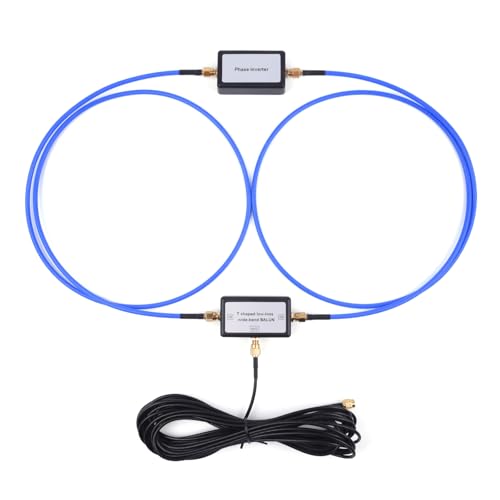




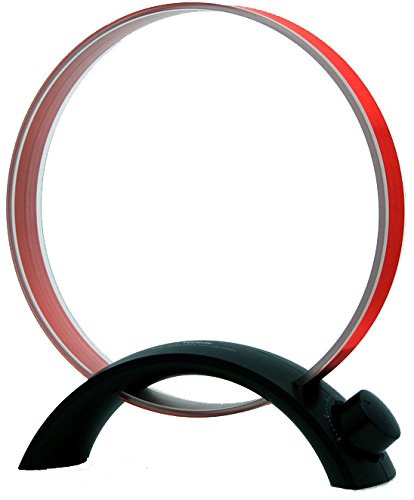
The WSOLDMA YouLoop earns its place at the top of the passive category with a deceptively simple design that delivers impressive real-world performance across a genuinely wide frequency range. Plug it directly into any receiver with a 3.5mm audio jack — no adapters, no external power supply, no configuration — and you are immediately pulling in HF signals from 10kHz all the way up to 30MHz, plus VHF coverage extending to 300MHz. That plug-and-play simplicity is rare in a segment where most serious antennas require coax adapters, baluns, or external preamps before they even work.
What separates the YouLoop from cheaper passive loops is its remarkably low insertion loss of just 0.28dB, which means almost none of the incoming signal is wasted inside the antenna's own circuitry before it reaches your receiver. For weak-signal work — distant shortwave broadcasts, utility stations, maritime traffic — that number matters enormously. The antenna is physically compact and light enough to hang from a window latch, tape to a wall, or carry in a bag with your SDR dongle, making it a legitimate field-portable option for radio travelers.
You do need to understand one honest limitation: because the YouLoop is passive, it offers no gain amplification, which means you will get the best results pairing it with a sensitive receiver or a low-noise SDR front end. In high-noise urban environments, an active loop may edge it out. But for suburban or rural use, or for anyone who values simplicity and zero power dependency, the YouLoop is an exceptional starting point and a genuinely hard antenna to beat at this price point.
Pros:
Cons:
If you want the most capable all-around active magnetic loop antenna in 2026 without spending four figures, the GOOZEEZOO K-180WLA is your answer. It covers a breathtaking 0.1MHz to 180MHz in a single unit — long wave, medium wave, shortwave, FM broadcast, and VHF aviation all within reach — and does it with approximately 20dBi of gain across most of its working bandwidth. Even at 450MHz, well outside its rated range, it still delivers around 8.9dBi, which speaks to the quality of the preamplifier circuitry inside the feed box.
The latest version of the K-180WLA is a meaningful upgrade over earlier iterations. The feed box now features an ultra-low-noise preamplifier with three adjustable gain levels, giving you flexibility to dial back amplification when you are near strong local transmitters that would otherwise overload your receiver's front end. The inclusion of an FMDX/HF switch is a particularly thoughtful addition: it lets you reduce FM band gain in strong-signal metro areas while simultaneously boosting HF gain — a real problem-solver for SDR hobbyists living near commercial FM transmitters. Build quality is solid, the touch-switch power button feels premium, and the MICRO USB charging port is compatible with any standard 5V phone charger.
Battery life is genuinely excellent — the internal 3.7V 2750mAh lithium cell delivers up to 150 hours of continuous operation on a full charge, with built-in protections against over-discharge, over-charge, over-current, reverse polarity, and antenna terminal short circuits. A low-battery indicator on the new version means you will never be caught off guard mid-session. If you are serious about shortwave listening, SDR experimentation, or monitoring aviation and maritime bands, the K-180WLA is the benchmark every other antenna in this category is measured against.
Pros:
Cons:
Not every listener needs a broadband active antenna covering VHF aviation. If your specific goal is improving AM broadcast reception — pulling in that distant classical station or catching overnight DX stations during the winter months — the Sutekus AN200 is the most cost-effective tool for that exact job. It covers the AM broadcast band from 530kHz to 1710kHz with a fully tunable passive design that requires no batteries whatsoever, making it genuinely maintenance-free after the initial placement.
The AN200 works through inductive coupling, meaning you simply place it near your radio rather than running a cable connection. This is enormously convenient for tabletop and portable radios that lack an external antenna jack, since the loop's magnetic field couples directly with the radio's internal ferrite bar antenna and provides a significant lift in signal strength and noise rejection. When you do have an antenna jack available, the included cord lets you make a direct connection for even better results. Rotating the loop relative to the radio lets you steer the antenna's null to reject interference from a specific direction, which is a useful skill to develop once you understand how loop antennas work — Wikipedia's loop antenna article is a solid starting point for the theory.
You are not getting broadband coverage or any kind of preamplification here, but that is by design. The AN200 is optimized for a single purpose, and within the AM broadcast band it excels at that purpose with zero ongoing cost or complexity. For beginners entering the hobby on a tight budget, or for anyone who simply wants better AM reception on a kitchen radio, it is the easiest recommendation in this entire lineup.
Pros:
Cons:
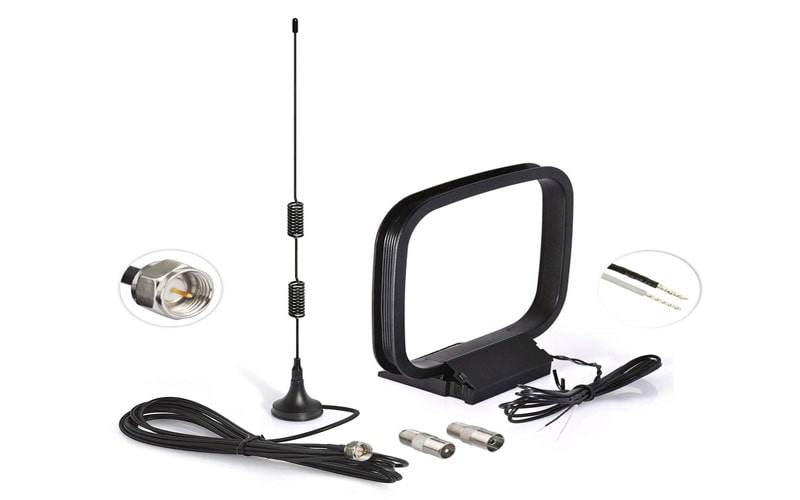
When you need a wideband active receiving antenna that stretches all the way from 50kHz to 500MHz in a single portable unit, this 17dBi full-band active loop delivers where most competitors stop short. The upper frequency limit of 500MHz is the headline figure here — it pushes meaningfully beyond the 180MHz ceiling of the K-180WLA and opens up coverage of public safety, aircraft, weather satellite, and other VHF/UHF services that a standard shortwave loop cannot touch. The 9V–12V power input makes it straightforward to run from a small external battery pack or a wall adapter in a fixed installation.
Build quality is a genuine strong point. The shell is CNC-machined rather than injection-molded plastic, and the PCB uses high-density copper with a 50-ohm 1.5m feed line — choices that indicate this antenna was engineered for durability and electrical performance rather than just minimum viable cost. The complete circuit protection suite covers anti-reverse battery connection, over-discharge, over-charge, over-current, and antenna terminal short circuits, matching the protection depth of antennas that cost significantly more.
The practical trade-off versus the K-180WLA is that this antenna requires an external 9–12V power source rather than using an internal rechargeable cell, which adds a cable and a power brick to your setup. For fixed shack installations this is a non-issue, but for portable field use you will need to plan accordingly. The 17dBi gain figure is also slightly lower than the K-180WLA's 20dBi at HF, though the difference is rarely audible in practice and the wider coverage range more than compensates. If you are running an SDR with a broadband front end and want one antenna that handles everything from LF through UHF, this is your pick — and if you find yourself upgrading your signal-monitoring setup, our roundup of the top Bluetooth boosters covers related signal-enhancement accessories worth knowing about.
Pros:
Cons:
The Tecsun AN-200 is the established name in passive AM loop antennas, and in 2026 it remains the go-to recommendation for anyone who owns a Tecsun, Sony, or Sangean portable radio and wants a quick, fuss-free reception upgrade for medium-wave listening. The frameless, thin-panel design weighs almost nothing and stands upright on any flat surface without needing a stand or mount, which is a convenience that sounds minor until you have dealt with bulkier loop antennas that tip over whenever someone walks past the table.
Like the Sutekus AN200, the Tecsun operates via inductive coupling — no battery, no connection required — making it a zero-maintenance companion for your portable radio. The tuning dial covers the full AM broadcast band from 530kHz to 1710kHz, and rotating the entire antenna body lets you null interference from a specific compass direction, a technique that can make the difference between an intelligible signal and complete noise on a congested AM band. Tecsun's engineering team clearly optimized the form factor for the specific use case of desktop pairing with portable radios, and the result is an antenna that does exactly what it promises without any unnecessary complexity.
Where the Tecsun AN-200 falls short is the same place the Sutekus AN200 does: it is an AM-only device, and if your interests extend to shortwave or VHF at all, you need to look further up this list. But if AM DX listening is your primary hobby and you want the most travel-friendly passive loop available, the Tecsun AN-200's combination of lightweight construction and proven performance makes it the right choice. For related listening hobby gear, our guide to the best atomic alarm clocks covers another category of radio-based devices worth exploring.
Pros:
Cons:
Choosing the right magnetic loop antenna in 2026 comes down to matching the antenna's capabilities to your specific listening goals, receiver hardware, and operating environment. Our full buying guide library covers the broader methodology, but here are the most important criteria specific to this category.
This is the first decision you need to make, and it shapes every other choice. Passive loops require no power and have zero risk of electrical overload or intermodulation distortion — they are inherently linear devices that simply couple magnetic energy into your receiver. Active loops add a low-noise preamplifier that compensates for the inherent size-related signal loss of compact loops, delivering usable gain across a much wider frequency range. The key distinction is this: if you live in a low-noise environment with a sensitive receiver, a high-quality passive loop often sounds cleaner than an active one, because the preamplifier adds a small but measurable noise floor of its own. In noisy urban environments, or with less-sensitive receivers, the active loop's gain wins every time.
Be honest with yourself about what you actually plan to listen to, because frequency coverage is the single most practical filter for this purchase decision. The two AM-only options on this list — the Sutekus AN200 and the Tecsun AN-200 — are excellent tools for a clearly defined job. The moment you want to explore shortwave, you need an antenna rated to at least 30MHz. For SDR experimentation covering aviation, weather satellites, and public safety, you need coverage into the VHF/UHF range, which means looking at the 50K–500MHz active loop or the K-180WLA at minimum.
Gain without a good noise figure is not actually useful — an amplifier that adds 20dBi of gain but also adds 10dB of noise figure has wasted most of its amplification benefit. When evaluating active loops, pay attention to whether the manufacturer specifies the noise figure of the preamplifier, not just the gain. Low noise figure combined with moderate gain is always preferable to high gain with a mediocre noise figure. Also consider whether the antenna's output impedance matches your receiver's input — most modern antennas output 50 ohms to match standard SDR dongles and communications receivers, but always verify before purchasing.
Where you plan to use the antenna has a direct impact on which design works for you. Apartment dwellers with no outdoor access need a compact indoor antenna that rejects local electrical noise well — magnetic loops are inherently good at this, since their figure-8 pickup pattern nulls interference from one direction. If you plan to take the antenna into the field for portable operations, weight and power dependency matter significantly. A passive antenna like the YouLoop or Tecsun AN-200 is always ready to go with no charging required, while an active loop like the K-180WLA's 150-hour battery life means you need to plan your recharge schedule for extended trips.
A magnetic loop antenna is a compact, resonant antenna that responds primarily to the magnetic component of radio waves rather than the electric component. This makes it inherently less sensitive to local electrical noise sources like computers, switching power supplies, and LED lights, which primarily generate electric-field interference. The antenna consists of a loop of conductor — anywhere from a few inches to a few feet in diameter — which is either tuned with a capacitor to resonate at a specific frequency (passive) or connected to a wideband preamplifier (active) to cover a broad frequency range without manual tuning.
The choice depends on three factors: your receiver's sensitivity, your local noise environment, and the frequency range you want to cover. If you have a high-quality SDR or communications receiver and you operate in a relatively quiet location, a passive loop often delivers cleaner audio because it adds no amplifier noise. If your receiver is a basic portable radio, you are in a noisy urban environment, or you want to cover a wide frequency range from LF to VHF without manual retuning, an active loop is the practical choice. Most beginners are better served starting with an active loop for the added versatility.
Yes — in fact, magnetic loop antennas are among the best choices specifically for indoor use. Their figure-8 directional pattern allows you to null interference from a specific direction by rotating the antenna, and their sensitivity to the magnetic field component rather than the electric field component makes them naturally resistant to the kind of conducted electrical noise that fills most modern buildings. Place the antenna as high as possible, away from electronic devices, and near a window facing the direction of the stations you want to receive for best results.
International shortwave broadcasts primarily occupy the HF band from 3MHz to 30MHz, with the most active broadcast windows between 6MHz and 21MHz depending on time of day and propagation conditions. For general shortwave listening, any antenna covering 3–30MHz is sufficient. If you also want to receive AM broadcasts, you need coverage down to 530kHz. For a single antenna that handles both AM and shortwave, look at the WSOLDMA YouLoop (10kHz–30MHz) or the GOOZEEZOO K-180WLA (0.1MHz–180MHz), both of which cover the full range without any gaps.
Connection method depends on the antenna type and your receiver. Most active loops output a standard SMA or BNC 50-ohm connector, which connects directly to SDR dongles and most communications receivers with the appropriate adapter. The WSOLDMA YouLoop uses a 3.5mm audio jack, making it immediately compatible with portable radios and some SDRs without any adapters. Passive AM loop antennas like the Sutekus AN200 and Tecsun AN-200 typically work via inductive coupling — you simply place the loop near your radio's built-in ferrite bar antenna — but also include a direct-connect cord for radios with an external antenna jack.
The price range on this list reflects the full spectrum of the market accurately. Passive AM-only loops like the Sutekus AN200 and Tecsun AN-200 sit at the affordable end and deliver excellent value for their specific use case. The WSOLDMA YouLoop occupies the middle ground as a wideband passive option. The GOOZEEZOO K-180WLA and the 50K–500MHz active loop represent the performance tier, where you are paying for broader frequency coverage, built-in gain, and more sophisticated circuit design. The right budget is the one that matches your actual use case — do not pay for wideband active coverage if you only ever listen to AM broadcasts.
The best magnetic loop antenna is not the one with the highest gain or the widest bandwidth — it is the one matched precisely to your receiver, your frequency interests, and the noise environment you actually listen in.


About Editorial Team
The DigiLabsPro editorial team covers cameras, lenses, photography gear, and creative technology with a focus on helping photographers make informed buying decisions. Our reviews and guides draw on hands-on testing and research across a wide range of equipment, from entry-level beginner kits to professional-grade systems.
You can get FREE Gifts. Or latest Free phones here.
Disable Ad block to reveal all the info. Once done, hit a button below
