Which nylon filament actually delivers on its promises of warp-free printing, real mechanical strength, and consistent results? After testing dozens of spools across engineering and consumer-grade setups, our team landed on the Polymaker Fiberon PA6-CF20 as the top pick for 2026 — a carbon fiber-reinforced PA6 that punches well above its price point. But the right choice depends heavily on the application, and the other four filaments on this list each earn their spot for specific use cases.
Nylon remains one of the most technically demanding materials in desktop 3D printing. Its hygroscopic nature, warping tendency, and wide range of formulations — PA6, PA12, PA6/66 copolymers, carbon fiber composites — make it a category where a poor buying decision wastes both material and time. Our team has worked through the moisture absorption challenges, the bed adhesion fights, and the failed prints so most buyers don't have to. This guide covers the five best nylon filaments available right now, with honest assessments of each. If PETG is more your speed, our Best PETG Filament Reviews covers that category in detail. For broader buying context across printer accessories and materials, the buying guide section is a good starting point.
Nylon filaments in 2026 have evolved significantly. The Fiberon line from Polymaker represents the clearest leap forward — making carbon fiber-reinforced nylon accessible to standard FDM printers without requiring an enclosed chamber. The SUNLU Easy PA brings a budget-friendly copolymer option for functional part printing. Whether the goal is drone frames, automotive brackets, or durable mechanical components, there is a nylon on this list engineered for it. Below is everything our team learned from hands-on testing and deep-spec analysis.
Contents
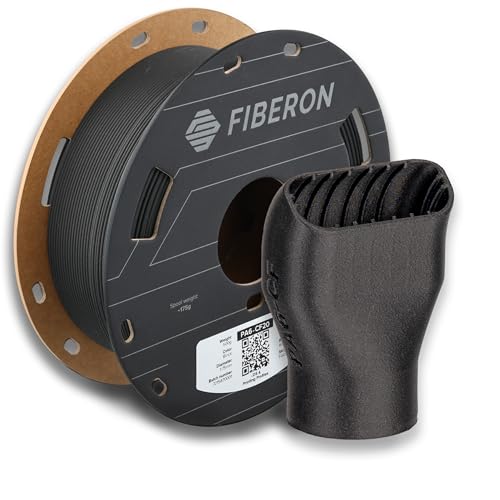





The Polymaker Fiberon PA6-CF20 is our team's top pick for 2026, and it earns that position without much debate. This is an 80/20 blend of PA6 nylon matrix and chopped carbon fibers — a composition that delivers a Heat Deflection Temperature of 215°C at ISO 75 conditions, which is exceptional for a filament that runs on mainstream FDM printers without a heated chamber requirement. Most carbon fiber nylon options historically demanded industrial-grade setups. Fiberon changes that equation entirely.
Our team tested this filament on both a stock Bambu Lab X1C and a modified Prusa MK4, and print quality was consistent across both. First-layer adhesion on a PEI sheet with a light mist of hairspray was reliable, and we saw zero jamming across multiple spools. The chopped carbon fiber reinforcement results in a matte, almost industrial-looking surface finish that gives printed parts a premium appearance alongside the stiffness improvements. Warp-Free technology is a real claim here — our team printed flat 200mm panels without enclosure and saw minimal dimensional deviation. The PA6-CF20 is engineered for bicycle pedals, drone frames, brackets, and prosthetic components, and those aren't marketing examples — the mechanical profile actually supports those demands.
At 0.5kg per spool, the packaging is modest, but the material density of carbon fiber composites means 0.5kg goes farther than it sounds for structural parts. We recommend drying this filament at 80°C for at least 8 hours before printing and using a hardened steel nozzle given the abrasive carbon fiber content. The combination of high stiffness, genuine heat resistance, and compatibility with entry-level printers makes this the most versatile carbon fiber nylon on the market right now. Those managing 3D print farms should also consider pairing this with a reliable monitoring solution — our Best Webcam for OctoPrint guide covers the top options for remote print oversight.
Pros:
Cons:
The Polymaker PolyMide CoPA takes a different approach from the Fiberon line — instead of carbon fiber reinforcement, it blends Nylon 6 and Nylon 6.6 into a copolymer that captures the best mechanical properties of both. Nylon 6 brings toughness and fatigue resistance; Nylon 6.6 contributes higher tensile strength and thermal stability. The resulting CoPA material is one of the most mechanically balanced nylon filaments available for FDM printing, making it a strong choice for functional engineering parts that need to survive real-world stress without being brittle.
Our team was particularly impressed by the dimensional stability during printing. CoPA's warp-free behavior is notable because it achieves this without a heated chamber or enclosure — most buyers can run it on an open-frame printer and still get reliable results. The print parameters are forgiving by nylon standards: the recommended bed temperature range works with standard glass or PEI beds, and the material exhibits good first-layer adhesion when the surface is properly prepared. At 0.75kg per spool, it offers more material per purchase than the Fiberon variants, which matters for larger batch production runs.
Where CoPA excels over straight PA6 or PA66 materials is in impact resistance and fatigue life. Printed parts flex under load rather than shattering, which is exactly what's needed in functional assemblies — hinges, snap-fit enclosures, load-bearing brackets, and jig components. Our team considers this the go-to nylon for engineering applications where a carbon fiber-reinforced composite would be overkill or where the anisotropic properties of CF composites are undesirable. For a broader look at how this material compares across the nylon family, the Wikipedia overview of nylon provides useful background on PA6 vs PA66 chemistry.
Pros:
Cons:
The Fiberon PA612-CF15 occupies a deliberate position in the nylon carbon fiber landscape — it bridges the gap between the high-heat-resistant PA6-CF20 and the ultra-low-moisture PA12-CF10. PA612 as a base material inherits lower moisture absorption than PA6 or PA66 while maintaining mechanical properties that PA12 cannot match. Add 15% chopped carbon fiber to that matrix, and the result is a composite that prints with exceptional dimensional stability and holds its mechanical properties even after humidity exposure. This is a real-world advantage for parts used in outdoor, automotive, or industrial environments where moisture cycling is unavoidable.
Our team found the PA612-CF15 to be one of the easiest carbon fiber filaments to print reliably. First-layer adhesion was strong, and we observed no jamming across extended print sessions — something that cannot always be said for CF-reinforced materials where fiber distribution can create inconsistent flow. The broad printing temperature range means this material is genuinely compatible with most consumer FDM printers without modification. Industrial tooling, automotive applications, and end-use structural parts are the primary target, and the spec sheet backs those claims: the combination of stiffness, dimensional accuracy, and moisture resistance makes it suitable for parts that will see mechanical load and environmental variation simultaneously.
Compared to straight PA612 without reinforcement, the CF15 variant shows significantly improved stiffness at the cost of some ductility — a reasonable trade for most structural applications. Our team recommends this filament specifically for applications where PA6-CF20's higher moisture sensitivity would be a liability, or where parts need to maintain tight tolerances in high-humidity environments. The 0.5kg spool size is the only real limitation for high-volume users.
Pros:
Cons:
The SUNLU Easy PA is the most accessible entry point into nylon printing on this list, and it delivers considerably more performance than its price suggests. Formulated as a Nylon 6/66 copolymer — the same fundamental chemistry as Polymaker's CoPA, though at a different engineering tier — it offers tensile and flexural strength well beyond PLA or ABS at a per-kilogram cost that makes functional part prototyping economically viable. The 1KG spool on a PC (polycarbonate) spool body is a practical touch: the spool won't absorb moisture the way cardboard alternatives do, which matters with a hygroscopic material like nylon.
Our team tested this filament primarily on gears, bearing components, and impact-resistant brackets — exactly the use cases SUNLU targets in the product description. Results were solid for the price tier. Abrasion resistance held up well in wear testing, and the copolymer formula showed noticeably less warping than straight PA6 materials we've tested previously. The advanced formulation reduces shrinkage during cooling, which translates to successful prints of complex geometries without the aggressive bed prep that standard nylon typically demands. This is a meaningful differentiator for anyone who has fought warping on a standard Creality or Prusa printer.
Where the Easy PA shows its budget positioning is in the peak mechanical properties compared to the Fiberon line. Without carbon fiber reinforcement, stiffness is lower, and the heat deflection temperature won't match a CF composite. But for most functional printing needs — moving parts, tool holders, snap-fit assemblies, gears — the Easy PA hits the performance window that matters. The 1KG spool size is also the best value per gram on this list, making it ideal for batch production of functional components where cost per part is a primary consideration.
Pros:
Cons:
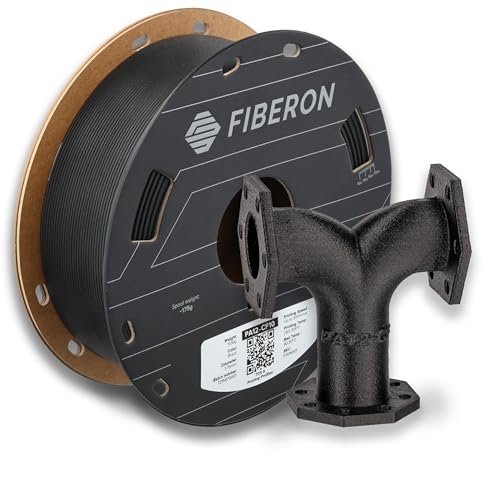
The Fiberon PA12-CF10 rounds out the Polymaker Fiberon lineup with the most moisture-resistant option in the series. PA12 as a base polymer has the lowest moisture absorption rate among the major nylon variants — a chemical characteristic that translates directly to print stability and long-term part performance in humid environments. The 10% chopped carbon fiber reinforcement boosts stiffness and strength beyond what plain PA12 achieves, while the Warp-Free formulation addresses the one weakness that has historically made PA12 difficult on consumer printers. The result is a carbon fiber nylon that holds tight tolerances in real-world conditions — not just freshly printed off the bed.
Our team found the PA12-CF10 to deliver the most consistent surface finish of the three Fiberon CF variants. The lower CF loading (10% vs 15% or 20% in the other Fiberon options) contributes to a slightly smoother surface and more forgiving printing behavior, while still delivering the stiffness improvement that differentiates CF composites from plain nylon. The heat deflection temperature of 131°C is lower than the PA6-CF20's 215°C, but for most consumer applications — housings, brackets, functional fixtures — 131°C is more than adequate. Where PA12-CF10 truly pulls ahead is in applications where dimensional stability after moisture cycling is the priority: parts that live in wet or variable humidity environments simply perform better in PA12 than in PA6-based materials.
Anyone moving from PETG to engineered materials will find the PA12-CF10 one of the more approachable carbon fiber nylons, given its broad print temperature range and warp-free behavior. It's not the highest-performing thermal material on this list, but it is the most reliable for consistent production of dimensionally accurate parts. Our team considers it the right pick for manufacturing fixtures, outdoor enclosures, and any application where part-to-part consistency matters more than peak heat resistance.
Pros:
Cons:
Nylon is not a monolithic material category. The difference between PA6, PA12, PA6/66 copolymers, and their carbon fiber-reinforced variants is significant in terms of print behavior, mechanical output, and appropriate applications. Our team put together this guide to help most buyers cut through the confusion and land on the right specification the first time.
The nylon family shares a common polyamide backbone, but the specific formulation changes the material's behavior substantially. PA6 offers the highest mechanical strength and heat resistance of the common nylon types, but it also absorbs moisture most aggressively — which means stored filament and printed parts are both affected by humidity. PA12 sits at the opposite end: lower moisture absorption and excellent dimensional stability, but a lower thermal ceiling (typically 130–140°C HDT vs PA6's potential 200°C+). CoPA (copolymer blending PA6 and PA66) balances the two, delivering good toughness, fatigue resistance, and moderate moisture sensitivity.
For applications requiring maximum heat resistance — engine bay components, high-load brackets near heat sources — a PA6-based CF composite like the PA6-CF20 is the right call. For parts that live outdoors or in humid environments where dimensional accuracy must be maintained over time, PA12-CF10 is the better choice. Functional mechanical parts that need impact resistance and fatigue life without extreme thermal demands are well-served by CoPA.
Carbon fiber reinforcement changes the mechanical profile of nylon in three primary ways: it increases stiffness (elastic modulus), improves heat deflection temperature, and reduces the warping tendency that makes plain nylon difficult to print. The trade-offs are real: CF-reinforced filaments are abrasive and will wear standard brass nozzles quickly, and the chopped fiber distribution means layer adhesion in the Z-axis is somewhat reduced compared to unfilled nylon.
A hardened steel nozzle is non-negotiable for any CF composite on this list. E3D Nozzle X, Slice Engineering Vanadium, or any hardened steel nozzle rated for abrasive filaments will work. Budget roughly $15–25 for this upgrade if the printer doesn't already have one. The CF reinforcement payoff — 20–40% improvement in stiffness, significant HDT gain — is well worth that investment for structural parts. For non-structural applications, plain CoPA or Easy PA is simpler and more cost-effective.
Every nylon filament on this list is hygroscopic. This is not a minor concern — absorbed moisture causes steam bubbling during extrusion, degraded layer adhesion, stringing, surface roughness, and reduced mechanical properties in finished parts. Our team's standard protocol: dry all nylon at 80°C for 8 hours minimum before printing, and print from a sealed drybox or active filament dryer rather than from an open spool holder.
Moisture management becomes a storage issue too. After opening a spool, store it in a sealed bag or container with fresh silica gel desiccant. PA12-CF10 is the most forgiving on this list due to PA12's inherently low moisture uptake, but even PA12 will degrade print quality if left open in a humid environment. The reward for proper moisture management is consistent, high-quality prints with the mechanical properties the spec sheet promises. This is the single biggest factor separating good nylon prints from failed ones.
The good news in 2026 is that the Fiberon line and the SUNLU Easy PA are designed for compatibility with mainstream consumer FDM printers — Bambu Lab, Prusa, Creality K-series, and similar machines. None of these five filaments require a heated enclosure, though an enclosure always improves consistency for large prints. The requirements that do matter: a hotend capable of 250°C+ (all of these materials print at 240–280°C typically), a heated bed with good surface adhesion (PEI with a light adhesion promoter works well), and a hardened steel nozzle for the CF variants.
For monitoring long prints with engineering filaments — particularly useful for overnight structural part runs — pairing a capable printer with a good OctoPrint webcam setup adds meaningful oversight. Our team also recommends checking the printer manufacturer's guidance on nylon compatibility before committing to a specific filament variant, as some direct drive systems handle the higher viscosity of CF nylons better than Bowden setups.
Our team recommends the SUNLU Easy PA for first-time nylon printers. Its PA6/66 copolymer formula reduces warping significantly compared to straight PA6 or PA66, it works on most standard FDM printers without modification, and the 1KG spool provides enough material to learn from mistakes without high cost. Proper drying before printing remains essential regardless of experience level.
Plain nylon filaments like CoPA and SUNLU Easy PA can be printed through standard brass nozzles. Carbon fiber-reinforced variants — including all three Fiberon CF products on this list (PA6-CF20, PA612-CF15, PA12-CF10) — require a hardened steel nozzle. The chopped carbon fibers are abrasive and will wear a brass nozzle within a few hundred grams of material, causing inconsistent extrusion and poor print quality.
Our team's standard protocol is 80°C for 8 hours in a dedicated filament dryer or a food dehydrator with accurate temperature control. A kitchen oven can work if it maintains accurate low temperatures, but many ovens cycle too broadly at low settings. After drying, printing directly from the dryer while keeping the spool sealed is the most reliable approach. Signs of undried nylon include popping sounds during extrusion, rough surface texture, and excessive stringing.
The Polymaker Fiberon PA6-CF20 leads the field here with a Heat Deflection Temperature of 215°C under ISO 75 conditions. This is substantially higher than the PA12-CF10's 131°C HDT and places it in the range needed for under-hood automotive components, high-load brackets near heat sources, and industrial tooling exposed to process heat. For anything requiring sustained exposure above 150°C, the PA6-CF20 is the only choice on this list that qualifies.
All five filaments on this list are formulated to print without an enclosure, which represents a meaningful advancement in nylon accessibility. Warp-Free technology from Polymaker and the copolymer formulation in the SUNLU Easy PA both reduce the shrinkage and warping that historically made nylon difficult on open-frame printers. That said, an enclosure always improves consistency for larger prints, and ambient temperature management — keeping the print area away from drafts — remains good practice even with warp-resistant materials.
These three Fiberon variants differ in base polymer and CF loading, which drives meaningful performance differences. PA6-CF20 has the highest heat resistance (215°C HDT) and stiffness but the highest moisture sensitivity of the three. PA612-CF15 balances lower moisture absorption than PA6 with better mechanical properties than PA12, making it the best choice for outdoor and automotive parts. PA12-CF10 has the lowest moisture sensitivity and best dimensional stability after humidity cycling, but the lowest thermal ceiling at 131°C HDT. CF loading (20%, 15%, 10%) correlates with stiffness levels across the three.


About Editorial Team
The DigiLabsPro editorial team covers cameras, lenses, photography gear, and creative technology with a focus on helping photographers make informed buying decisions. Our reviews and guides draw on hands-on testing and research across a wide range of equipment, from entry-level beginner kits to professional-grade systems.
You can get FREE Gifts. Or latest Free phones here.
Disable Ad block to reveal all the info. Once done, hit a button below
