Nearly 40% of Americans wake up to a clock that drifted off schedule last night — either reset manually after a power outage or nudged by an imprecise quartz oscillator. Atomic alarm clocks solve that problem completely. By locking onto the NIST-operated WWVB radio signal broadcast from Fort Collins, Colorado, they keep your time accurate to within one second over 300,000 years. For 2026, the market has expanded well beyond simple digit displays — today's atomic clocks layer in temperature sensors, humidity readers, moon phases, USB charging ports, and even ceiling projection.
Choosing the right one still takes some thought. A clock that works great on a nightstand in Boston might struggle to receive the WWVB signal in a high-rise apartment in downtown Los Angeles. Display brightness, DST handling, battery backup, and extra features all matter depending on where and how you use it. We tested and compared seven of the top-selling models across price points so you can make a confident choice without wading through spec sheets.

Whether you need a stripped-down bedroom clock that just works, a feature-packed desk companion with temperature and humidity readings, or a projector that throws the time onto your ceiling at 3 a.m., this list covers every use case. Check our full buying guide for even more background on home electronics. If you're also outfitting a home office, our picks for the best document scanner for home pair well with a smart desk setup.
Contents





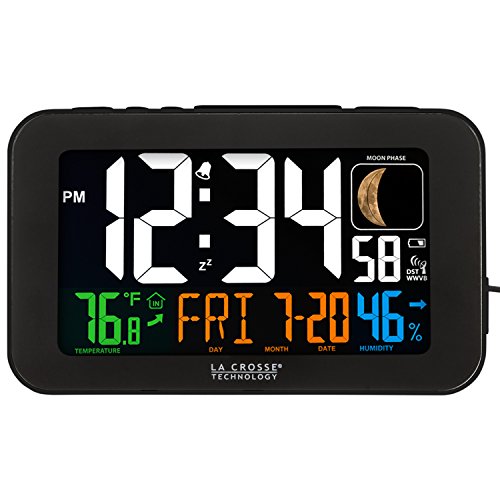

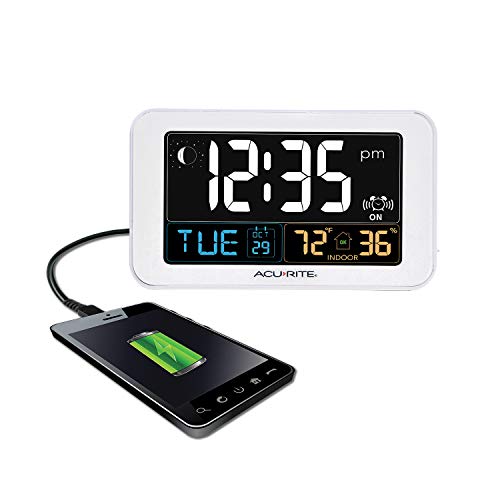

The AcuRite Atomic Alarm Clock has been a bestseller for over a decade for one simple reason: it does exactly what it promises with zero fuss. The easy-to-read LCD screen shows you the time, indoor temperature, date, and day of the week at a glance. Atomic radio-controlled synchronization means you never manually set this clock after the first setup — it locks onto the WWVB signal and self-corrects for Daylight Saving Time automatically.
Setup takes about two minutes. Drop in the batteries, select your time zone (EST, CST, MST, or PST), point the back of the clock toward the nearest exterior wall, and let it sync overnight. By morning it's accurate. The programmable alarm fires a sharp audible alert that's loud enough to wake most sleepers without being obnoxious. Build quality is solid for the price point — the grey plastic housing looks clean on a nightstand or kitchen counter.
The trade-off is feature simplicity. You don't get humidity, moon phase, USB ports, or a color display here. But if you want a reliable, accurate clock that you never have to fiddle with, this AcuRite delivers that promise year after year in 2026.
Pros:
Cons:
The Geevon Digital Atomic Alarm Clock is the most feature-dense option on this list. The standout is the 6-inch VA color display — vivid, wide-angle, and color-coded so each function (time, temperature, humidity, date) is instantly readable even from across the room. It supports all seven North American time zones including Alaska and Hawaii, which the cheaper options skip. Leave it plugged in overnight with WWVB enabled and it syncs itself to atomic time automatically.
The dual USB ports on the back let you charge two devices simultaneously — your phone and a tablet, or two phones. This is a genuine convenience upgrade for a busy nightstand. The real-time moon phase display is a nice bonus for anyone who tracks the lunar cycle. Temperature and humidity readings come with comfort indicators, so you can see at a glance whether your bedroom air is too dry or too humid. Adjustable brightness prevents the screen from blasting you awake at 2 a.m.
This clock is bigger and pricier than the AcuRite. But for a bedroom or home office where you want one device to handle multiple monitoring tasks, the Geevon justifies its price. It's one of the most well-rounded atomic clocks available in 2026.
Pros:
Cons:
If you hate turning your head to check the time at night, the La Crosse Technology 616-41667 solves that problem by putting the time on your wall or ceiling. The 270-degree rotating projection arm lets you angle the display exactly where you need it, and four brightness levels keep it from washing out in a dark room. You can cycle between projecting the time, indoor temperature, outdoor temperature, or alternate between all three — genuinely useful if you wake up wondering whether to grab a jacket.
The 1-inch time digits on the main clock face are crisp, and the adjustable white backlight (four levels plus off) means you can dial in the perfect bedside glow. Atomic time sync covers all seven North American time zones, and DST handling includes an AUTO/ON/OFF option so you're never caught off guard when clocks spring forward. The 10-minute snooze alarm in 12/24-hour mode rounds out a feature set that punches well above its price.
Projection clock receivers aren't always perfect in signal-weak areas, so note that this includes a manual time set option as a fallback. That's smart design — you're never left with a blank screen if the WWVB signal doesn't reach your floor. Overall, this is the clear choice if you want hands-free time-checking in bed.
Pros:
Cons:
The La Crosse 617-1485B strikes a balance between style and substance. The dynamic color display shows large 1.5-inch time digits that are bold and easy to read across a dark room, and the color scheme keeps things visually distinct without being garish. Atomic time sync with automatic DST resets keeps accuracy locked in, and the 10-minute snooze gives you that critical extra window in the morning. Moon phase display is a unique addition at this price tier.
Power options are smarter than most. With the power cord plugged in, you get continuous adjustable backlight — ideal for a bedroom clock. Running on 2 AAA batteries (not included), the backlight switches to on-demand only, which conserves battery life significantly. There's also a USB charging port built in, so you can keep your phone topped off on the nightstand without an extra adapter block. The compact form factor fits easily on most nightstands without dominating the space.
This is a strong choice if you want a colorful, glanceable display with the practical addition of USB charging. It's not as feature-packed as the Geevon, but it's more refined in its design and simpler to operate day to day.
Pros:
Cons:
Sharp built this clock for people who want clean, no-nonsense functionality without any distractions. The high-contrast LCD screen shows time and alarm settings in large, legible numbers when viewed head-on. This is important to understand before you buy: this is an LCD, not an LED — it performs best from straight on. Viewing at sharp side angles reduces visibility, which is completely normal behavior for LCD technology and is not a defect. If your clock sits directly in front of you on a desk or nightstand, you'll never notice.
The always-on backlight option is a practical choice for bedrooms where you want a gentle, constant glow rather than fumbling for a button at 3 a.m. You can also switch to on-demand illumination for a more sleep-friendly setup. Atomic synchronization keeps the time precise automatically. The interface is genuinely simple — Sharp designed this for users who want to set it once and never think about it again.
There are no extra features like temperature, humidity, USB ports, or moon phases. This is a clock that does one job extremely well. For people who find cluttered displays overwhelming — seniors, minimalists, or anyone who just needs a reliable alarm — the Sharp is the right answer in 2026. It's also one of the most office-friendly options on this list, sitting cleanly on a desk without demanding attention.
Pros:
Cons:
AcuRite's Intelli-Time steps up from its basic atomic clock with a vibrant color display that shows not just the time but also the date, indoor temperature, indoor humidity level, and moon phase in one organized view. The combination of these readings in a single glance effectively makes this a mini personal weather station for your bedroom. If you monitor your home environment for allergy, HVAC, or comfort reasons, having real-time temperature and humidity on your nightstand is genuinely useful — not just a gimmick.
The integrated 1.5A USB port charges your phone, tablet, or any 5V device at a solid speed. Wake up to a fully charged device without needing a separate adapter taking up another outlet. The alarm tone is a classic, clear alert — suitable for kids, adults, and elderly users alike. AcuRite's Intelli-Time technology handles DST automatically just like the rest of the lineup. The snooze function gives you that extra cushion without requiring much conscious thought at 6 a.m.
This is the AcuRite to choose if you want more than just the time displayed but don't need a projector or dual USB ports. It's compact, colorful, and genuinely informative. If you're building out a full home office setup, it pairs well with other productivity tools — for example, just like choosing the best Epson EcoTank printer means thinking about long-term value, the Intelli-Time rewards you with continuous environmental data that basic clocks skip entirely.
Pros:
Cons:
The DreamSky lives up to its "auto set" billing. Plug it into any USB power source and it automatically sets itself to the correct time — no button pressing, no scrolling through time zones manually. The WWVB atomic signal handling is seamless, and it self-adjusts for Daylight Saving Time when DST is enabled. A cell button backup battery (included) preserves your time, date, and alarm settings during power outages so you don't wake up to a flashing 12:00.
The 4.3-inch LCD screen displays crisp blue digits that are genuinely easy to read at a glance. The dimmer is the best on this list: a continuous 0–100% range means you can dial the brightness to exactly the level you want, not just choose between three preset steps. That matters when you're trying to sleep next to a clock and need it dim without being completely invisible. Temperature and date round out the information displayed, and the snooze function does its job without being complicated.
Time zone selection covers EST, CST, MST, and PST — which covers most of the continental US. Alaska and Hawaii users will need to look elsewhere. The DreamSky is the smartest plug-and-play option for renters, travelers, or anyone who moves frequently and doesn't want to re-configure a clock every time. Pure convenience, backed by solid atomic accuracy in 2026.
Pros:
Cons:
The WWVB signal that atomic clocks rely on broadcasts from Colorado and covers most of North America — but reception isn't guaranteed everywhere. Signal strength weakens in basements, high-rise interiors, and buildings with heavy concrete construction. When you're shopping, look for clocks that include a manual time-set option as a fallback. All seven North American time zones (AST, EST, CST, MST, PST, AKST, HST) should be supported if you're in Alaska or Hawaii. Most budget models stop at four zones, so double-check coverage before buying.
You'll encounter two main display technologies: LCD and color VA/LED. LCD screens are high-contrast and power-efficient but read best from directly in front. Color VA displays are vibrant and wide-angle but can be harder on the eyes in a dark room. Brightness control is critical for a bedroom clock. Look for at least three brightness levels, and ideally a continuous dimmer like the DreamSky's 0–100% range. An auto-dim feature that reduces brightness after a set time is an excellent bonus for heavy sleepers.
Modern atomic clocks pack in extras that were once limited to dedicated weather stations. Not all of them are equally useful — here's what's genuinely worth having versus what's nice but not essential.
Most atomic clocks run on AA or AAA batteries, AC power via USB, or both. Battery-only operation limits backlight usage — many clocks switch from continuous to on-demand backlight when running unplugged to conserve battery life. AC-powered models offer continuous backlight but are tied to an outlet. The smartest setup is a clock with dual power support: runs on AC normally, falls back to battery during outages without losing your settings. Verify whether the backup battery is included in the box — some manufacturers include it, others don't.
Atomic alarm clocks receive a low-frequency radio signal broadcast at 60 kHz by the NIST WWVB station in Fort Collins, Colorado. This signal carries a time code that the clock decodes and uses to set itself precisely. The sync typically happens automatically during the early morning hours when interference is lowest. Once synchronized, the clock remains accurate unless it loses signal for an extended period — in that case, it continues running on its internal oscillator until it can re-sync.
The WWVB signal covers most of North America, but reception quality varies significantly by location. Basements, steel-framed buildings, and interior rooms far from exterior walls can have weak or no signal. In those cases, place the clock near a window or exterior wall on the first night. All the clocks on this list include either automatic retry logic or a manual time-set fallback for locations where WWVB reception is unreliable.
No — that's one of the main advantages of an atomic clock. Every model on this list automatically adjusts for Daylight Saving Time when the DST setting is enabled. The time change happens overnight, so your clock is already correct when you wake up. Most models also include a DST OFF option for regions like Arizona that don't observe Daylight Saving Time.
Some can, but only when paired with a compatible wireless outdoor sensor — which is typically sold separately. The La Crosse Technology 616-41667 supports outdoor temperature projection, but the sensor isn't included. Indoor temperature sensors, by contrast, are built directly into the clocks on this list that support temperature monitoring, and they work immediately out of the box with no additional accessories.
First-time synchronization typically takes between 3 and 8 minutes under good signal conditions, but the clock may not attempt its first full sync until the early morning hours (midnight to 4 a.m.) when WWVB signal strength peaks. It's normal for the clock to display a preliminary time shortly after setup and then snap to the precise atomic time overnight. Don't adjust the clock manually if it seems slightly off on the first day — give it one full night to sync.
They're the same thing. "Atomic clock" is the popular term consumers use, while "radio-controlled clock" is the technically accurate description of how the time signal is received. The actual atomic clock is the NIST WWVB transmitter in Colorado — your bedside clock is a radio receiver that decodes the signal from that atomic reference. Both terms describe the same product category and can be used interchangeably when shopping.
The best atomic clock is the one you never have to think about — accurate by design, set automatically, and ready every morning without any help from you.


About Editorial Team
The DigiLabsPro editorial team covers cameras, lenses, photography gear, and creative technology with a focus on helping photographers make informed buying decisions. Our reviews and guides draw on hands-on testing and research across a wide range of equipment, from entry-level beginner kits to professional-grade systems.
You can get FREE Gifts. Or latest Free phones here.
Disable Ad block to reveal all the info. Once done, hit a button below
