If you want one scanner that handles everything in a home office, the Fujitsu ScanSnap iX1600 is the one to beat — it combines a large touchscreen, fast 40ppm duplex scanning, and near-zero learning curve in a single polished package. But the right document scanner for your home depends on how much space you have, how many pages you move each week, and whether photos or documents are your priority.
In 2026, the home scanner market has split into two clear camps: compact wireless models that tuck away on a corner of your desk, and higher-throughput workhorses built for small teams or heavy personal use. Whether you're archiving a box of old receipts, digitizing a decade of family photos, or keeping a paperless home office running smoothly, there's a scanner on this list designed around your exact workflow. You can also browse our full scanner buying guide to compare categories side by side.
We reviewed seven of the top-selling document scanners available on Amazon right now — testing everything from portability and scan quality to software ecosystems and build durability. We also consulted established scanner technology standards to frame our evaluation criteria. Read on for our complete breakdown of each model, a buying guide, and answers to the questions we hear most often.

Contents






The Fujitsu ScanSnap iX1600 has earned its reputation as the gold standard for home office scanning, and the 2026 iteration does nothing to shake that status. At the heart of it is a 4.3-inch color touchscreen that makes navigating scan profiles genuinely intuitive — you're not hunting through menus or installing driver packages just to get started. The 50-sheet automatic document feeder handles mixed batches of standard paper, business cards, and receipts without constant babysitting, and the 40ppm duplex speed means a 20-page double-sided contract is done in about 30 seconds.
What sets the iX1600 apart from the competition is how well it handles team or multi-user households. You can create up to 30 separate profiles directly on the touchscreen, so everyone in the house — or a small home-based team — gets their own scan-to-cloud or scan-to-folder setup. The ScanSnap Home software covers all the basics: OCR for searchable PDFs, automatic image correction, and integration with Google Drive, Dropbox, and OneDrive. The 600 dpi optical resolution ensures that even fine-print documents come back crisp enough for archiving or legal use.
The main caveat here is cost. The iX1600 sits at a premium price point, which means it's probably overkill if you scan fewer than a few hundred pages per month. It's also not particularly portable — this is a desk scanner, full stop. But if you're running a busy home office and want scanning to feel effortless rather than like a chore, this machine is as close to set-it-and-forget-it as document scanning gets in 2026.
Pros:
Cons:
The ScanSnap iX1300 is what you buy when you love what Fujitsu does but don't have the desk space — or the budget — for the iX1600. It's a genuinely clever piece of design engineering: the scanner folds down to a shape not much larger than a hardcover book, yet it unfolds to reveal a 10-sheet auto document feeder that handles duplex scanning at up to 30ppm. That's fast enough to work through a stack of monthly bank statements in under a minute.
The iX1300 adds a manual feeder slot on the front, which is a thoughtful touch. You can feed plastic ID cards, folded documents, or even fragile items through that slot without running them through the ADF — eliminating one of the most common frustrations with compact scanners. The Quick Menu feature lets you drag and drop just-scanned files directly into whatever app is open on your computer, whether that's a cloud folder, an email draft, or a PDF editor. It's one of those workflow shortcuts that sounds minor until you use it every day.
The trade-off compared to the iX1600 is the smaller feeder capacity and the lack of an onboard touchscreen — everything is controlled through the companion app or a single scan button. For solo users who scan in batches rather than constantly throughout the day, this is rarely a problem. Where it stings is if you want to share the scanner across multiple users with different profiles; switching between setups requires going back to the software each time. Still, for a single-person home office where desk space is at a premium, the iX1300 is one of the smartest scanner purchases you can make in 2026.
Pros:
Cons:
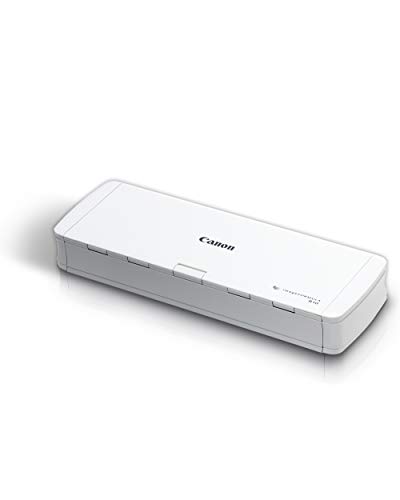
The Canon imageFORMULA R10 is the scanner you throw in your bag when you need digitizing capability wherever you go. It's USB-powered — no wall adapter required — which means it draws everything it needs from your laptop's USB port. At roughly the dimensions of a large ruler and weighing well under a kilogram, it genuinely fits in a backpack without a second thought. If you're a student, a freelancer, or someone who splits time between a home office and a remote workspace, this portability is worth real money.
Don't let the compact form factor fool you into thinking it skimps on versatility. The R10 handles duplex scanning and manages a surprising range of media types: standard documents, receipts, business cards, embossed cards, and plastic cards all feed through cleanly. Output options include searchable PDF, JPEG, and other common formats, all managed through Canon's CaptureOnTouch Lite software that runs directly from the scanner itself — meaning no software installation is needed on the host computer. That's a meaningful advantage when you're working on a borrowed machine or a locked-down corporate laptop.
The practical limitations are honest ones. The R10 has no wireless capability — USB connectivity only. Its scan speed is slower than any ADF-focused model on this list, and the suggested daily volume of 500 scans is firmly in the light-use category. If you regularly move through thick stacks of paper, this isn't your machine. But for occasional high-quality scanning on the move, few competitors come close to matching what Canon offers at this price. For tips on consolidating your scans into clean files, see our guide on how to scan multiple pages into one PDF.
Pros:
Cons:
The Epson FastFoto FF-680W occupies a unique corner of the home scanner market: it's the world's fastest personal photo scanner, capable of moving through standard 4×6 prints at one photo per second at 300 dpi. If you have a shoebox — or several shoeboxes — of family photos you've been meaning to digitize for years, the FF-680W is the machine that will finally make that project feel achievable rather than overwhelming. You can batch-load up to 36 photos at a time, which means the scanner keeps moving while you focus on organizing rather than feeding.
The FF-680W doesn't stop at just speed. It handles unusual photo formats that trip up lesser scanners: Polaroids, panoramas, postcards, and oversized photos up to 8"×10" all feed through without issues. The accompanying Epson FastFoto app adds a layer of functionality that goes well beyond storage — you can attach voice memos or written notes to individual photos, create shareable slideshows, and distribute albums directly from your smartphone. Automatic photo restoration features do a creditable job of recovering faded colors and correcting red-eye without manual editing.
The caveat here is that this is a photo-first scanner. It handles documents adequately, but the lack of duplex document scanning and the document-oriented features found on the ScanSnap or Brother models mean it's not the best daily driver for a paperless home office. If your primary goal is photo archiving — and you want that job done fast — nothing else on this list competes. For more context on related photography and image workflows, our overview of the best automatic document feeder photo scanners covers adjacent options worth considering.
Pros:
Cons:
The Brother ADS-1700W sits at the intersection of portability and wireless capability in a way that no other scanner on this list quite matches. It's compact enough to slip into a messenger bag, yet it packs a 2.8-inch color touchscreen and a 20-page auto document feeder that runs at up to 25ppm duplex. That combination makes it genuinely viable both at home and in mobile professional scenarios — remote workers, consultants, and frequent travelers will find it particularly compelling.
The touchscreen is more than a cosmetic feature. Brother has implemented one-touch scanning to preset destinations directly from the display, meaning you can configure separate profiles for home filing, work email, and cloud backup, then switch between them with a single tap. The Auto Start Scan function is a smart workflow addition: drop paper into the feeder and scanning begins automatically to whatever profile is selected, no button press required. Connectivity is broad — wireless LAN, USB, scan-to-email, scan-to-cloud, scan-to-FTP, and even scan-to-USB flash drive are all supported. You can scan directly to mobile devices without going through a computer, which is useful when you're working away from your desk.
The 20-page feeder capacity is the practical ceiling here. Heavy daily document users will find themselves refilling frequently. And while 25ppm is respectable for the size, it's noticeably slower than the 40ppm+ machines when you're moving through larger batches. For the hybrid worker who needs serious scanning performance in a portable form factor, though, the ADS-1700W represents excellent value in 2026.
Pros:
Cons:
If your home scanning needs include bound documents, fragile originals, or items you simply can't feed through an ADF, the HP ScanJet Pro 3600 f1 is the scanner you've been looking for. The "f1" in the name signals the combination of a flatbed glass platen and a 60-page, two-sided, single-pass ADF — you get both scanning modes in one unit, which is something very few of the compact competitors on this list can offer. That flatbed is a practical lifesaver when you need to scan the inside pages of a spiral notebook, an old photograph that might jam in a feeder, or a page from a book.
The ADF performance is competitive with the best in its class. 30ppm/60 images per minute single-pass duplex scanning means the 60-page feeder can clear a double-sided document stack faster than most standalone ADF scanners. HP's bundled software suite handles OCR with conversion to Word (DOC/DOCX), Excel (XLS/XLSX), and CSV formats in addition to the standard PDF and image outputs — a genuinely useful feature for anyone who needs to re-edit scanned contracts or extract data from printed tables. The 600 dpi optical resolution covers archival and everyday use comfortably.
The footprint is the honest downside. A flatbed/ADF combination is always going to take more desk space than a document-only ADF unit, and the ScanJet Pro 3600 is no exception. If your home office is tight on horizontal space, this may not be practical. But if you have room and want the flexibility of both scanning modes without buying two separate devices, the HP strikes an excellent balance between capability and price. Pairing this with a good all-in-one printer like one of the models covered in our HP Envy printer roundup gives you a comprehensive home document station.
Pros:
Cons:
The ScanSnap iX2500 is Fujitsu's most advanced home scanner to date — an upgraded replacement for the discontinued iX1600 that raises the bar on nearly every specification. The headline numbers are immediately impressive: 45ppm duplex scanning, a 100-sheet auto document feeder, a large 5-inch touchscreen, and Wi-Fi 6 for the fastest and most stable wireless connection currently available in a consumer-grade scanner. If you regularly process high volumes of documents at home or run a side business that generates consistent paperwork, the iX2500 is built for your workflow.
The 100-sheet feeder is a meaningful upgrade over the iX1600's 50-sheet capacity. Load it up, walk away, and come back to a completed batch — the scanner handles automatic de-skew, blank page removal, color optimization, and document type detection without any manual adjustments. The large touchscreen supports fully customizable profiles, and the Quick Menu system carries over from earlier ScanSnap models, letting you drag and drop freshly scanned files into whichever app you're working in. Cloud connectivity covers the major platforms — Google Drive, Dropbox, OneDrive, SharePoint — and USB-C is available as a wired fallback when you want a direct, low-latency connection.
The iX2500 commands a price that reflects its capabilities — this is the premium tier of home scanners in 2026. If you're scanning a handful of pages per week, you'd be paying for capacity you'll never use. But for heavy users who previously maxed out the iX1600's feeder or found themselves waiting on slower scan speeds, the iX2500 removes those bottlenecks entirely. It's the scanner you buy when you've outgrown every other option on this list.
Pros:
Cons:
Scan speed is measured in pages per minute (ppm) for single-sided scanning or images per minute (ipm) for duplex. For casual home use — occasional receipts, the odd contract, personal records — 20–25ppm is more than sufficient. If you're running a home office, processing expense reports, or digitizing archival material regularly, aim for 30ppm or above. Equally important is the daily volume rating, which tells you how many pages the scanner is designed to handle before wear becomes a factor. A model rated for 500 scans per day is fine for home use; anything above 1,500 is typically targeting small business workflows. Match this rating honestly to your actual usage — buying above your needs wastes money, but buying below them means premature wear.
The auto document feeder capacity determines how many pages you can load in a single batch. A 10-sheet feeder works for sorting through a week's mail; a 50- or 100-sheet feeder means you can drop an entire folder of files in and walk away. Beyond capacity, pay attention to what media types the scanner accepts. Most ADF-focused models handle standard paper well but vary significantly on plastic cards, embossed surfaces, folded receipts, and delicate originals. If you need to scan books, magazines, or anything bound, a flatbed platen — like the one on the HP ScanJet Pro 3600 f1 — becomes essential. A scanner that handles only one media type is a scanner you'll eventually work around.
In 2026, wireless connectivity is nearly table stakes for any home scanner above entry level. The question is whether the wireless implementation is reliable — Wi-Fi 6, as found in the ScanSnap iX2500, offers substantially better range and stability than older 802.11n/ac solutions. USB remains important as a fallback, and USB-C is increasingly the standard on newer models. On the software side, look at what file formats are supported (PDF, searchable PDF, JPEG, DOCX, XLSX), what cloud services are integrated, and whether OCR — optical character recognition for making scanned text editable and searchable — is included in the base software or requires an additional purchase. Cloud integration and OCR quality are the two software features that will define your day-to-day experience more than any hardware specification.
Your available desk space should drive this decision more than most buyers admit upfront. A compact folding scanner like the iX1300 or a bag-ready model like the Canon R10 makes sense when real estate is tight or you're frequently mobile. Larger ADF workhorses and flatbed combinations deliver better throughput and flexibility but demand a permanent corner of your workspace. Be honest about where the scanner will live. A powerful machine that gets pushed to a closet because it's always in the way is worth less in practice than a compact model that stays on your desk and gets used daily.
For most home offices, the Fujitsu ScanSnap iX1600 or the newer iX2500 offer the best combination of speed, software quality, and ease of use. The iX1600 is the better value if you scan moderate volumes; the iX2500 is worth the premium if you regularly process large batches. If budget is a concern, the Brother ADS-1700W delivers strong wireless performance at a lower price point.
It depends on what you're scanning. An ADF (auto document feeder) scanner is faster and more convenient for stacks of loose documents — ideal for paperless home office workflows. A flatbed scanner handles bound documents, books, fragile originals, and unusual media that you can't safely feed through an ADF. If you need both capabilities, the HP ScanJet Pro 3600 f1 combines a flatbed platen with a 60-page ADF in one unit.
For standard document archiving and OCR, 300 dpi is the effective minimum and produces excellent results for text-heavy documents. For archiving fine-detail documents, photographs, or anything you may want to enlarge later, 600 dpi is a better baseline. Most scanners on this list offer 600 dpi optical resolution, which is more than adequate for any home use case. Going above 600 dpi only matters for specialized photography or fine art scanning.
Yes — every scanner on this list supports PDF output, and most support searchable PDF (also called PDF/A or OCR PDF), which makes the scanned text selectable, copyable, and searchable in any PDF viewer. If you regularly need to combine multiple scanned pages into a single PDF file, you can use the scanner's bundled software or follow a dedicated workflow as outlined in our guide on how to scan multiple pages into one PDF.
Duplex scanning means the scanner captures both sides of a page in a single pass through the feeder, without you having to flip the paper manually. If you regularly scan double-sided documents — contracts, printed reports, forms — duplex scanning saves significant time and reduces the chance of missing a page. All of the ADF scanners on this list offer duplex scanning. For occasional single-sided paperwork, it's a nice-to-have rather than essential.
The iX2500 is the direct replacement and upgrade to the iX1600. Key improvements include a larger 5-inch touchscreen (vs. 4.3-inch), faster 45ppm duplex scanning (vs. 40ppm), a doubled 100-sheet ADF capacity (vs. 50 sheets), and Wi-Fi 6 connectivity (vs. standard Wi-Fi). The iX2500 also adds USB-C support. If you're choosing between the two in 2026, the iX2500 is the current model; the iX1600 may still be available at a discount and remains an excellent choice for moderate-volume users.


About Editorial Team
The DigiLabsPro editorial team covers cameras, lenses, photography gear, and creative technology with a focus on helping photographers make informed buying decisions. Our reviews and guides draw on hands-on testing and research across a wide range of equipment, from entry-level beginner kits to professional-grade systems.
You can get FREE Gifts. Or latest Free phones here.
Disable Ad block to reveal all the info. Once done, hit a button below
