Picture this: you're six months pregnant, working from home, and by 2 p.m. your lower back is screaming, your hips are aching, and you've readjusted your sitting position about forty times. You know you need a better chair — but the options are overwhelming and most reviews don't even mention pregnancy. That's exactly why we put this guide together. Whether you're in your first trimester or pushing through the final stretch, the right ergonomic chair makes a real difference in how you feel at the end of every workday.
Pregnancy changes your body's center of gravity, adds pressure to your lumbar spine, and makes standard office chairs feel like medieval torture devices. The best office chair for pregnancy in 2026 needs to support your lower back, accommodate a growing belly, and offer enough adjustability to adapt as your body changes week by week. We've reviewed seven of the top-rated options on Amazon, tested their ergonomic credentials, and broken down exactly who each one is best for. If you're also setting up a comfortable home workstation, you might find our guide to the best foot and calf massager helpful for reducing leg swelling at the end of long sitting sessions.

According to ergonomics research, proper lumbar support (support for the curved lower portion of your spine) and seat depth adjustment are the two most critical features for prolonged comfortable sitting — and they become even more important during pregnancy. This list covers budget-friendly options, premium splurges, and everything in between. Use our buying guide section below to understand which specs matter most before you decide.
Contents





The Herman Miller Aeron is the gold standard of ergonomic seating, and even in its Classic form (the 1994–2016 version, renewed by Office Logix Shop), it still outperforms most modern chairs on the market. The PostureFit lumbar system targets both the sacrum (the triangular bone at the base of your spine) and the lumbar vertebrae — something that becomes invaluable as your belly grows and shifts your center of gravity forward. The mesh suspension seat and back distribute your weight evenly, eliminating the pressure points that cause hip and tailbone discomfort during long work sessions.
The Size B fits people between 5'3" and 6'0", which covers most pregnant women working through their third trimester. The forward tilt feature is particularly useful during pregnancy — it lets you tilt the seat pan slightly forward, which reduces compression in the hip flexors and makes it easier to breathe when your diaphragm is being pushed upward. Yes, this is a refurbished Classic model, not the newer Remastered version, but the core ergonomic architecture is identical. For sheer, long-term all-day support, nothing on this list beats it.
The fully loaded configuration includes adjustable armrests, tilt limiter, and the PostureFit sacral pad. It arrives fully assembled and the renewed certification means it's been inspected and cleaned to manufacturer standards. If budget isn't your primary concern and you want the chair that the most discerning ergonomics professionals recommend, start and end your search here.
Pros:
Cons:
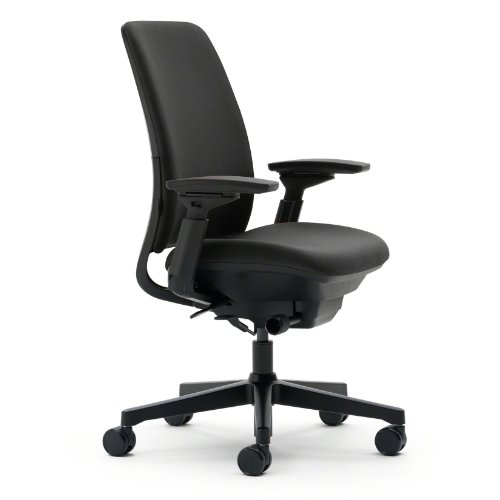
The Steelcase Amia is the chair you choose when you want lumbar support that moves with you rather than staying rigidly in one place. Its hidden LiveLumbar system responds to your body's micro-movements throughout the day — a feature that's genuinely useful during pregnancy when you're constantly shifting to find a comfortable position. There's no mechanism to manually adjust; the LiveLumbar flex is automatic and entirely passive, which means you never have to stop and fiddle with a dial mid-meeting.
The seat itself is worth highlighting. Flexible seat edges reduce pressure on the backs of your thighs, which is a common complaint during pregnancy when circulation to the legs can already be compromised. The seat also includes extra foam cushioning compared to typical mesh-only seats, giving you a softer initial feel without sacrificing the structured support underneath. Steelcase's 4D arm support lets you adjust height, width, pivot, and depth — so whether your belly is 20 weeks or 38 weeks along, you can keep your arms and shoulders in a neutral, relaxed position.
Full recline with lockout is included, which is useful for taking short breaks without leaving your desk. The Buzz2 black fabric is durable and breathable, though if you run hot during pregnancy, you may prefer a mesh back chair. For 8–10 hour workdays, the Amia's combination of dynamic lumbar and pressure-reducing seat design makes it one of the most comfortable chairs available at this price level.
Pros:
Cons:
Not everyone wants a mesh chair, and the Serta Garret proves that cushioned ergonomic seating can still be genuinely supportive during pregnancy. The layered body pillow system in the backrest is the standout feature here — it adapts to your posture rather than forcing your spine into a predetermined shape. The contoured lumbar support section targets the lower back curve directly, and the waterfall edge seat (where the front of the seat curves downward to reduce pressure on the back of your thighs) is a practical comfort feature that most padded executive chairs skip entirely.
Serta uses non-recycled, non-toxic foam throughout — an important detail if you're pregnant and want to minimize chemical exposure. All Serta chairs are endorsed by the American Chiropractors Association, which adds credibility to their ergonomic claims. The bonded leather upholstery in ivory white (also available in six other colors) looks polished enough for video calls, which matters if you're working remotely and your chair appears on screen regularly. A well-designed home office makes a difference not just in comfort but productivity — and if you're upgrading your full setup, pairing this chair with the right tech (like a laptop with a numeric keypad for data-heavy work) makes a real difference during long pregnancy leave projects.
The mid-back design provides targeted support without overwhelming your upper back, which is helpful because many pregnant women experience upper back fatigue from shifting posture. The padded armrests are fixed in shape but cushioned enough for all-day use. If aesthetics and plush comfort are your priorities alongside solid lumbar support, the Garret is the chair to consider.
Pros:
Cons:
The HON Ignition 2.0 is the answer when you need genuine ergonomic support at a price that doesn't require a second mortgage. HON is a well-established commercial furniture brand — their chairs end up in corporate offices, law firms, and hospitals — so the quality control on this model is several notches above comparably priced consumer chairs. The advanced synchro-tilt recline (a mechanism that moves the backrest and seat in coordinated proportions rather than just tilting the seat back) reduces the "dump" feeling of cheap chairs that tilt awkwardly when you lean back.
The 4-way stretch mesh back improves airflow significantly, which is a real practical benefit during pregnancy when your core temperature runs higher than usual. Adjustable lumbar support lets you position the cushion exactly where you feel the most lower back strain — typically this shifts upward as your pregnancy progresses and your center of gravity changes. Pneumatic height adjustment accommodates a wide range of desk heights, and the adjustable armrests let you keep your elbows at a 90-degree angle regardless of your changing body position.
For the price, the HON Ignition 2.0 delivers features you'd expect on chairs costing twice as much. It won't match the PostureFit precision of the Herman Miller Aeron or the LiveLumbar intelligence of the Steelcase Amia, but it covers all the fundamentals: lumbar support, breathable back, height adjustment, and recline control. If you're prioritizing budget without sacrificing the core ergonomic needs of pregnancy, this is your chair.
Pros:
Cons:
If lower back pain is your primary concern — and for many pregnant women in their second and third trimester, it absolutely is — the AUTONOMOUS ErgoChair Pro is built specifically around that problem. The combination of an adjustable lumbar support system and headrest works together to keep your entire spine aligned from the base of your neck to your tailbone. Most office chairs focus exclusively on lumbar support; this one extends that care upward, which is valuable when pregnancy posture shifts your head and shoulders forward to compensate for belly weight.
The hybrid seat design pairs a breathable mesh backrest with a supportive foam seat — giving you airflow where you need it (your back and shoulders) and cushioned support where you need it most (your seat). This combination works better during pregnancy than a fully mesh seat, which can feel too firm on sensitive tissue during the later trimesters. The reinforced frame supports up to 300 lbs, which is meaningful reassurance in the third trimester when your total body weight is well above your pre-pregnancy baseline. The premium gas lift cylinder provides smooth, reliable height adjustment that won't feel unstable under the extra weight.
The headrest is a feature worth dwelling on. Neck tension is a common secondary complaint during pregnancy — your head is constantly adjusting to your changing posture — and having a headrest you can actually position correctly (rather than the fixed neck rolls on cheaper chairs) provides real relief during 8-hour work sessions. If back pain is driving your purchase decision, this chair addresses it more directly than almost any other option at this price point.
Pros:
Cons:
Branch has earned a reputation for delivering near-premium ergonomic features at mid-range pricing, and the Branch Ergonomic Chair continues that tradition. The headline stat is eight adjustment points — that's not marketing fluff, that's a legitimate differentiator. You can fine-tune recline angle, tilt tension, lumbar position, armrest height, armrest width, armrest depth, seat height, and seat depth. Seat depth adjustment (moving the seat pan forward or backward relative to the backrest) is especially important during pregnancy because your hip geometry changes and a standard seat depth can create pressure at the back of your thighs.
The breathable mesh backrest keeps your back cool during extended sitting, and the lumbar support module is independently adjustable in height — so you can track it upward as your belly grows and your lower back curvature increases. Eight adjustment points give you the flexibility to reconfigure the chair as your body changes week by week, which is something most fixed-ergonomic chairs simply can't match. The smooth-rolling wheels work well on both carpet and hard floors, and the overall build quality feels significantly more substantial than the price would suggest.
Branch also keeps things simple in a useful way — the adjustments are intuitive and don't require reading a manual to operate. If you're buying your first proper ergonomic chair and want something that covers all the ergonomic basics without overwhelming complexity, the Branch hits that sweet spot confidently. Pair it with a good foot massager for end-of-day swelling relief and you've got a complete pregnancy comfort workstation setup.
Pros:
Cons:
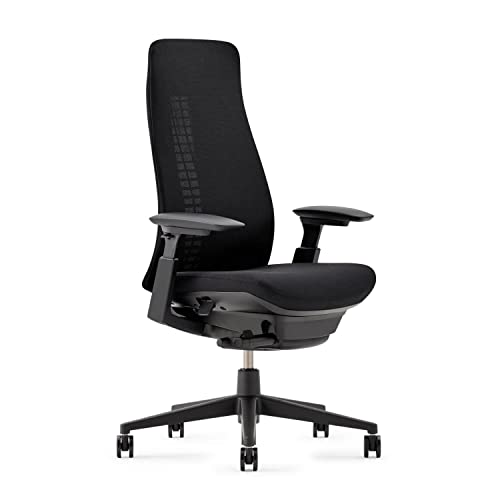
The Haworth Fern is in a category of its own. Inspired by the structural flexibility of a leaf, its patented Wave Suspension system (a flexible mesh backrest that bends and cradles your spine in multiple directions) is one of the most sophisticated back support mechanisms available in any consumer chair. Unlike static mesh backs that simply stretch, the Wave Suspension actively responds to lateral movement — so when you shift side to side, as pregnant women constantly do to relieve pressure, the chair moves with you instead of pushing back against you.
The lumbar support is built into the backrest structure rather than added as a separate bolted-on module, which means it's always in the right position relative to your back. Padded 4D armrests, pneumatic seat height adjustment, seat depth adjustment, tilt tension control, and a back stop that lets you lock your recline angle are all included as standard. The 350 lb weight capacity and 12-year warranty signal that Haworth built this chair to last decades, not years. This is the kind of chair you buy once, use through pregnancy, and keep as your permanent workstation chair for the next decade.
The coal color option is sleek and professional, and the mesh construction keeps air circulating freely — something you'll deeply appreciate during the third trimester when temperature regulation becomes difficult. At this price point, the Fern competes directly with the Herman Miller Aeron Remastered and the Steelcase Leap. If you're comparing those options, the Fern's Wave Suspension is genuinely unique and worth experiencing before committing. For complete home office setups that match this caliber of ergonomic investment, our roundup of the best budget laptops for intensive work may also be worth a look.
Pros:
Cons:
Lumbar support is the single most important feature for a pregnancy office chair. As your belly grows, the natural inward curve of your lower spine (called the lumbar lordosis) increases, and without proper support, you'll compensate by slouching — which creates pressure across your entire spine. Look for chairs with independently height-adjustable lumbar support rather than fixed-position cushions. Better still, look for dynamic lumbar systems like the Steelcase Amia's LiveLumbar or the Haworth Fern's Wave Suspension, which adapt continuously to your movement rather than supporting one static posture. If you can only prioritize one feature, prioritize lumbar support — it directly determines how much back pain you carry into your evenings.
Seat depth adjustment — the ability to slide the seat pan forward or backward — is often overlooked but becomes critical during pregnancy. The standard test: when you're seated with your back against the backrest, there should be about two to three finger-widths of space between the back of your knees and the front edge of the seat. As your hips widen and your sitting posture shifts during pregnancy, a seat that was correctly sized before conception may suddenly cut into the back of your thighs. Chairs with seat depth adjustment (like the Branch Ergonomic and Haworth Fern) let you recalibrate this throughout all three trimesters. Waterfall seat edges, like the one on the Serta Garret, partially compensate for this by reducing edge pressure even without adjustment.
Pregnancy raises your core body temperature, and a chair that traps heat turns a comfortable morning into an uncomfortable afternoon very quickly. Mesh back chairs — the HON Ignition 2.0, Branch Ergonomic, Haworth Fern, and AUTONOMOUS ErgoChair Pro — all allow air to circulate freely behind you. If you prefer a cushioned chair, look for fabric upholstery (like the Steelcase Amia) over bonded leather, which tends to hold heat and moisture. The AUTONOMOUS ErgoChair Pro's hybrid approach (mesh back, foam seat) is a good middle ground if you want some cushioning without sacrificing airflow entirely.
This is often the last thing people check, but it matters more during pregnancy than at any other time. Most standard office chairs are rated for 250–275 lbs. If your pre-pregnancy weight plus pregnancy weight gain exceeds that, you want a chair explicitly rated higher. Both the AUTONOMOUS ErgoChair Pro (300 lbs) and the Haworth Fern (350 lbs) provide meaningful overhead capacity for peace of mind through the final trimester. Beyond the weight rating, look for chairs with stable five-point bases and quality gas lift cylinders that don't gradually sink during long sitting sessions — an unstable chair forces you to unconsciously tense your core to compensate, which adds fatigue.
Adjustable lumbar support, seat depth adjustment, and breathability are the three most important features. Lumbar support prevents and relieves lower back pain caused by your shifting center of gravity. Seat depth adjustment keeps the seat from cutting into the back of your thighs as your hips widen. Breathability (mesh back or breathable fabric) prevents overheating, which is a common complaint during pregnancy. Secondary priorities include armrest adjustability and a stable base with an adequate weight capacity rating.
Yes, with the right setup and regular breaks. Prolonged sitting — even in an ergonomic chair — can reduce circulation to your legs and increase lower back pressure. Ergonomists recommend taking a short break to stand or walk every 30–60 minutes. Use a footrest if your feet don't rest flat on the floor (common later in pregnancy when your chair needs to be raised to reach a desk). An ergonomic chair significantly reduces the stress of long sitting sessions, but it works best as part of a routine that includes movement breaks throughout the day.
Set your seat height so your feet rest flat on the floor and your knees are at roughly a 90-degree angle. Adjust the lumbar support to fill the curve of your lower back — not to push into it. Set armrests so your shoulders are relaxed and your elbows are at approximately 90 degrees. As your belly grows, you may need to increase the seat height slightly to maintain comfortable desk access, which means you may also need a footrest. Keep your monitor at eye level to avoid forward head posture, which adds strain to your upper back and neck.
Yes, significantly. Poor lumbar support is one of the leading contributors to pregnancy-related lower back pain during working hours. A chair with proper lumbar support keeps your spine in a neutral alignment rather than forcing you into a rounded-back slouch. Many pregnant women who switch from a standard chair to an ergonomic model report noticeable reduction in end-of-day back pain within the first week. The Herman Miller Aeron's PostureFit system and the Steelcase Amia's LiveLumbar are two of the most effective designs available for this specific purpose.
The AUTONOMOUS ErgoChair Pro is the most directly targeted at back pain relief, combining an adjustable lumbar support module with a headrest to address full-spine alignment. The Herman Miller Aeron with PostureFit is the gold standard if budget allows — it supports both the sacrum and lumbar vertebrae simultaneously, which is unique among the chairs on this list. If your pain is primarily in the lower lumbar, the Steelcase Amia's dynamic LiveLumbar system adapts to every micro-movement and provides continuous rather than static support.
Mesh chairs are generally better for temperature regulation — a real advantage during pregnancy when your body runs warmer. They also maintain consistent support without compressing over time the way foam cushions do. However, some women find full-mesh seats too firm in the third trimester when seat bones (the ischial tuberosities) become more tender. A hybrid approach — mesh back with foam seat, like the AUTONOMOUS ErgoChair Pro — is an excellent compromise. If you prefer a fully cushioned chair, look for one with a waterfall seat edge and high-density foam that doesn't bottom out under sustained use, like the Serta Garret.


About Editorial Team
The DigiLabsPro editorial team covers cameras, lenses, photography gear, and creative technology with a focus on helping photographers make informed buying decisions. Our reviews and guides draw on hands-on testing and research across a wide range of equipment, from entry-level beginner kits to professional-grade systems.
You can get FREE Gifts. Or latest Free phones here.
Disable Ad block to reveal all the info. Once done, hit a button below
