Research in visual perception consistently shows that human viewers form an emotional response to a photograph within 150 milliseconds — and lighting quality is the single strongest predictor of that reaction. That's why understanding the types of lighting in photography is not optional background knowledge. It's the core skill that separates images that stop people from images that get scrolled past. Whether you shoot portraits, products, or landscapes, every technique discussed in our photography articles section traces back to how you manage light.
Light has four variables you're always managing simultaneously: direction, quality, color temperature, and intensity. Change any one and you change the character of the image. A photographer who understands why overcast light flatters skin tones — because the sky becomes a massive diffuser — makes better decisions on location than one who memorizes preset recipes. Fluency with light comes from studying how different sources behave and then deliberately practicing with each one.
This guide covers the core lighting categories you'll encounter across portrait, product, landscape, and event work. For each type, you'll learn what makes it distinctive, when to reach for it, and what common errors undermine it. If you're still building foundational camera skills, start with Digital Photography Tips and Tricks for Beginners — then come back here to layer in the lighting specifics.
Contents
Natural light is free, constantly changing, and capable of producing results that no studio rig can fully replicate. Window light, open shade, and the golden hour each create a quality of illumination that carries organic warmth — one most viewers respond to instinctively without being able to articulate why. Overcast skies act as an enormous softbox, wrapping your subject in even, shadow-free light that flatters skin tones without any modifier. Shade on a bright day delivers similar diffusion at a cooler color temperature, though you'll typically need a half to one stop of positive exposure compensation to avoid underexposure.
Golden hour — the 20 to 40 minutes after sunrise and before sunset — produces warm, low-angle light that sculpts faces and textures with long, directional shadows. That window is short. You plan for it and position your subject before the light peaks, or you miss it. The limitation of all natural light is control: clouds shift, the sun moves 15 degrees every hour, and you cannot reposition your source. A reflector, a diffusion panel, or a sheet of white foam core expands what you can accomplish within available light — but the source itself remains outside your command.
Artificial light — strobes, speedlights, LED panels, ring lights — gives you consistency, repeatability, and complete control over placement, intensity, and color temperature. When you need matching exposures across 300 frames of a product shoot, or when you're photographing headshots under a deadline with no margin for weather variables, artificial light is not a compromise. It's the right tool for the job.
Photographic lighting encompasses any source used intentionally to illuminate a subject — from a single candle to a multi-head studio strobe system. Understanding where you fall on that spectrum helps you invest in the right gear and develop the right skills. For a focused look at which setups consistently produce flattering portrait results, see our dedicated guide on best lighting for portraits.
The fastest upgrade most photographers can make is showing up at the right time. Golden hour is not a myth — it's physics. A low sun angle means a longer atmospheric path, which scatters blue wavelengths and leaves warm amber tones. The light is directional without being harsh, creating natural dimensionality on faces and landscapes. Arrive 15 minutes early. Set your exposure on a test frame before the light peaks. When the moment arrives, you're shooting — not adjusting.
Overcast light is underrated in the opposite direction. Flat, yes — but that flatness eliminates the harsh shadows that ruin otherwise well-composed portraits on bright midday days. For subjects with textured skin, or any situation where you need consistent, repeatable output across a large group, overcast conditions frequently outperform the most expensive studio configuration.
When shooting portraits in harsh midday sun, don't fight the light — move your subject into open shade and use a silver reflector to add directional fill from below. You get soft ambient wrap plus controlled dimension without any power source.
Three-point lighting — key light, fill light, and backlight — is the foundational artificial setup used across portrait and product photography. The key light is your primary source, positioned at roughly 45 degrees to the subject and slightly above eye level. The fill light sits on the opposite side at one to two stops lower intensity, softening shadows without eliminating them. The backlight or rim light separates your subject from the background, adding depth that flat two-light setups lack entirely.
Once you internalize this structure, you can scale it to any situation. A single speedlight with a reflector on the opposite side achieves the same core result as a full three-head strobe kit. The principle is what matters — not the price of the equipment.
| Lighting Type | Quality | Color Temp | Best Use Cases | Control Level |
|---|---|---|---|---|
| Direct Midday Sun | Hard | 5500K | Architecture, abstract | Low |
| Golden Hour Sun | Semi-hard | 2000–3500K | Portraits, landscapes | Low |
| Overcast Sky | Soft | 6500–7000K | Portraits, macro | Low |
| Window Light | Soft | 5000–7000K | Portraits, still life | Medium |
| Studio Strobe | Adjustable | 5000–6000K | Commercial, headshots | High |
| LED Panel | Soft–Medium | 3200–5600K | Video, product | High |
| Speedlight (bare) | Hard | 5500K | Event, fill flash | Medium |
| Ring Light | Soft | 5000–6000K | Beauty, macro | High |
Continuous lights — LED panels, tungsten fixtures, fluorescent banks — stay on throughout the shoot. You see exactly what you're getting before you press the shutter. This makes them ideal for video work, for learning how light behaves, and for any situation where precise framing under your actual shooting conditions matters. The tradeoff is raw output. Even high-end LED panels rarely match the burst intensity of a studio strobe, which becomes critical when you need to overpower ambient daylight or freeze motion at high shutter speeds.
Strobes fire a brief, high-intensity burst synchronized to your shutter. They produce more light per watt, run cooler over long sessions, and recycle fast in professional configurations. The learning curve is steeper — you cannot see the exact lighting effect until you review a test frame — but monolights with built-in modeling lamps narrow that gap considerably. For most portrait and commercial photographers, a two-strobe setup with basic modifiers is the most versatile starting investment.
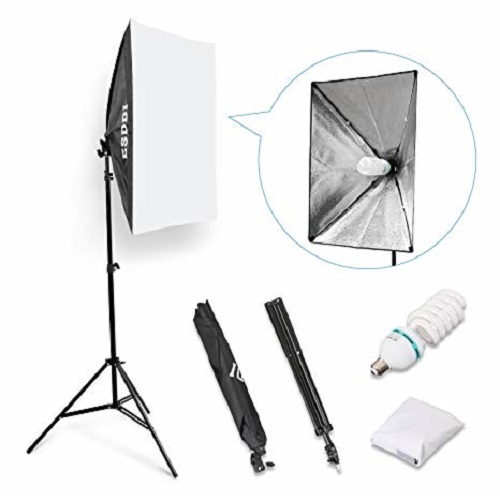
Softboxes, umbrellas, and beauty dishes each transform a single strobe or LED into a distinct quality of light. A rectangular softbox produces directional yet diffuse output similar to window light — controllable, flattering, and consistent. A shoot-through umbrella provides broader, wraparound coverage at lower cost and sets up in under 30 seconds. A beauty dish delivers semi-specular light with a distinctive catchlight that portrait and fashion photographers specifically seek out for its combination of contrast and wrap.

Reflectors — the five-in-one collapsible kind — remain underutilized even by experienced photographers. A silver reflector in open shade adds a full stop of clean fill without any power source. A gold reflector under overcast conditions introduces the warmth of golden hour when you're not shooting in it. For headshot work specifically, where the relationship between modifier placement and subject position determines whether a shot reads as polished or amateur, these choices carry real weight. Our guide on 10 tips for taking professional headshots walks through exactly how lighting decisions translate to client-ready results.
Midday sun is not inherently bad — it's misunderstood. When the sun sits directly overhead, shadows fall straight down: deep eye sockets, harsh nose shadows, blown highlights on foreheads. This works for specific genres — high-contrast street photography, abstract architectural texture. It fails for portraits, and photographers who avoid it entirely leave a usable light source on the table. The fix is not avoiding midday shooting. It's understanding what that light produces and choosing locations accordingly. Move your subject to open shade. Use a diffusion panel between the sun and your subject. Flip your reflector to block rather than bounce. The options are there — you just have to reach for them.
Direction and quality are the two dimensions that define every type of light. Direction describes where the source originates relative to your subject: front lighting is flat and shadowless, sidelight is textural and dramatic, backlight creates rim separation and halo effects. Quality describes whether the light is hard — small source, sharp shadow edges, high contrast — or soft — large source relative to subject, gradual shadow transitions, reduced contrast.
A bare speedlight fired at your subject from 10 feet produces a fundamentally different image than the same speedlight bounced through a five-foot umbrella. Neither is wrong. Both serve specific, intentional purposes. The error is treating them as interchangeable or choosing one without understanding why. Photographers who consistently control their results make this distinction deliberately — before every shot, not after.


About Editorial Team
The DigiLabsPro editorial team covers cameras, lenses, photography gear, and creative technology with a focus on helping photographers make informed buying decisions. Our reviews and guides draw on hands-on testing and research across a wide range of equipment, from entry-level beginner kits to professional-grade systems.
You can get FREE Gifts. Or latest Free phones here.
Disable Ad block to reveal all the info. Once done, hit a button below
