Which Epson EcoTank printer actually delivers the best value in 2026 — and is it really worth ditching ink cartridges for good? The short answer: yes, and the Epson EcoTank ET-3850 earns the top spot for most home office users. But with seven distinct models spanning basic home printing all the way to professional wide-format photo output, picking the right one requires a closer look at what each machine actually does well.
The EcoTank line built its reputation on a single, disruptive promise: replace tiny, expensive ink cartridges with large refillable ink tanks that cost a fraction of the price. According to inkjet printing research, the per-page cost advantage of tank-based systems over cartridge models can be dramatic — often 80 to 90 percent savings. Epson's own figures back this up. Buyers who print regularly will recoup the higher upfront cost within months, not years. That math is hard to argue with.
This guide covers every current EcoTank model worth considering in 2026, from the entry-level ET-2800 to the wide-format photo powerhouse ET-8550. Whether the goal is simple homework printing, busy home office output, or borderless photo prints that rival a photo lab, there's an EcoTank that fits. Buyers already researching their options should also check the broader printer buying guide for context on what features matter most at each price tier. Read on for the full breakdown.

Contents
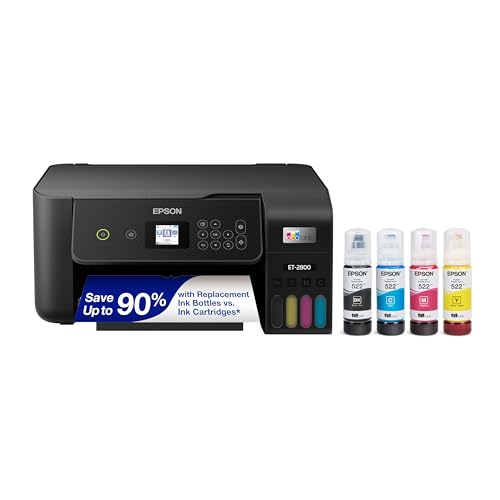





The ET-2800 is the entry point into the EcoTank ecosystem, and it earns its place by doing the basics extremely well. Powered by Epson's Micro Piezo Heat-Free Technology — a printhead design that uses electrical impulses rather than heat to push ink, resulting in less ink wasted and longer printhead life — the ET-2800 produces vibrant, sharp documents and color prints that punch well above its price class. Print speeds reach up to 10 pages per minute (ppm) for black text, which handles typical household jobs without frustrating wait times.
Where this model really wins is the cost-per-page equation. Each ink bottle set replaces roughly 80 individual cartridges, and the replacement bottles provide up to 4,500 pages in black and 7,500 in color. For a household printing report pages, school projects, or the occasional recipe, the ET-2800 could run for well over a year before needing a refill. Wireless connectivity is built in, so it handles mobile printing from phones and tablets without needing a dedicated computer nearby. There's no automatic document feeder (ADF) or fax capability, and the print speed is modest compared to higher-tier models, but for basic home use those omissions rarely matter.
Build quality feels appropriately compact and lightweight — this is a printer that fits on a bookshelf or small desk without dominating the room. Scanning and copying are both included, covering every core function a typical household needs. The lack of an LCD touchscreen means navigation happens through a small button panel, which is straightforward once buyers get familiar with it. The ET-2800 is the right call for anyone who prints infrequently and refuses to keep spending on cartridges.
Pros:
Cons:
The ET-3850 is the editor's top overall pick for 2026, and the reasons are straightforward. It hits a near-perfect balance of speed, features, and long-term ink economy without crossing into the price territory of the Pro-tier models. Print speeds reach 15.5 ppm in black and 8.5 ppm in color, which means a 10-page document finishes in well under a minute. The 4800 x 1200 dpi (dots per inch) print resolution produces crisp text and smooth photo gradients — sharp enough for client-facing documents or polished school projects.
The included automatic document feeder (ADF) is the feature that separates the ET-3850 from entry-level models. An ADF allows multi-page documents to be scanned or copied without manually placing each page on the flatbed glass — a genuine productivity boost for anyone handling contracts, tax forms, or homework packets regularly. Ethernet connectivity sits alongside Wi-Fi, which matters in home offices where a wired network connection delivers more consistent speeds than wireless. The printer also supports mobile printing standards including Apple AirPrint and Epson's own iPrint app, covering essentially every modern device.
For buyers considering the jump to an EcoTank, the ET-3850 makes a compelling comparison against traditional cartridge printers. For more context on how scanners fit into a home office setup, the guide on the best document scanners for home use explains what to look for in flatbed and ADF-equipped devices — and the ET-3850's scanner holds its own in that comparison. Ink capacity follows the standard EcoTank formula, with thousands of pages before a refill. This is the model most home offices should buy.
Pros:
Cons:
The ET-2760 lands in a comfortable middle ground between the bare-bones ET-2800 and the more office-focused ET-3850. It's the model families gravitate toward, and for good reason. Auto-duplex printing (automatic two-sided printing without manually flipping pages) saves paper on multi-page documents — a practical feature for school reports, newsletters, or household paperwork. A color LCD display simplifies operation, letting users navigate settings and scan options without guessing at button combinations. The high-resolution flatbed scanner handles photos and documents cleanly.
Ink capacity on the ET-2760 is impressive: up to 7,500 pages in black and 6,000 in color, equivalent to roughly 90 individual ink cartridges. That level of output means most families won't think about ink for years. Epson's EcoFit ink bottles are designed to prevent overfilling and spills during refills — an important detail when kids might be nearby. The wireless setup connects quickly to home networks and supports mobile printing apps without a dedicated software installation on every device.
The ET-2760 does lack an ADF and Ethernet, which keeps it in the consumer rather than office category. But for a household that prints consistently — homework, recipes, boarding passes, the occasional photo — it covers all the bases with a lower long-term cost than any cartridge-based alternative. Families who also need scanning capabilities for school records or important documents will appreciate the clean flatbed integration.
Pros:
Cons:
The ET-4760 is the model for small businesses and home offices that need every function covered under one machine. It adds fax capability to the EcoTank lineup — a requirement for real estate offices, law firms, medical practices, and any operation that still runs on faxed paperwork. The 2.4-inch color touchscreen makes navigation intuitive, with clearly labeled menu options that don't require reading a manual to figure out. An ADF handles multi-page documents automatically, and the combination of Wi-Fi, Ethernet, and USB connectivity means it plugs into virtually any office setup.
Ink economy matches the ET-2760 at up to 7,500 pages in black and 6,000 in color, which keeps the per-page cost low even in environments with moderate to heavy daily print volumes. The ET-4760 also supports automatic duplex printing, reducing paper consumption over time. Print quality is solid for a business-class inkjet, with enough resolution for sharp letterhead, invoices, and presentation documents. It won't match laser printer speeds in head-to-head comparisons, but for most small office volumes it's fast enough that the wait is never a bottleneck.
Buyers upgrading from a cartridge-based all-in-one will immediately notice the difference in running costs. The ET-4760 competes directly with mid-range HP and Brother all-in-ones — for a comparison of how it stacks up against HP's cartridge-based lineup, the review of the best HP Envy printers offers useful context. The EcoTank wins on ink costs; HP competes on print speed and ecosystem features. For most small offices, the EcoTank math wins decisively over a multi-year ownership period.
Pros:
Cons:
The ET-5850 Pro steps into genuine business-class territory. Print speeds hit 25 ppm for both color and black-and-white — matching many laser printers — with a monthly duty cycle (the maximum number of pages a printer is rated to handle per month) of 66,000 pages. That number signals a machine built for real workloads, not light occasional use. The four-color all-pigment ink system using TFP2 (Thin Film Piezo 2) technology reaches up to 4800 x 2400 dpi resolution, producing text sharp enough to satisfy even demanding professional documents.
The connectivity suite covers every port a business environment needs: USB 2.0, Ethernet, a USB host port for direct thumb-drive printing, and Wi-Fi. The 50-sheet ADF handles multi-page scan and copy jobs without babysitting, and automatic two-sided duplexing works for both printing and copying. Fax memory accommodates up to 550 pages, which prevents jobs from dropping during busy periods. The ET-5850 also supports a broad range of media types — cardstock, glossy photo paper, envelopes, matte paper — giving offices flexibility without requiring a second machine for specialty jobs.
Where the ET-5850 Pro distinguishes itself most is reliability under pressure. High-volume users who burned through cartridge costs every few weeks will find the math dramatically better here. The pigment-based inks also resist water and fading better than dye-based alternatives, which matters for archival documents or anything that might sit in a filing cabinet for years. This is the EcoTank for offices that are serious about cutting printing costs without sacrificing throughput.
Pros:
Cons:
The ET-15000 occupies a specialized niche that no other EcoTank fills: printing up to 13 x 19 inches (sometimes called Super B or tabloid-plus size). That capability opens the door to poster-sized prints, architectural layouts, marketing banners, and large-format creative work — all from a home or small office setup that eliminates outsourcing costs. The machine functions as a complete all-in-one, handling scanning, copying, faxing, and Ethernet-connected network printing alongside its wide-format output capability.
Built-in wireless (802.11b/g/n) covers standard home and office network setups, while the included Ethernet port provides a wired fallback for environments where Wi-Fi reliability is a concern. The ET-15000 handles the same ink economy model as the rest of the EcoTank line — bulk ink bottles rather than cartridges — which makes it especially attractive for users who print large-format pieces regularly. Running a poster through a professional print shop costs several dollars per sheet; at-home large-format printing on the ET-15000 brings that cost down to cents.
The machine's footprint is notably large — this is not a printer that fits on a standard desk without planning. But for creative professionals, architects, teachers preparing classroom materials, or small businesses that produce their own marketing collateral, the trade-off is worthwhile. The combination of large-format output and EcoTank ink savings creates a category that no cartridge-based home printer can match economically. Buyers who also use a dedicated document scanner alongside this printer should check the best automatic document feeder photo scanners for options that complement its scanning capabilities.
Pros:
Cons:
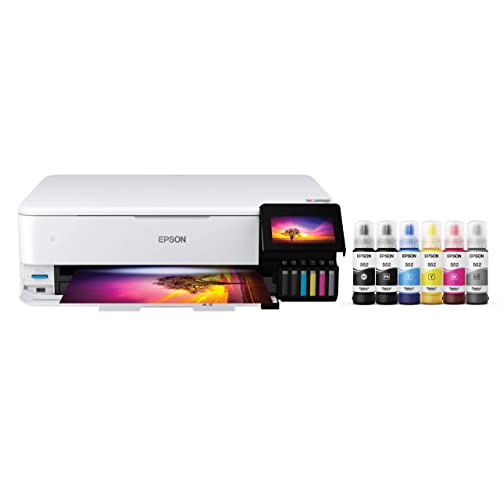
The ET-8550 is built for a completely different mission than the rest of the EcoTank family. Where other models optimize for document output and office tasks, this one targets photographers, designers, and serious creative users who need lab-quality photo prints at home. The six-color Claria ET Premium ink system (versus the standard four-color setup on other EcoTanks) adds dedicated photo and matte black inks, producing smoother gradients, more accurate skin tones, and deeper shadow detail than any four-color printer can achieve.
A 4 x 6-inch photo prints in as fast as 15 seconds, and the machine handles borderless photos up to 13 x 19 inches — the same wide-format capability as the ET-15000, but with photo-optimized ink chemistry rather than document-focused pigment inks. The media support is equally impressive: cardstock, specialty papers, CD/DVDs, and stock up to 1.3 mm thick all load without issue. Epson's high-accuracy printhead maintains tight ink droplet placement across the full print width, which is visible in fine detail areas like hair, fabric texture, and background gradients in landscape shots.
The economics are compelling for photographers who currently outsource their printing. Traditional lab prints at a local store run 25 to 40 cents per 4 x 6-inch image. The ET-8550 brings that down to roughly 4 cents per print — a 90-percent reduction that pays off quickly for anyone printing more than a few dozen photos per month. A 4.3-inch color touchscreen makes navigation smooth, and auto two-sided printing covers non-photo document output. The ET-8550 is a specialized tool rather than an everyday office workhorse, but for its target audience it's the clear best choice in 2026.
Pros:
Cons:
The single most important buying decision factor is how much a household or office actually prints per month. Light users — those printing a few dozen pages monthly — will never notice the speed difference between the ET-2800 (10 ppm) and the ET-5850 Pro (25 ppm). But offices printing hundreds of pages per week will feel the gap immediately. Buyers should estimate their monthly page count honestly before shopping. As a rough guide: under 200 pages per month suits the ET-2800 or ET-2760; 200 to 500 pages fits the ET-3850 or ET-4760; above 500 pages warrants serious consideration of the ET-5850 Pro. The duty cycle rating (maximum pages per month) tells buyers whether a machine is built to sustain their workload without premature wear.
An automatic document feeder is one of the most underrated features on a multifunction printer. Anyone who regularly scans multi-page documents — tax returns, contracts, medical forms — will find an ADF saves significant time compared to placing each page manually on the flatbed glass. The ET-3850, ET-4760, ET-5850 Pro, ET-15000, and ET-8550 all include an ADF; the ET-2800 and ET-2760 do not. Fax is rarer still: only the ET-4760, ET-5850 Pro, and ET-15000 include it. Connectivity matters too — Ethernet provides more reliable network performance than Wi-Fi alone, and the ET-3850, ET-4760, ET-5850 Pro, and ET-15000 all include wired network ports for environments where wireless drops are a concern.
Most EcoTank models use a four-color dye-based ink system that handles document output and casual photo printing well. The ET-8550 Photo is the exception — its six-color ink configuration with dedicated photo ink channels produces noticeably better color gradation, more accurate skin tones, and sharper fine detail in photographic prints. Buyers whose primary use case is text documents, spreadsheets, and occasional color graphics should choose any model in the ET-2800 through ET-15000 range. Buyers who print photos regularly — family portraits, travel shots, creative projects — should look at the ET-8550 first. The per-print cost savings versus a photo lab make it a financially sound choice within months for active photo printers.
Every EcoTank model saves money on ink versus cartridge-based printers, but the magnitude depends on how much printing happens. The break-even point — where the higher upfront price of an EcoTank is offset by ink savings — typically falls between six months and one year for moderate users. Heavy users reach break-even faster. The ink bottles themselves are straightforward to refill: Epson's EcoFit design on newer models prevents overflow and color mix-ups. Buyers who previously spent $40 to $80 every few months on cartridges will see those costs collapse to $10 to $20 for far more pages. Over a three-to-five year ownership period, the total cost of ownership on an EcoTank is consistently lower than comparable cartridge printers at every tier.
The Epson EcoTank ET-3850 is the top pick for most home users in 2026. It combines fast print speeds (15.5 ppm black), an automatic document feeder, Ethernet connectivity, and excellent ink economy in one machine. Buyers who only need basic printing without an ADF can save money by choosing the ET-2800 or ET-2760 instead.
EcoTank ink bottle sets typically last thousands of pages between refills. The ET-2800, for example, prints up to 4,500 pages in black and 7,500 in color on a single set of bottles. Most households will go one to two years between refills depending on print volume. The exact page yield varies by model and the content being printed — photo-heavy pages use more ink than plain text documents.
Yes — significantly. Epson estimates savings of up to 90 percent on replacement ink costs compared to traditional cartridge printers. Each ink bottle set replaces the equivalent of 80 to 90 individual cartridges. Over a three-year ownership period, the ink savings on a typical EcoTank printer far exceed the additional upfront cost compared to a cartridge-based model at the same feature level.
All EcoTank models can print color photos, but print quality varies. The ET-8550 Photo is purpose-built for photography with its six-color Claria ET Premium ink system, producing lab-quality results at roughly 4 cents per 4 x 6-inch print. Other EcoTank models use four-color ink systems that handle casual photo printing well but cannot match the ET-8550's color accuracy and gradient smoothness for serious photo work.
Every EcoTank model reviewed here includes built-in Wi-Fi for wireless printing from computers, smartphones, and tablets. Several models — the ET-3850, ET-4760, ET-5850 Pro, ET-15000, and ET-8550 — also include Ethernet ports for wired network connections. All models support mobile printing standards including Apple AirPrint and Epson's iPrint app, covering virtually every modern device and operating system.
The ET-4760 is a full-featured home office printer with fax, ADF, touchscreen, and EcoTank ink savings — designed for small offices with moderate print volumes. The ET-5850 Pro steps up to 25 ppm print speeds, a 66,000-page monthly duty cycle, all-pigment inks for better water resistance, and a USB host port — targeting high-volume business environments. The ET-4760 suits most home offices; the ET-5850 Pro is for buyers who need sustained heavy-duty output without sacrificing ink economy.
The Epson EcoTank lineup in 2026 covers every realistic printing need — from a compact household model that eliminates cartridge costs forever to a professional photo printer that rivals commercial labs at a fraction of the price. Buyers who match the right model to their actual print volume and feature requirements will see immediate, lasting savings over any cartridge-based alternative. Start with the ET-3850 for most home offices, step down to the ET-2800 for light home use, or step up to the ET-5850 Pro for heavy business workloads — and never think about buying ink cartridges again.


About Editorial Team
The DigiLabsPro editorial team covers cameras, lenses, photography gear, and creative technology with a focus on helping photographers make informed buying decisions. Our reviews and guides draw on hands-on testing and research across a wide range of equipment, from entry-level beginner kits to professional-grade systems.
You can get FREE Gifts. Or latest Free phones here.
Disable Ad block to reveal all the info. Once done, hit a button below
