You've finally decided to stop handing out flimsy inkjet cards and invest in something that actually reflects your brand. You type "best printer for business cards" into a search bar, and suddenly you're drowning in specs — laser vs. inkjet, ppm (pages per minute), duplex, toner yield. Sound familiar? You're not alone. Picking the right printer is one of those decisions that feels small until you realize your entire first impression depends on it.
In 2026, the market is packed with solid options at every price point. Whether you're printing a handful of cards for a freelance side hustle or cranking out hundreds for a full office team, there's a printer built for your situation. The models below cover the full range — from compact home-office picks to workhorse all-in-ones built for heavy daily use. Check out our broader printer buying guide if you want to compare categories beyond business cards.
We evaluated each printer on color accuracy, print speed, cost per page, and ease of setup. Business cards live or die on sharp edges and vivid color, so we paid close attention to output quality on card stock and heavier media. According to Wikipedia's overview of laser printing, the electrophotographic process used in laser printers delivers sharper text and more consistent color than inkjet for high-volume runs — something worth keeping in mind as you compare options below.
Contents





The HP Color LaserJet Pro M255dw is a renewed (refurbished) wireless color laser printer that punches well above its price point. You get automatic two-sided printing (duplex), fast speeds up to 22 pages per minute, and a 2.7-inch color touchscreen that makes navigation genuinely easy. For a solo professional or small team printing business cards and marketing materials, this model covers the basics without overwhelming you with complexity.
Setup is handled through the HP Smart app, which doubles as a remote management tool — you can check ink levels, queue jobs, or trigger scans from your phone. The app's customizable shortcuts let you cut repetitive steps by up to 50%, according to HP. As a renewed unit, it typically comes at a significant discount compared to new, though you should expect cosmetic wear and confirm the return policy before buying.
If you're also printing labels alongside cards, you might want to cross-reference our best printer for Avery labels guide — this model handles standard label stock well too.
Pros:
Cons:
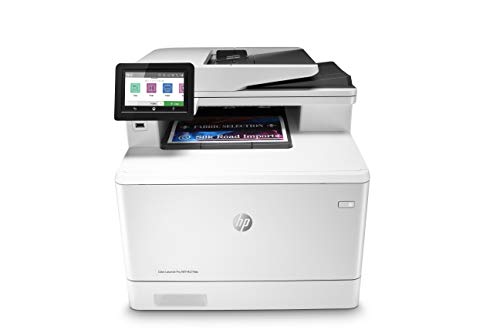
If you need more than just printing, the HP Color LaserJet Pro M479fdw delivers print, scan, copy, and fax in a single wireless unit. This is a serious machine for a growing business — it comes with a one-year, next-business-day onsite warranty, which is a real differentiator if downtime costs you money. The customizable touchscreen control panel lets you set up automated workflows and recall them with a single tap, making repetitive office tasks genuinely faster.
HP Wolf Pro Security is built directly into the hardware, firmware, and operating system. For a business handling client data or sensitive documents, that hardware-level protection matters. Print speeds top out around 28 ppm in color, and wireless connectivity means it works with your existing network without any complicated wiring.
The M479fdw is on the higher end of the price range, but the onsite warranty alone justifies a chunk of that premium for most small business owners. If you want to compare this to a more budget-friendly inkjet option, see our Best HP Envy Printer roundup.
Pros:
Cons:
Brother refreshed their mid-range all-in-one line with the MFC-L8930CDW, and the results are impressive. This model runs at up to 33 pages per minute for both print and copy — one of the fastest in this price category. The new design is 25% smaller than the previous generation while maintaining a full MFP feature set: duplex print, scan, copy, and a high-speed two-sided document scanner running at 104 images per minute (ipm) with an 80-page auto document feeder.
What really stands out is the scanning flexibility. You can scan directly to cloud storage, email, SharePoint, and more from the touchscreen. It even supports creating searchable and editable Microsoft Office documents from scanned files — a feature that saves hours in a busy office. The included toner cartridges offer solid out-of-box value at 3,000-page black and 1,800-page color yields, and if you upgrade to Brother's TN635XXL super high yield toner, you're looking at 7,500 pages black and 6,500 pages color per cartridge set.
The multipurpose tray handles custom media including business card stock, making it practical for in-house card printing runs alongside your standard document workload.
Pros:
Cons:
The Brother HL-L8430CDW is a print-only color laser built for busy offices where multiple people are sending jobs throughout the day. At 33 ppm with vibrant color output, it keeps up with demanding team environments without bottlenecking your workflow. The durable design is engineered specifically for reliability under sustained use — this isn't a printer that'll start jamming after a few months.
Paper capacity is a strong selling point. The standard 250-sheet tray plus a 50-sheet multipurpose tray handles card stock and envelopes out of the box. If your team needs more, you can expand up to 1,340 sheets total with optional additional trays — meaning fewer interruptions to reload paper during long print runs. Toner costs are kept manageable with the same TN635XXL super high yield option as its MFP sibling, giving you 7,500-page black and 6,500-page color yields per set.
Since this is a print-only model, it's worth pairing with a dedicated scanner if your office handles a lot of incoming documents. Check out our best document scanner for home guide for solid companion picks.
Pros:
Cons:
If desk space is tight and your print volume is moderate, the Brother HL-L3280CDW is one of the most practical picks on this list. It's compact, wireless, and delivers laser-quality digital color output at up to 27 ppm — faster than most inkjet alternatives and with far better color consistency on business card stock. Automatic duplex (two-sided) printing is built in, and Ethernet connectivity gives you wired network options alongside wireless.
The HL-L3280CDW works with Alexa for voice-activated printing, which is a nice touch for home office setups where hands-free control matters. It also includes a two-month Brother Refresh subscription trial — Brother's ink/toner replenishment service — so you won't have to scramble for supplies immediately after unboxing. Mobile printing is supported through standard protocols, so it plays well with both iOS and Android devices.
For a home-based business professional printing their own cards and marketing materials, this model hits the sweet spot between capability and footprint. It won't overwhelm a corner desk and the learning curve is minimal.
Pros:
Cons:
The Canon Pixma iX6820 takes a different approach from the laser printers above. It's an inkjet model, but one designed specifically with business printing in mind. Its standout feature is wide-format printing up to 13 inches wide, which opens up options for oversized business cards, promotional materials, and brochures that standard letter-size printers can't handle. If your brand uses unconventional card dimensions, this is worth a close look.
Canon's FINE print head technology (Full photolithography Inkjet Nozzle Engineering) delivers sharp edges and accurate color reproduction — critical for cards where logos and typography need to look clean. It supports AirPrint, Google Cloud Print, and Canon's own Pixma Printing Solutions for wireless printing from mobile devices. Setup is straightforward and it's compatible with a wide range of Windows and Mac operating systems.
The trade-off is cost per page. Inkjet ink cartridges are more expensive per print than laser toner at high volumes. If you're printing business cards in large batches regularly, factor that into your total cost of ownership. For smaller runs or specialty media, though, the iX6820 is hard to beat on output quality.
Pros:
Cons:
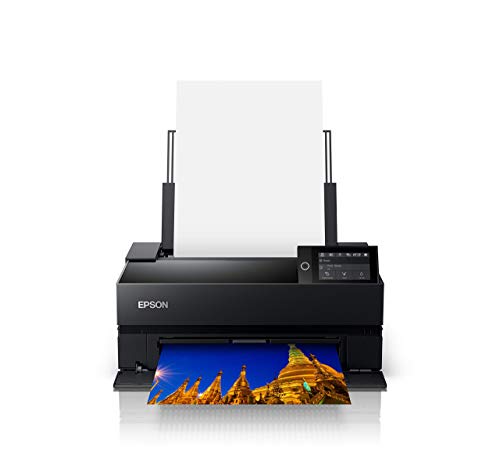
The Epson SureColor P700 is in a different class from everything else on this list. It's a professional 13-inch photo printer using Epson's UltraChrome PRO10 ink system — a 10-channel ink set that includes a dedicated Violet channel for an exceptionally wide color gamut (range of reproducible colors). If your business cards include photography, gradient artwork, or bold brand colors that standard printers struggle to reproduce accurately, this is the machine that gets it right.
The dedicated nozzles for both Photo Black and Matte Black inks eliminate the switching delay that plagues most photo printers — you don't have to wait for ink to purge and reload when switching between glossy and matte card stock. The new 10-channel MicroPiezo AMC printhead delivers consistent accuracy at professional print speeds. Output quality on heavy card stock is genuinely gallery-grade.
This is a specialist tool, not an everyday office workhorse. If you need to print spreadsheets or standard documents alongside cards, look elsewhere. But for a photographer, graphic designer, or brand-conscious business owner who demands color accuracy above all else, the P700 justifies its premium price. If you're also interested in Epson's ink-saving technology for document printing, our Best Epson EcoTank Printer guide covers the other side of Epson's lineup.
Pros:
Cons:
Business cards have specific demands that a standard home printer may not meet. Before you pull the trigger, run through these four criteria to make sure you're buying the right tool for your actual needs in 2026.
This is the most fundamental decision. Laser printers use toner (a dry powder) fused to the page with heat — they're fast, produce sharp text, and have a lower cost per page at volume. Inkjet printers spray liquid ink and tend to produce richer photo-quality color but at a higher per-page cost for large runs.
Business cards live or die on how faithfully they reproduce your brand colors. Look for these specs when comparing models:
Standard copy paper is around 75–90 gsm (grams per square meter — a measure of paper thickness). Business card stock typically runs 280–400 gsm. Not every printer handles heavy stock reliably. Check these before buying:
The sticker price is just the beginning. Factor in ongoing costs before deciding:
Yes, most color laser printers can print on business card stock, but you need to verify the maximum media weight the printer supports. Look for a multipurpose or bypass tray that can handle heavier cardstock (200 gsm or more) without jamming. Models like the Brother HL-L8430CDW and MFC-L8930CDW include multipurpose trays specifically designed for custom media including envelopes and card stock.
It depends on your card design and volume. Laser printers produce sharper text and cost less per page at higher volumes, making them better for most standard business cards with logos and text. Inkjet printers like the Epson SureColor P700 or Canon Pixma iX6820 deliver richer photo-quality color, making them better for cards featuring photography or complex artwork. For most home offices printing occasional batches, a compact color laser like the Brother HL-L3280CDW is the practical choice.
Standard business cards are typically printed on 280–350 gsm (grams per square meter) cardstock. Before printing, confirm your printer's maximum supported media weight — many consumer laser printers top out at 163–200 gsm, which is thinner than commercial card stock. For thicker, more premium cards, a wide-format inkjet like the Epson P700 handles heavier media more reliably. You can also order pre-cut business card sheets (like Avery's) designed to work with standard home printers.
This varies significantly by printer and cartridge type. A standard business card is about 1/10th of a standard letter page, so a cartridge rated at 3,000 pages could theoretically yield 30,000 card-sized prints if coverage is similar. In practice, yields depend on ink coverage on your design. High-yield cartridges like Brother's TN635XXL (7,500-page black, 6,500-page color) offer the best per-card economics for high-volume printing.
You need a printer with automatic duplex printing to print both sides without manually flipping sheets. Most models on this list include this feature — including the HP M255dw, HP M479fdw, Brother MFC-L8930CDW, Brother HL-L3280CDW, and Brother HL-L8430CDW. The Canon Pixma iX6820 does not include automatic duplex, so you'd need to flip sheets manually for double-sided cards.
For small quantities (under 250 cards), online print shops like Vistaprint or Moo often offer competitive pricing that's hard to beat at home when you factor in cardstock cost, ink, and your time. For larger quantities or frequent reprints — especially if you update contact information regularly — a home printer quickly pays for itself. A Brother HL-L8430CDW with high-yield toner can bring per-card costs well under a cent once the initial hardware cost is amortized over a full year of use.


About Editorial Team
The DigiLabsPro editorial team covers cameras, lenses, photography gear, and creative technology with a focus on helping photographers make informed buying decisions. Our reviews and guides draw on hands-on testing and research across a wide range of equipment, from entry-level beginner kits to professional-grade systems.
You can get FREE Gifts. Or latest Free phones here.
Disable Ad block to reveal all the info. Once done, hit a button below
