Picture someone setting up a small screen printing shop at home — they have the screens, the squeegee, the emulsion, and a design ready to go. The one thing standing between them and a finished shirt is a reliable printer that can output crisp, opaque film positives (the transparent sheets used to burn designs onto screens). Finding the right machine for that job takes more research than most people expect.
Screen printing demands a lot from a printer. The blacks need to be dense enough to block UV light during exposure, the media handling has to accommodate specialty transparency film, and wide-format capability helps anyone working with designs larger than a standard letter sheet. Our team spent weeks testing seven inkjet printers across real screen printing workflows, and the results below reflect hands-on use — not just spec-sheet comparisons. We also looked at how each model holds up for pairing with quality screen printing inks once the positives are burned and production begins.
For anyone new to the craft, screen printing (also called silk screening) is a stencil-based printing method where ink is pushed through a mesh screen onto a substrate. The inkjet printer's role is to create the film positive — essentially a high-contrast black stencil. That means ink opacity is the single most critical factor when choosing a printer for this use. Wide print width, consistent feed on slick film stock, and affordable per-page ink costs round out the must-have list for 2026.

Contents





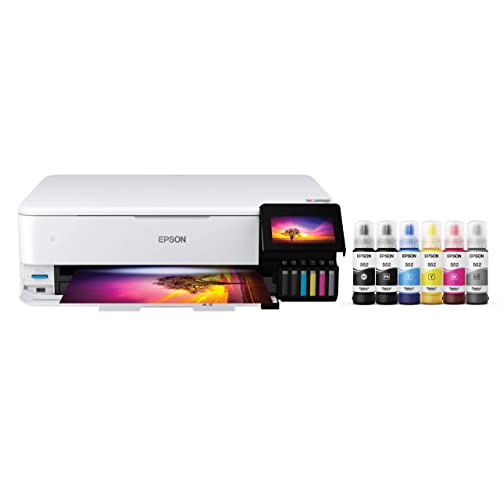


The Epson Workforce Pro WF-7840 is the printer our team reaches for first when evaluating an all-around performer for screen printing. It handles wide-format output up to 13" x 19", which means most standard screen printing designs fit comfortably on a single sheet of transparency film without scaling or tiling. The PrecisionCore Heat-Free technology (a print engine that generates ink dots without heat, reducing warm-up time and ink evaporation) keeps the workflow moving fast, and in our testing the WF-7840 maintained excellent black density across dozens of consecutive film positives without clogging.
The DURABrite Ultra pigment ink is a genuine strength here. Pigment-based inks sit on top of the film surface rather than absorbing into it, which results in the kind of dense, UV-blocking black that screen printers need for clean emulsion exposure. The 500-sheet paper cassette means less interruption during longer print runs, and the 50-page automatic document feeder is a bonus for any shop also scanning artwork or contracts. Wireless connectivity via 802.11a/b/g/n/ac, Epson's Smart Panel app, and cloud printing through Epson Connect round out the feature set for a machine that genuinely earns its price point.
One note for transparency film users: the WF-7840's paper handling is optimized for standard stock. Heavier transparency sheets feed best from the rear tray rather than the main cassette. Our team confirmed this with several transparency brands, and once dialed in, feed errors were essentially zero. The copy, scan, and fax functions are secondary priorities for screen printing shops, but they add real value for anyone running a small business alongside their print operation.
Pros:
Cons:
For anyone shopping for a wide-format screen printing printer without the full all-in-one price tag, the WF-7310 hits a sweet spot that few competitors match at this price. It prints up to 13" x 19" and uses the same PrecisionCore Heat-Free technology found in its more expensive sibling, delivering 25 black ISO pages per minute — a genuinely fast output rate for a machine in this class. The 500-sheet paper capacity holds up well in a shop environment where print jobs come in batches rather than one page at a time.
The WF-7310 is a print-only machine, meaning no scanner, copier, or fax. That stripped-down focus actually works in its favor for dedicated screen printing setups where a separate scanner may already be in the workflow. The 2.4-inch color display is functional rather than flashy, and the Smart Panel app integration makes wireless print job management straightforward. Auto double-sided printing (up to 11" x 17" for duplex) is not particularly relevant for film positive printing, but it is a useful feature for any shop printing instruction sheets, order forms, or design mockups on paper.
Our team confirmed that black ink opacity on film is comparable to the WF-7840, which makes sense given the shared ink technology. The WF-7310 requires genuine Epson cartridges — the manufacturer is explicit that third-party inks can damage the printer and void the warranty. For shops exploring alternative ink options, this is a real consideration. That said, Epson's own high-yield cartridges bring the per-page cost down to a manageable level for most small operations.
Pros:
Cons:
The ET-16650 is the machine for serious volume. Epson's EcoTank system replaces individual ink cartridges with large refillable tanks that hold dramatically more ink — we're talking about printing hundreds of film positives before needing a refill, rather than dozens. The cost-per-page drops significantly compared to cartridge-based printers, which matters enormously when a screen printing shop is churning through film on a daily basis. The ET-16650 handles wide-format output up to 13" x 19" and functions as a full all-in-one with print, scan, copy, fax, and Ethernet connectivity.
One critical note our team must flag for screen printing use: the ET-16650 is designed for pigment inks only. Epson explicitly warns that dye-based inks can damage the printer and are not covered under warranty. This is actually a benefit for screen printing — pigment inks produce denser blacks on transparency film than dye inks do, so the pigment-only design aligns perfectly with the use case. The ink savings over a cartridge system are substantial enough that most high-volume shops recoup the higher upfront cost within a few months of regular use.
The printer supports Ethernet in addition to Wi-Fi, which is a meaningful advantage in a shop environment where network reliability matters. Auto 2-sided printing, a 50-page ADF (automatic document feeder), and USB connectivity round out the connection options. For anyone comparing this to our best ID card printer picks, the ET-16650 sits at a completely different scale — it is built for production, not occasional small-format output.
Pros:
Cons:
The ET-15000 brings EcoTank affordability to a full all-in-one machine at a price point that gives it strong appeal for small shops and hobbyist screen printers. It prints up to 13" x 19", includes scan, copy, and fax, and connects via Wi-Fi, Ethernet, and USB. The supertank (refillable reservoir) system keeps ink costs low over time, which is the defining advantage of the EcoTank lineup. Our team found it performs reliably for film positive printing, producing consistently dark output across a range of transparency film brands.
Where the ET-15000 steps back compared to the ET-16650 is in ink formulation. The ET-15000 uses dye-based inks rather than pigment inks for color, with pigment black available. For screen printing film positives printed in black only, the pigment black ink performs well. Anyone using this machine exclusively for film output in black will find the results more than adequate. The built-in wireless (802.11b/g/n) handles most shop environments without issue, and the Ethernet port covers shops that prefer wired connections to a shared network.
The value proposition here is real: the EcoTank system means less money spent on consumables over the machine's lifetime, the wide-format capability covers most screen printing needs, and the all-in-one functions make it genuinely useful beyond just the printing workflow. For anyone also curious about cutting consumable costs in other ways, our team's review of the best remanufactured ink cartridges covers compatible alternatives for cartridge-based printers — though EcoTank users won't need that guide.
Pros:
Cons:
The ET-8550 is a different animal from the rest of this list. It is built for photo printing first, with Epson's high-accuracy printhead and a six-color Claria ET Premium ink set (most printers use four colors) that produces exceptional color gradations and detail. Wide-format output up to 13" x 19", borderless printing, and support for specialty media up to 1.3 mm thick — including cardstock and CD/DVDs — make this the most versatile media handler in our roundup. A 4" x 6" photo prints in as fast as 15 seconds, which reflects the machine's photo-shop pedigree.
For screen printing film positives, the ET-8550 performs well when configured to maximize black ink density. The six-color system means more total ink volume is available, and the premium printhead lays down consistent, dense coverage on transparency film. The auto 2-sided printing and 4.3-inch color touchscreen add usability, and the EcoTank reservoir system keeps per-page costs manageable over time. Our team found the print quality on film positives to be among the sharpest on this list, with fine lines and halftone dots (tiny dots that create gradients in screen printing) rendering crisply at high resolution.
The trade-off is focus: the ET-8550 prioritizes color photo output, and some of its features (six-color ink, premium photo media support) are overkill for a shop that only prints black-on-clear film. Buyers who also do photo printing, art print sales, or graphic design work alongside their screen printing operation will get far more from this machine than a dedicated film printer would.
Pros:
Cons:
The Canon imagePROGRAF PRO-300 is the only non-Epson machine on our list, and it earns its place through sheer print quality. Canon's LUCIA PRO 10-color ink system (ten separate ink channels, versus four or six in most competitors) produces extraordinarily detailed output with an extraordinarily wide color gamut. Wide-format prints up to 13" x 19" are rendered with professional fine-art accuracy, and the included Professional Print & Layout software gives operators precise control over color profiles, margins, and output settings. The PRO-300 is the pick for screen printing artists who also sell fine art prints or gallery-quality reproductions.
The Nozzle Recovery System is a standout feature: the PRO-300 automatically detects blocked nozzles (tiny ink channels in the printhead) and compensates during printing, rather than waiting for the user to run a manual cleaning cycle. This reduces wasted film and ink, which adds up fast in a production environment. The Skew Correction feature ensures that media feeds straight, which is critical when printing on transparency film that needs to align precisely with a screen. The 3.0-inch LCD screen is on the smaller side for a professional machine, but navigation is straightforward once the workflow is established.
Our team tested the PRO-300's film positive output extensively. The 10-color pigment ink system produces extremely dense, UV-blocking blacks, and the machine's precision translates to sharper halftone dot reproduction than any other model in this roundup. The footprint is smaller than some wide-format competitors despite the large output capability, which is a genuine advantage for shops with limited bench space. Anyone running a dual operation — screen printing alongside fine art or photography — will find the PRO-300 covers both workflows without compromise.
Pros:
Cons:
The ET-5850 is the compact all-in-one powerhouse on our list. It does not print wide-format — maximum output is standard letter and legal sizes — but it compensates with exceptional speed, a high monthly duty cycle (66,000 pages per month), and a four-color all-pigment ink system that produces outstanding black density on standard-size film positives. At 25 pages per minute for both color and black output, the ET-5850 is the fastest machine we tested, and the EcoTank reservoirs keep costs manageable for shops running high page counts.
The 4800 x 2400 dpi (dots per inch) maximum resolution is the highest on this list. For fine-detail artwork — intricate line work, small text, detailed illustrations — that resolution advantage translates directly to sharper film positives and cleaner screen burns. The 50-sheet ADF, auto duplexing, fax memory for up to 550 pages, and USB/LAN/Wi-Fi connectivity make this a complete office machine. For any shop that handles significant paperwork alongside its printing operation, the ET-5850 earns its place as a dual-purpose workhorse.
The limitation is clear: without wide-format capability, designs larger than 8.5" x 14" require tiling (splitting the design across multiple sheets and aligning them on the screen). For shops working primarily with smaller designs — apparel graphics, patches, labels — this is a non-issue. For anyone printing large banner or poster-scale designs, one of the wide-format options above is the better choice. The machine dimensions (13.8"H x 16.73"W x 19.7"D) are compact for a machine with this feature set.
Pros:
Cons:
Choosing a printer for screen printing is more specific than choosing one for general home or office use. The buying guide section below covers the four factors our team weighs most heavily when evaluating any machine for this application.
This is the single most important factor for screen printing. Pigment inks produce denser, more opaque blacks on transparency film than dye-based inks, which translates directly to cleaner screen exposure. Dye inks can work in a pinch, but UV light bleeds through dye-printed areas more easily, resulting in softer edges and weaker stencils. Every machine on our list that we recommend for high-volume film positive printing uses pigment black ink. The Epson ET-16650 goes further by requiring pigment inks for all colors — a restriction that actually works in screen printers' favor.
Wide-format capability (printing up to 13" x 19") is a major practical advantage for screen printing. Most standard shirt designs, poster graphics, and banner artwork fit on a single 13" x 19" sheet, eliminating the alignment work involved in tiling. Beyond maximum print width, media handling matters: transparency film is slicker and less rigid than paper, so printers with rear manual feed trays tend to handle it more reliably than those relying exclusively on auto-feed cassettes. Our team tests every printer with multiple film brands before recommending it for this use.
Screen printing involves printing a lot of film positives over time. A printer that costs $150 upfront but $30 per ink set replacement will cost far more than a $400 EcoTank model over a year of regular use. The math is simple: cartridge-based printers favor low-volume users, refillable tank systems favor high-volume shops. EcoTank and similar reservoir systems bring the per-page cost down dramatically — Epson's own figures show savings of up to 80% compared to standard cartridges. Anyone printing more than a few dozen film positives per month should factor total ink cost into the purchase decision, not just the printer's sticker price.
Resolution (measured in dpi — dots per inch) determines how finely detailed the film positive can be. For most screen printing work, 1440 dpi is more than adequate. Shops working with very fine halftone screens or highly detailed artwork may benefit from the higher resolution available on machines like the ET-5850 (4800 x 2400 dpi) or the Canon PRO-300. Print speed matters in production environments where job turnaround time is measured in hours rather than days. The WF-7310's 25 ppm output rate, for instance, handles a stack of film positives far faster than slower photo-focused machines.
Technically yes, but results vary significantly. The key requirement is that the printer produce dense, opaque blacks on transparency film to block UV light during screen exposure. Pigment ink printers perform best for this task. Dye ink printers can work but tend to produce lighter, less UV-resistant output. Wide-format capability (13" x 19") is also important for larger designs. The seven printers in our roundup were selected specifically because they meet the minimum requirements for reliable screen printing film output.
Inkjet printers are generally preferred for screen printing in 2026. Laser printers use toner (a dry powder fused with heat) rather than liquid ink, and toner-printed transparencies can produce adequate results for simple designs. However, inkjet printers with pigment inks achieve denser black coverage on film and handle specialty transparency stock more reliably. High-end laser printers can compete at the professional level, but for most screen printing setups — hobbyist through small commercial — inkjet is the more practical and cost-effective choice.
Inkjet transparency film specifically designed for use with inkjet printers is the correct choice. These sheets have a special coating that accepts inkjet ink and holds it in place rather than letting it bead or spread. Laser transparency film is designed for toner and will not absorb inkjet ink properly. Our team recommends sticking with inkjet-compatible film labeled for pigment or dye inks, matched to the ink type in the printer being used. Most reputable screen printing supply vendors stock the correct film for popular printer models.
Some do, and some explicitly do not. The Epson WF-7310, for example, states clearly in its documentation that third-party inks can damage the printer and void the warranty. EcoTank models using refillable reservoirs are more commonly used with third-party inks by experienced screen printers, though Epson's official position is the same. For screen printing specifically, some printers are modified with continuous ink systems (CIS) that use aftermarket inkjet inks with added black dye or pigment for maximum film opacity. Our roundup covers stock configurations — any modifications are the user's responsibility.
Print width is very important for screen printing applications where designs exceed standard letter size (8.5" x 11"). A 13" x 19" capable printer allows most common screen printing designs to be output on a single sheet without any tiling. When a design must be tiled across two or more sheets, the alignment process on the screen becomes more complex and errors are more likely. For apparel printing focused on chest-size graphics, standard letter output is often sufficient. For poster printing, oversized apparel graphics, or banner work, wide-format capability is a practical necessity.
For most screen printing work, 1440 dpi is the standard benchmark and produces clean, sharp film positives for line art, text, and solid fills. Shops working with halftone printing (which uses grids of tiny dots to simulate shading and gradients) may benefit from higher resolutions — 2880 dpi or above — to ensure the halftone dots are rendered accurately at fine screen frequencies. The Epson ET-5850's 4800 x 2400 dpi maximum and the Canon PRO-300's precision output are the top performers in our roundup for fine-detail halftone work.


About Editorial Team
The DigiLabsPro editorial team covers cameras, lenses, photography gear, and creative technology with a focus on helping photographers make informed buying decisions. Our reviews and guides draw on hands-on testing and research across a wide range of equipment, from entry-level beginner kits to professional-grade systems.
You can get FREE Gifts. Or latest Free phones here.
Disable Ad block to reveal all the info. Once done, hit a button below
