Picture this: you've just cut the cord, your antenna is mounted in the attic, and you're getting maybe a dozen channels when your neighbor two streets over picks up forty. The frustrating part is that the broadcast towers are well within range — the signal just isn't making it cleanly through the coax run and the building materials between you and clear reception. That's exactly the gap a good TV antenna booster fills, and it makes an enormous difference when you choose the right one.
TV antenna boosters — also called preamplifiers or distribution amplifiers — solve a specific problem: signal loss caused by long cable runs, splitters, and weak incoming signal. They don't create channels from thin air, and they can't cut through physical obstructions, but when low signal strength is the real culprit behind pixelation and drop-outs, a quality amplifier is the most cost-effective fix you can buy. In 2026, with the ongoing ATSC 3.0 rollout delivering NextGen TV broadcasts in more markets every month, having clean signal from your antenna matters more than ever.
This guide cuts through the noise (literally) and ranks the seven best TV antenna boosters available right now. Whether you need a preamplifier that mounts directly at the antenna mast, an indoor inline amp to compensate for a long cable run, or a distribution amplifier to feed four TVs from one antenna, there's a clear winner for your setup. We've also put together a thorough buying guide and FAQ to help you make sense of gain ratings, noise figures, and LTE filtering — all the specs that actually matter. You might also want to check out our guide on the best magnetic loop antennas if you're interested in maximizing your reception setup beyond just amplification.
Contents
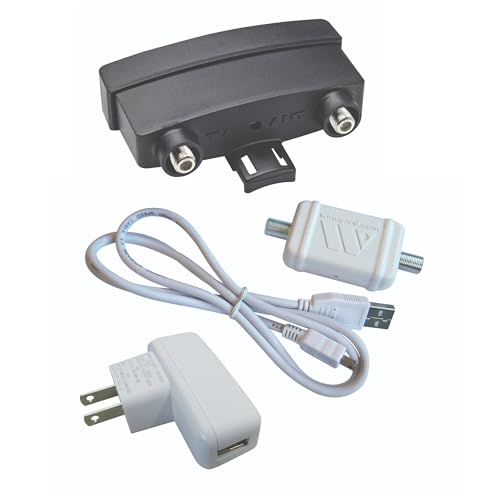


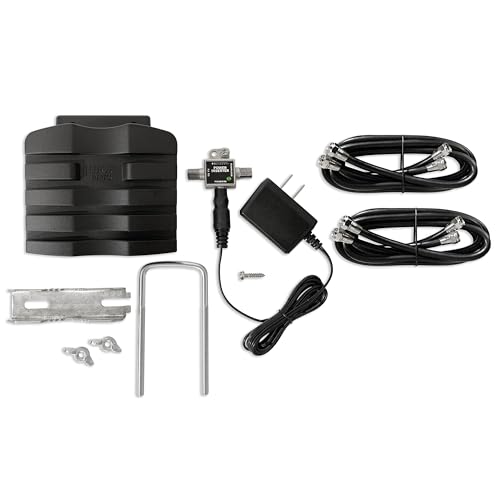

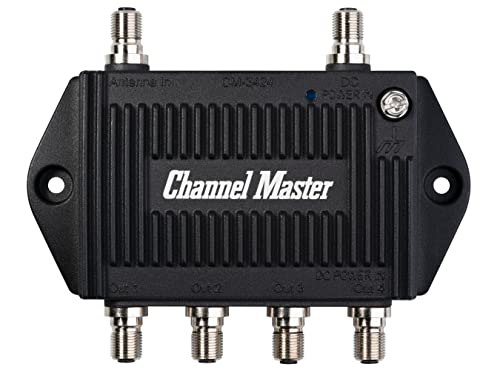
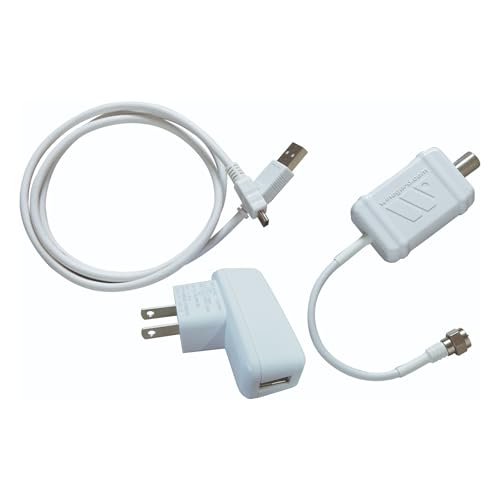


The Winegard LNA-200 Boost XT is the preamplifier that outdoor antenna owners consistently come back to, and it's not hard to understand why. Designed to mount directly at the antenna mast — as close to the antenna as possible — this unit amplifies the signal before any of it gets eaten up by the cable run to your TV. That upstream placement is the key advantage of a preamplifier over any inline amp, and the Boost XT executes it perfectly. It covers the full VHF and UHF spectrum, which matters because many broadcasters still transmit local news and network affiliates on VHF frequencies that weaker amps struggle with.
In real-world use, the Boost XT routinely adds 10 to 25 channels to setups that were previously marginal. The gain output is rated to compensate for up to 200 feet of coaxial cable loss, which covers the vast majority of residential antenna installations. The power inserter included in the kit feeds the amplifier via the coax line itself — you don't need a separate power run to the roof or attic — and the weatherproof housing has proven itself in all climates. If you're running a single TV with a passive outdoor or attic antenna and you want the single best upgrade you can buy, the LNA-200 is it. Just keep in mind: this unit is strictly for non-amplified, passive antennas. Using it downstream of an antenna with a built-in amp will cause signal overload, not improvement.
Build quality is exactly what you'd expect from Winegard, a company that has been making antenna hardware since the 1950s. The housing is compact, the connectors are solid F-type, and installation takes about fifteen minutes with a basic set of tools. The power inserter is compact enough to tuck behind a TV or entertainment center without any clutter.
Pros:
Cons:
If you're in a market where ATSC 3.0 NextGen TV broadcasts are already rolling out — and in 2026, that's most major metro areas — the Antennas Direct ClearStream Juice Plus is the forward-thinking choice. It's built from the ground up to support the new standard alongside 4K and 8K UHD content, not as an afterthought but as a core design specification. Boosts UHF, VHF, and FM frequencies simultaneously, which is an underrated feature if you want to run your FM radio through the same antenna system. It meets or exceeds the signal quality demands of NEXTGEN TV reception, so you're buying into a preamplifier that will still be relevant as broadcasters migrate their full channel lineups to ATSC 3.0 over the next several years.
The housing design deserves special mention. Antennas Direct engineered a weatherproof enclosure that tilts open to expose the coaxial cable connections — no fumbling with exposed ports during installation on a wet day. The whole unit closes and latches securely once you're done, providing genuine protection against rain, wind, and temperature extremes. At 4.25 inches square, it's a neat, compact package that doesn't look out of place on a roof or exterior wall mount. Installation is genuinely straightforward, even if you're not a dedicated antenna hobbyist. The user-friendly design lives up to the marketing claim: professional-grade performance with DIY-accessible installation.
Signal performance is excellent across the board. The Juice Plus handles weak signal conditions confidently, pulling in distant stations that cheaper preamplifiers miss or deliver at marginal quality. The FM support is a genuine bonus for listeners who run an FM antenna in parallel or want to use their TV antenna for radio as well. This is the preamplifier to buy if you want your setup to handle everything 2026's broadcast landscape can throw at it and still be ready for what's coming next.
Pros:
Cons:
Channel Master built the PreAmp 1 for one specific audience: people in genuine weak signal territory who need more power than a distribution amplifier can provide. The 17–30dB variable gain is the defining spec here. Most inline amplifiers offer a fixed, modest gain. The PreAmp 1 gives you a meaningful range to work with, so you can dial in the right amount of amplification without overdriving your tuner — a real problem when you push gain too high on strong-signal channels while trying to pull in distant ones. That adjustability makes it one of the most versatile single-port amplifiers on this list.
The built-in LTE filter is not a checkbox feature on this unit — it's one of the best implementations in the category. It blocks interference from 3G, 4G, and 5G devices along with EMI and FM out-of-band signals, which is essential if you live in an area with dense cellular infrastructure near broadcast frequencies. Channel Master was honest enough to include a clear caveat in the product specifications that matters: this amplifier won't solve problems caused by interference, multipath, or physical obstructions. If your signal issues come from trees, buildings, or competing towers rather than weak signal, no amplifier will fix that. But if raw signal strength is your bottleneck, the PreAmp 1 delivers higher power output than distribution amplifiers and handles long coaxial cable runs that would otherwise degrade quality before the signal reaches your tuner.
Compatibility is broad. The PreAmp 1 works with Channel Master's own power-passing splitters (the CM-3212HD, CM-3214HD, and CM-3218HD), making it an easy centerpiece for a whole-home distribution system. It installs indoors or outdoors, and the compact weatherproof housing handles both environments without compromise. If you're building a serious antenna setup from scratch and weak signal is your primary concern, this is the amplifier that goes at the head of your chain.
Pros:
Cons:
If you're distributing your antenna signal to multiple televisions throughout your home, a passive four-way splitter is quietly destroying your signal quality — each split costs you roughly 7dB, which is substantial. The Channel Master 4-Port Distribution Amplifier solves this by combining the splitting function with active signal amplification in a single weatherproof unit. Four amplified output ports replace your passive splitter entirely, delivering boosted signal to each TV rather than divided, degraded signal. It's the cleanest solution for whole-home antenna setups, and the compact heavy-duty housing means you can install it wherever your coax distribution point happens to be — attic, closet, or exterior wall.
The 7.5dB gain per port is calibrated specifically for the distribution use case. That's not as high as a dedicated preamplifier, but for a distribution amp it's appropriate — you want enough gain to overcome splitting loss without overdriving tuners on TVs that happen to be closer to the antenna. The built-in LTE filter handles the same cellular interference blocking as its single-port sibling, which matters since cellular signals continue to creep into broadcast TV frequencies in dense markets. This unit is the direct replacement for the older Ultra Mini model and improves on it in every measurable way.
The installation scenario here is straightforward: your antenna feeds into the single input, and four outputs feed four separate TVs via individual coax runs. If you currently have a passive splitter in your setup and you're experiencing pixelation on one or more TVs, swapping in this unit is the most direct fix available. This is the kind of hardware where the value proposition is immediately obvious the first time all four TVs pull in clean signal simultaneously.
Pros:
Cons:
The Winegard LNA-100 is the indoor counterpart to the LNA-200, and it fills a different but equally important role. Where the LNA-200 goes outside at the mast, the LNA-100 is designed for the living room — it connects inline between your indoor flat antenna and your TV, providing 20dB of gain through Winegard's Clear Circuit Technology. The 1dB typical noise figure is among the lowest you'll find in any inline amplifier, which translates directly to cleaner signal and less pixelation on weak channels. A low noise figure matters more than raw gain in most real-world scenarios, and Winegard consistently delivers on this metric.
Setup is as simple as it gets. The LNA-100 sits between your antenna and your TV, powered by a USB cable with a built-in LED indicator so you always know the unit is active. The included 110V adapter means you don't need a USB port on your TV — plug it into any outlet nearby. The white finish blends well with modern flat antennas and interior setups, which sounds like a minor point until you're looking at a black box clashing with your entertainment center setup.
This is the right amplifier when you have an indoor flat antenna in a marginal reception location and you're experiencing intermittent pixelation or missing channels you know are broadcasting in your area. It won't extend your antenna's range dramatically, but it will maximize the signal quality from whatever your antenna is already capturing. Think of it as a precision tuner for indoor reception rather than a long-range signal hauler. For cord-cutters who haven't been happy with their indoor antenna's performance, this is the first upgrade to try before investing in a larger outdoor antenna. You can pair it with insights from our Bluetooth booster guide if you're building out a comprehensive home wireless setup at the same time.
Pros:
Cons:
The Channel Master Ultra Mini has been the go-to budget amplifier for cord-cutters for years, and it continues to earn its place on this list in 2026. The 15dB gain from a single amplified output port is enough to compensate for moderate signal loss from cable runs and inline splitters, and the form factor is genuinely tiny — you can tuck this behind a TV, inside a cable box enclosure, or anywhere along a coax run without it creating any kind of installation headache. Compatibility extends beyond TV antennas to CATV installations as well, making it useful in more setup scenarios than a narrowly focused preamplifier.
Where this unit stands out is in its value-to-performance ratio. You're not getting the LTE filtering of Channel Master's newer amplifiers, and the fixed 15dB gain offers none of the adjustability of the PreAmp 1. But for a straightforward single-TV setup where you know your signal loss is moderate and your interference environment is manageable, the Ultra Mini does the job cleanly and at a price point well below the premium options on this list. It works with all TV antennas and CATV installations, and it will not work with satellite systems — that's a firm limitation worth noting upfront.
If you're on a budget, setting up a secondary TV in a guest room, or just want to test whether amplification will solve your reception problem before committing to a more expensive preamplifier, the Ultra Mini is the right starting point. It's also a solid option for anyone dealing with a single long coax run to a remote room in a larger home — 15dB of gain handles that scenario efficiently without the cost or complexity of a more capable unit.
Pros:
Cons:
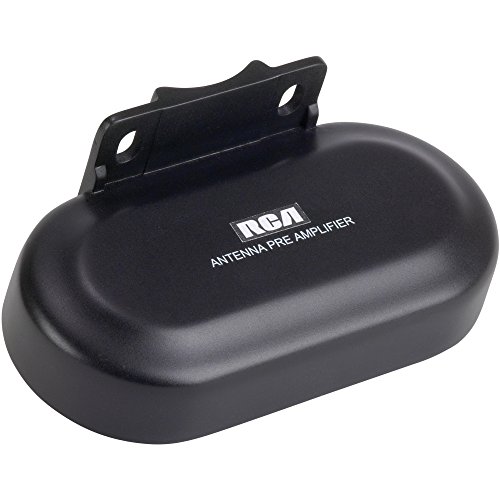
RCA's TVPRAMP12E is built for outdoor antenna installations where you're reaching for distant stations at the edge of your antenna's theoretical range. The combined UHF/VHF input is an improved design over older split-input models — you get cleaner combined amplification without the signal losses that come from managing separate input paths. The extremely low noise (ELN) amplifier circuitry is what sets this unit apart in the long-range reception category: by keeping the noise floor as low as possible at the amplification stage, signal purity is preserved all the way through to your TV's tuner, producing a crystal-clear HD picture from stations that other amplifiers deliver as marginal or pixelated.
The enhanced voltage regulator with short circuit protection is a practical reliability upgrade. Outdoor electronics in residential settings face power fluctuations, lightning-adjacent events, and the general stress of year-round weather exposure. The short circuit protection adds a meaningful layer of resilience, and mounting hardware is included so you can get the unit positioned optimally at the antenna location. The dimensions — roughly 5.9 by 4.1 by 3.9 inches — are compact enough to mount neatly without being too small to handle a robust coaxial connection at both ends.
This is the preamplifier for the dedicated outdoor antenna setup in a rural or suburban location where you're genuinely trying to extend range. If your closest broadcast tower is 40-plus miles away and you're running a large outdoor directional antenna, the RCA TVPRAMP12E gives you the cleanest amplification path to capture those distant signals reliably. It's not as polished as the Winegard or Antennas Direct units in terms of industrial design, but the signal performance is competitive and the ELN circuitry does exactly what it promises.
Pros:
Cons:

Buying a TV antenna booster without understanding the basics of what it does — and doesn't do — is a common mistake that leads to disappointment and returns. Before you pull the trigger on any amplifier, you need to be honest with yourself about what's actually causing your reception problem. The FCC's consumer guide on over-the-air reception covers the fundamentals of TV broadcast signal and what affects it. An amplifier fixes signal attenuation from cable runs and splitting. It does not fix multipath interference, physical obstructions, or an antenna pointed in the wrong direction. Know your actual problem before shopping.
The most important decision you'll make is choosing between a preamplifier and a distribution amplifier. A preamplifier mounts at or near the antenna and boosts the signal before it enters any coaxial cable run. This is the most effective placement because you're amplifying before any loss occurs. Preamplifiers like the Winegard LNA-200 and the Channel Master PreAmp 1 are the right choice when your signal is weak at the source — when you're far from broadcast towers, in a fringe reception area, or running a long cable from a roof or attic antenna.
A distribution amplifier, like the Channel Master 4-Port, addresses a different problem: signal loss from splitting. Every time you split an antenna signal to feed multiple TVs, you lose roughly 3.5dB per way. A four-way split costs you approximately 7dB — a significant reduction. A distribution amplifier compensates for that loss so all four TVs receive a strong signal. If your single-TV reception is great but your second and third TVs are marginal, a distribution amp is what you need, not a preamplifier.
Gain is measured in decibels and tells you how much the amplifier boosts the incoming signal. More gain is not always better. If you're in a strong signal area and you apply too much gain, you'll overload your TV's tuner and actually lose channels — a phenomenon that confuses many first-time amplifier buyers. In strong signal areas, 10–15dB is plenty. In weak signal areas 40+ miles from broadcast towers, you may need 20–30dB of gain to recover usable signal strength.
The noise figure is arguably more important than raw gain for signal quality. A low noise figure — ideally 1 to 2dB — means the amplifier adds minimal interference of its own as it boosts the signal. The Winegard LNA-100's 1dB typical noise figure is a benchmark-level spec that translates directly to cleaner reception. When comparing amplifiers, don't just chase the highest gain number. A 30dB amp with a 4dB noise figure will often produce worse picture quality than a 20dB amp with a 1dB noise figure.
LTE filtering has become essential in 2026. Cellular networks operating on frequencies adjacent to broadcast TV channels create interference that manifests as pixelation, missing channels, or signal dropout — problems that look exactly like weak signal but are actually interference-driven. Any amplifier you buy for an urban or suburban installation should include an LTE filter. Channel Master's newer units (the PreAmp 1 and 4-Port Distribution Amp) have excellent built-in LTE filtering. The Winegard LNA-200 handles this via its design, while older units like the RCA TVPRAMP12E and the Channel Master Ultra Mini were designed before dense cellular infrastructure became the norm.
Every amplifier on this list specifies compatibility with passive, non-amplified antennas only. This is a critical compatibility requirement. If your antenna already has a built-in amplifier, adding an external amp creates signal overload, not improvement. Check your antenna's specifications before buying. If it came with a separate power supply, it almost certainly has a built-in amp and you should not stack an additional amplifier on top of it.
Your installation location determines which type of amplifier to prioritize. For an outdoor or attic antenna with a long cable run to your TV, a preamplifier at the antenna location is the highest-impact upgrade. For an indoor flat antenna, an inline amp between the antenna and TV handles signal loss from the shorter cable run. For any setup distributing signal to multiple TVs, factor a distribution amp into your plans from the start. You can also combine a preamplifier at the antenna with a distribution amp at the split point — a configuration that handles both weak incoming signal and multi-room distribution simultaneously. Exploring other signal-related upgrades? Our guide on top mobile ham radios covers related RF and reception topics if you're building a broader antenna system.
Any amplifier installed outdoors or in an attic needs weatherproof housing. Attics experience temperature extremes — from freezing in winter to 130°F-plus in summer in warm climates — and outdoor installations face moisture, UV exposure, and wind. All the outdoor-rated units on this list (Winegard LNA-200, Antennas Direct Juice Plus, Channel Master PreAmp 1, Channel Master 4-Port, and RCA TVPRAMP12E) have housings rated for these conditions. Don't cut corners by using an indoor unit in an outdoor environment; the connectors will corrode and the electronics will fail prematurely.
Installation quality — specifically your coaxial connections — matters as much as the amplifier itself. A loose F-connector or a split in the coax shielding will undermine even the best amplifier's performance. Use quality RG6 coaxial cable, ensure all connectors are hand-tightened and then snugged with a wrench, and weatherproof any outdoor connections with self-amalgamating tape. The amplifier is only as good as the cable system around it.
It depends on why you're missing channels. If weak signal is the cause — you're far from broadcast towers or running a long coax run — an amplifier will recover channels you couldn't reliably tune before. If the problem is interference, physical obstructions between your antenna and the towers, or an antenna pointed in the wrong direction, an amplifier won't add channels and may make things worse by amplifying the interference alongside the signal. Run a free signal scan at a site like AntennaWeb or the FCC's DTV reception map to understand your signal environment before buying.
You can use an amplifier with any passive, non-amplified antenna. If your antenna already has a built-in amplifier or was sold with a separate power supply (indicating a built-in amp), you cannot safely add an external amplifier — you'll overload your tuner and likely lose channels rather than gain them. Check your antenna's product page or manual to confirm whether it's amplified before purchasing any booster.
A preamplifier mounts at or near the antenna and boosts the signal before it travels through the coax run. It's the right choice when your incoming signal is weak. A distribution amplifier connects inline at the point where your signal splits to multiple TVs, compensating for the signal loss that splitting causes. The right choice depends on your specific problem: weak incoming signal calls for a preamplifier, while splitting loss for multi-room setups calls for a distribution amplifier. In some installations, you use both.
An LTE filter blocks radio frequency interference from cellular networks operating on frequencies adjacent to over-the-air broadcast TV channels. In 2026, 4G and 5G cellular infrastructure is dense enough in most urban and suburban markets that this interference is a genuine problem — it can cause pixelation, signal dropouts, and missed channels that look exactly like weak signal but are actually interference-driven. Any amplifier purchased for use in a populated area should include an LTE filter as a standard feature.
In strong signal areas close to broadcast towers, 10–15dB of gain is sufficient. In moderate signal areas with cable runs of 50–100 feet, 15–20dB covers most scenarios. In weak signal or fringe areas more than 40 miles from the nearest broadcast tower, you need 20–30dB of gain to recover usable signal. Too much gain in a strong-signal area actually degrades performance by overloading your TV's tuner, so match your gain to your actual signal environment rather than choosing the highest number available.
Not necessarily. If your antenna is appropriately sized for your distance from broadcast towers, properly positioned and aimed, and connected via short quality coax to a single TV, you may not need any amplification at all. Add an amplifier when you have a specific signal loss problem: a long coax run (over 50 feet), a multi-TV setup using splitters, or verified weak signal from distant stations. An amplifier is a tool for a specific problem, not a universal upgrade. If your current setup delivers all available channels cleanly, leave it alone.
The right TV antenna booster is the one that solves your actual signal problem — buy for your installation, not for the highest gain number on the box.


About Editorial Team
The DigiLabsPro editorial team covers cameras, lenses, photography gear, and creative technology with a focus on helping photographers make informed buying decisions. Our reviews and guides draw on hands-on testing and research across a wide range of equipment, from entry-level beginner kits to professional-grade systems.
You can get FREE Gifts. Or latest Free phones here.
Disable Ad block to reveal all the info. Once done, hit a button below
