Which wood filament actually delivers that authentic timber look straight off the print bed? With dozens of wood-infused PLA options flooding the market in 2026, picking the right spool can mean the difference between a stunning faux-oak display piece and a clogged nozzle nightmare. After evaluating seven of the top contenders across print quality, texture, reliability, and value, the HATCHBOX Wood PLA stands out as the most consistently dependable choice for most makers — though your ideal pick depends heavily on what you're printing and how much post-processing you're willing to do.

Wood filaments blend real wood fibers — typically between 10% and 30% — into a PLA base, creating prints with a grainy, matte surface that genuinely resembles carved or sanded wood. They've come a long way since the early days of brittle, jam-prone formulas. Today's best wood PLAs offer tight diameter tolerances, smoother flow characteristics, and richer color variety. Some even let you vary the print temperature to simulate wood grain patterns, with darker tones emerging at higher nozzle temps. If you've worked with standard PLA filaments before — say, dialing in your best PLA settings on an Ender 3 — you already have the foundational skills. Wood filament just adds a few extra considerations around nozzle diameter, drying, and temperature tuning.
Whether you're building architectural models, board game components, cosplay props, or decorative home items, the right wood filament can eliminate the need for painting entirely. Some makers even sand and stain their wood PLA prints with actual wood stain for a finish that's nearly indistinguishable from the real thing. In this roundup, we'll break down seven filaments spanning budget picks, premium options, and specialty formulas so you can find the best match for your workshop. For more product comparisons across different categories, check out our full buying guide library.
Contents
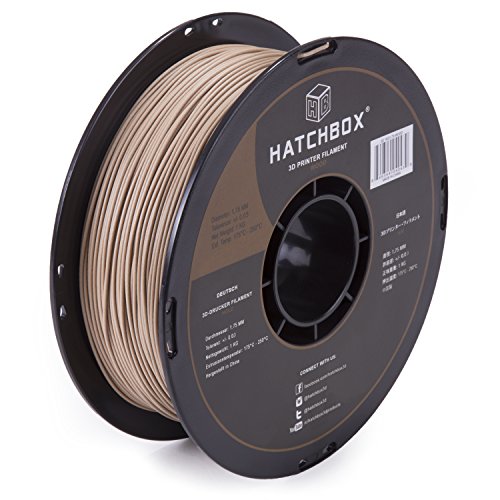




HATCHBOX has earned its reputation as one of the most trusted names in consumer 3D printing filament, and their Wood PLA lives up to the brand's track record. With 11% recycled wood fibers blended into a PLA base, this filament produces prints that carry a distinctly natural, warm appearance. The wood content is enough to create visible grain texture without pushing the formula into clog-prone territory. At a dimensional accuracy of +/- 0.03mm, you're getting the kind of consistency HATCHBOX is known for — smooth feeding, predictable extrusion, and minimal surprises mid-print.
The recommended nozzle temperature range of 175°C to 220°C gives you meaningful creative control. Print at the lower end and you'll get lighter, honey-toned surfaces. Push toward 220°C and the wood fibers darken noticeably, producing bands that mimic natural wood grain when you vary temperature across layers. This technique is one of the most satisfying tricks in the wood filament playbook. The 1 kg spool is standard sizing, and the filament feeds reliably through most direct-drive and Bowden setups with a 0.4mm or larger nozzle.
Where HATCHBOX really shines is in post-processing. The printed surface sands beautifully, and it accepts wood stain remarkably well — multiple makers in the community have demonstrated finishes that are genuinely hard to distinguish from real wood at arm's length. For architectural models, decorative items, and game board pieces, this is the filament that consistently delivers. The 11% fiber content does mean it's less aggressively textured than some competitors, so if you want a more pronounced grain, you might look at higher-fiber options. But for the broadest range of printing scenarios, HATCHBOX remains the benchmark.
Pros:
Cons:
If surface finish is your top priority, the eSUN Wood PLA in Oak deserves serious consideration. This filament produces a warm, sandy texture with a non-glossy matte surface that looks remarkably natural right off the bed — no post-processing required. The oak tone is subtle and warm, sitting in that sweet spot between too light and too dark that works well for display pieces and artistic projects. eSUN has clearly optimized this formula for visual appeal, and it shows in the finished product.
There are a couple of important practical notes that come with this filament. First, eSUN explicitly recommends a 0.4mm or larger nozzle and warns against using 0.2mm nozzles. This isn't unusual for wood filaments, but it's worth calling out if you typically run smaller nozzles for fine detail work. Second, they recommend disabling "decreasing printing speed" functions in your slicer. This is a meaningful detail — wood filaments can behave unpredictably when the slicer dynamically adjusts speed, so a consistent feed rate keeps things stable.
The biggest caveat with eSUN's wood PLA is moisture sensitivity. The manufacturer recommends drying at 60°C for at least 8 hours before printing, which is more aggressive drying than most standard PLA requires. If you don't own a filament dryer, you're going to have a harder time getting optimal results. Damp wood filament can cause stringing, popping sounds during extrusion, and poor layer adhesion. eSUN also notes that slight color variations can occur depending on moisture levels, which is worth knowing if color consistency matters for your project. For anyone who already practices good filament hygiene — and if you're working with specialty filaments, you should be — the print quality here is genuinely excellent. If you're curious about material drying in general, our guide on PETG filament and how to dry it properly covers techniques that apply to wood PLA as well.
Pros:
Cons:
colorFabb is the filament brand that 3D printing veterans tend to mention when someone asks for the "best, period." Their WoodFill was one of the original wood-infused filaments on the market, and the formula has been refined over the years into something genuinely impressive. The Dutch company uses precise laser measuring to maintain a diameter tolerance of +/- 0.05mm on their 1.75mm line, and while that's slightly looser than some competitors on paper, the real-world consistency is hard to fault. Their quality control includes climate-controlled warehouse storage, which prevents the moisture degradation that plagues wood filaments sitting on shelves.
What sets colorFabb apart is the fine wood particle distribution that produces an exceptionally smooth, even texture. Prints come out looking less like "PLA with wood chunks" and more like a fine wood veneer. The surface accepts staining and finishing beautifully, and the overall print quality reflects a premium formula. colorFabb also tests their filament against a wide range of popular 3D printers, so compatibility issues are rare. If you're printing display pieces, prototypes for clients, or anything where finish quality is paramount, this is the filament to reach for.
The trade-off is straightforward: you're paying premium prices for premium results, and the spool is 600g rather than the standard 1 kg. That means your cost per gram is significantly higher than the HATCHBOX or eSUN alternatives. For hobbyists cranking out large batches or functional parts where aesthetics are secondary, the premium may be hard to justify. But for the maker who treats 3D printing as a craft and wants the absolute best surface quality, colorFabb WoodFill continues to set the standard in 2026.
Pros:
Cons:
Gizmo Dorks takes a no-frills approach to wood filament that makes it an ideal entry point if you want to experiment with wood PLA without committing to a full-size spool. The 200g quantity is perfect for test prints, small projects, or for makers who want to try wood filament for the first time before investing in a larger spool. The filament ships vacuum-sealed with desiccant, which is a welcome detail at this price point — moisture exposure is the silent killer of wood filaments, and proper packaging makes a real difference.
Printing characteristics are straightforward. The recommended nozzle temperature of 220°C to 230°C sits at the warmer end of the wood filament spectrum, which produces slightly darker tones. Gizmo Dorks recommends a heated build platform, which is standard practice for most wood filaments to ensure good first-layer adhesion. Dimensional accuracy is rated at +/- 0.03mm, matching the HATCHBOX spec. The actual print quality is respectable — you'll get visible wood texture and a matte surface, though the grain isn't as refined as colorFabb or as consistently warm as eSUN.
The obvious limitation is the 200g spool size. That's roughly enough for a handful of medium-sized prints, and you'll run through it quickly on anything larger. If you know you like wood filament and plan to print regularly, the per-gram cost isn't as competitive as buying a full 1 kg spool from another brand. Think of this as a low-risk way to test compatibility with your specific printer before scaling up. For that purpose, it's well-priced and solidly executed.
Pros:
Cons:
Most wood filaments trend toward light tan or natural pine tones. OVV3D goes in a completely different direction with their Black Walnut formula, delivering a rich dark brown or chocolate brown color that opens up design possibilities the lighter options simply can't match. The key differentiator here is the wood fiber content — OVV3D claims more than 30% real wood fiber, which is substantially higher than the 10-15% you'll find in most competitors. That higher fiber ratio produces a more pronounced grainy appearance and, according to the manufacturer, even a wood-like smell during printing.
The practical upside of a high-fiber wood filament is a more convincingly wood-like result. The dark walnut tone looks fantastic for furniture prototypes, decorative bowls, picture frames, and anything that benefits from a richer, more luxurious wood appearance. The matte, frosted finish pairs well with the dark color to create prints that genuinely look like turned walnut. Dimensional accuracy is rated at +/- 0.03mm, and OVV3D uses European-sourced PLA Plus as the base material, which contributes to good toughness and flexibility during printing.
The higher fiber content does come with a trade-off that experienced makers will anticipate: more wood fiber means a greater risk of nozzle clogs if you're not careful with your setup. You'll want a 0.5mm or 0.6mm nozzle rather than a standard 0.4mm, and print speeds should be moderate. The manufacturer claims "no jamming, no bubble" performance, which has been optimistic in real-world community testing — most users report good results with proper settings, but it's less forgiving than a lower-fiber filament like HATCHBOX. If you specifically want a dark wood aesthetic and you're comfortable with some extra tuning, OVV3D is the clear choice in this roundup.
Pros:
Cons:
The Reprapper Variety Pack takes a fundamentally different approach to wood filament: instead of one spool in one tone, you get four 250g spools in Natural, Mahogany, Dark Mahogany, and Walnut — plus a unique two-tone blend. This is a genuinely smart product for makers who work across multiple projects or want to match specific wood tones without committing to a full kilogram of each. The variety also makes it excellent for prototyping different wood finishes before a larger print run.
Reprapper claims over 30% pure wood fibers and a tight diameter tolerance of +/- 0.02mm, which would make it one of the more precisely extruded wood filaments in this roundup. The European-sourced PLA Plus base is the same quality tier as what OVV3D uses, and Reprapper emphasizes anti-clogging properties and excellent layer adhesion. The two-tone blend is particularly interesting — it creates a dual-color wood grain effect during printing that no single-color filament can replicate, adding visual depth without any post-processing effort.
The four-spool format does introduce some practical considerations. At 250g per spool, you don't get a lot of material in any single tone. A moderately sized print can consume half a spool or more, so this pack is better suited for smaller items, color testing, or projects where you're combining multiple wood tones. Each spool is vacuum-sealed, which is critical given the moisture sensitivity of wood filaments. For someone building a collection of decorative items — say, a set of board game accessories or a series of architectural accents — having four distinct wood tones on hand is genuinely useful. Just be aware that restocking individual colors means buying another complete four-pack.
Pros:
Cons:
ELEGOO has built a massive following in the 3D printing community with their affordable printers, and their filament line follows the same philosophy: make it accessible and make it work. The ELEGOO Wood PLA loads real wood fibers into a standard PLA base to achieve a natural wood-like finish and appearance. With a dimensional accuracy of +/- 0.02mm — matching the tightest tolerance in this roundup — the filament feeds smoothly and produces consistent results across long prints.
What makes this filament particularly appealing for beginners is the emphasis on ease of use. ELEGOO uses full mechanical winding combined with strict manual examination to ensure the filament is neatly arranged on the spool. If you've ever dealt with a tangled spool mid-print — and if you've been printing long enough, you have — you know how valuable proper winding is. Tangled filament during a multi-hour wood print is especially frustrating because the material is harder to splice and restart cleanly than standard PLA. ELEGOO addresses this at the manufacturing level, and the difference is noticeable.
The wood finish quality is solid without being exceptional. You'll get a natural, warm appearance that works well for decorative prints, architectural models, and general crafting. It's not quite at the level of colorFabb's refined particle distribution, and the wood fiber percentage isn't as high as OVV3D or Reprapper, but the print-after-print reliability is excellent. For someone moving from standard PLA into specialty materials for the first time, ELEGOO provides a smooth transition. The 1 kg spool is competitively priced, and compatibility across FDM printers is broad. It's the kind of filament that builds confidence in working with wood materials before you step up to more demanding (and more expensive) options.
Pros:
Cons:
The percentage of wood fiber in a filament directly affects how convincing the finished print looks and feels. Lower-fiber options (around 10-15%, like HATCHBOX) produce a subtler wood appearance with smoother printing characteristics and fewer clogs. Higher-fiber filaments (30%+, like OVV3D and Reprapper) deliver more pronounced grain and texture but demand more from your printer. There's no universally "correct" fiber ratio — it depends on whether you prioritize ease of printing or maximum realism. For most makers, the 10-20% range offers the best balance between aesthetics and reliability.
This is the single most important technical consideration when switching to wood filament. Standard 0.4mm nozzles work with most wood PLAs, but higher-fiber formulas may require 0.5mm or 0.6mm nozzles to avoid clogs. The wood particles are abrasive over time, so consider using a hardened steel or ruby-tipped nozzle if you plan to print with wood filament regularly. Brass nozzles will wear faster. Also verify that your printer's Bowden tube or direct-drive path can handle the slightly rougher texture of wood-filled filament — shorter feed paths generally perform better. If you're working with specialty materials regularly, you might also be interested in how different hardware setups handle various print jobs, similar to what we cover in our specialty ink printing guide.
Wood filament is significantly more hygroscopic than standard PLA. The wood fibers absorb ambient moisture, which causes stringing, popping, poor layer adhesion, and color inconsistency. Investing in a filament dryer is strongly recommended — most wood PLAs perform best after drying at 50-60°C for 6-8 hours. Between prints, store your spools in sealed containers or vacuum bags with desiccant. According to the 3D printing filament resource on Wikipedia, PLA-based composites are particularly susceptible to moisture degradation during storage. This isn't optional maintenance — it's the difference between good prints and frustrating failures.
Wood filaments typically print in natural tan, light brown, or dark walnut tones. Some filaments let you adjust color by varying nozzle temperature — printing at 190°C versus 220°C can produce noticeably different shades on the same spool. Beyond that, wood PLA accepts post-processing that standard PLA doesn't. You can sand it with progressively finer grits (start at 120, finish at 400) to achieve a very smooth surface, and real wood stain penetrates the fibers to create convincingly wooden finishes. Some makers even apply polyurethane or lacquer for a sealed, furniture-quality surface. If post-processing is part of your workflow, prioritize filaments with higher fiber content, as they respond better to sanding and staining.
A 0.4mm nozzle works for most wood filaments with lower fiber content (10-15%). For filaments with 30%+ wood fiber, a 0.5mm or 0.6mm nozzle is recommended to prevent clogging. Regardless of nozzle size, consider switching to a hardened steel nozzle if you print with wood filament regularly, as the wood particles are abrasive and will gradually enlarge a brass nozzle.
Yes, and this is one of the biggest advantages of wood filament. Water-based and oil-based wood stains both work, though water-based stains are easier to control. Sand the print first with 200-400 grit sandpaper, apply the stain with a brush or cloth, and allow it to dry. Multiple coats deepen the color. Higher wood-fiber filaments absorb stain more effectively and produce more convincing results.
A heated bed at 50-60°C is recommended for most wood filaments to improve first-layer adhesion and reduce warping. Some lower-fiber formulas like HATCHBOX can print successfully on an unheated bed with painter's tape or glue stick, but a heated bed produces more consistent results. Gizmo Dorks specifically requires a heated platform per their guidelines.
The most common cause is moisture absorption. Wood fibers are highly hygroscopic and absorb ambient humidity, leading to popping, stringing, and uneven extrusion. Dry your filament at 50-60°C for 6-8 hours before printing. If problems persist after drying, check for partial nozzle clogs — perform a cold pull and verify your nozzle diameter is appropriate for the filament's fiber content.
Wood PLA is generally weaker than standard PLA. The wood fibers create micro-discontinuities in the layer bonds, reducing tensile strength and impact resistance. Wood filament is best suited for decorative, artistic, and display pieces rather than functional or load-bearing parts. If you need both aesthetics and strength, consider printing a structural core in standard PLA and adding a wood filament shell.
Yes, this is a popular technique called temperature-based wood graining. Printing at lower temperatures (around 180-190°C) produces lighter tones, while higher temperatures (210-220°C) darken the wood fibers. By gradually adjusting temperature across layers in your slicer, you can simulate natural wood grain banding. HATCHBOX wood PLA is particularly well-suited for this technique due to its wide recommended temperature range of 175°C to 220°C.


About James W.
A contributing writer at DigiLabsPro covering photography gear reviews, buying guides, and camera comparisons. Specializes in evaluating cameras, lenses, and accessories for photographers at the intermediate and enthusiast level looking to upgrade their kit.
You can get FREE Gifts. Or latest Free phones here.
Disable Ad block to reveal all the info. Once done, hit a button below
