The global screen printing market crossed $3.9 billion in 2025 — and plastisol ink is the reason most of that volume is even possible. No other ink type holds color this well on fabric, cures this reliably, or tolerates the demands of commercial production the way plastisol does. If you're serious about screen printing, you're using plastisol. The question is which one.
Picking the wrong ink costs you more than money. It costs you shirts, time, and customers. Inks that cure at the wrong temperature scorch delicate fabrics. Inks with poor opacity look washed out after one wash. And inks that bleed into polyester fibers will haunt your print shop every time a customer posts a photo online. In 2026, the options are better than ever — but only if you know what to look for.
This guide cuts through the noise. We tested and reviewed the top plastisol inks available on Amazon, with a focus on cure temperature, opacity, versatility, and value. Whether you're just starting out or scaling up production, you'll find a clear recommendation here. If you're also working with other ink types, our guide on the best sublimation ink for 2026 is worth reading for comparison. And if you want a broader view of your printing setup, check out the buying guide section for more helpful resources.
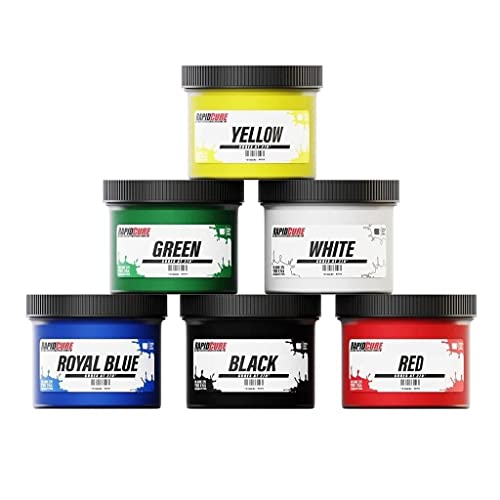




If you're building your screen printing setup from scratch, this six-color kit from Screen Print Direct is one of the most complete starting points you'll find. You get a full range of primary colors plus metallic and pastel options — all in 8 oz. jars — giving you enough to experiment, layer, and mix without ordering a dozen separate products. The kit is designed around the Rapid Cure formula, which means you're working with a low-temperature curing ink that activates at just 270°F, roughly 50 degrees lower than standard plastisol. That gap matters enormously when you're printing on athletic wear, fashion fabrics, or anything that can't handle sustained high heat.
The ink itself performs well on cotton, linen, polyester, and most common blends. Coverage is solid — you get a soft, tactile finish that feels intentional rather than stiff or plasticky. Colors are vibrant straight out of the jar, and they hold up through repeated washings without significant fading. The kit also carries a non-toxic, low-odor formulation, which is a genuine advantage if you're working in a home studio, garage, or shared creative space. You won't need a dedicated ventilation system just to open the jars.
Where this kit shows its nature as a beginner product is in the jar size. Eight ounces per color is enough to learn, practice, and complete small runs — but if you're producing any real volume, you'll exhaust these quickly. Experienced printers may also want to dial in viscosity more precisely than a starter kit allows. That said, for someone building skills and a small client base in 2026, this set delivers exceptional value and eliminates the guesswork of assembling a color palette from scratch. If you're comparing print consumables, our roundup of the best printers for stickers covers some overlapping territory worth bookmarking.
Pros:
Cons:
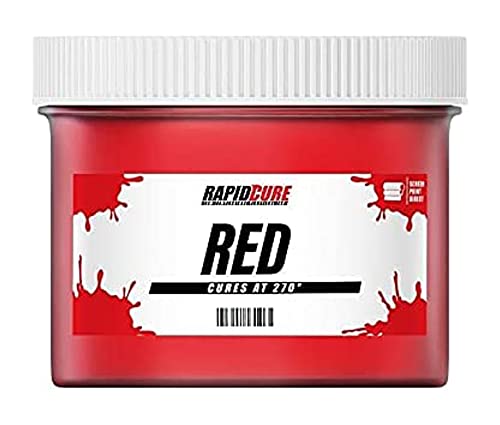
Red is one of the most technically demanding colors in screen printing. It tends to bleed into polyester fibers, loses opacity on dark substrates, and can look muddy when layered incorrectly. The Rapid Cure Red from Screen Print Direct addresses these issues directly. The ink is formulated with a short body — meaning it flows cleanly through the mesh without excessive smearing — and delivers high opacity that holds up on both light and dark fabric. The color itself is a bold, saturated red with no orange shift, which is harder to find than it sounds in this price range.
The low-temperature cure profile (270°F) is the defining feature. It means you can run this ink through a flash cure unit faster, increase your output speed, and reduce the risk of scorching lighter polyester blends that would normally require careful temperature management. The shelf life exceeds 12 months when stored properly, so buying in 8 oz. jars is workable even for shops with variable print schedules. This ink also handles heat transfer printing — you can use it for cold peel transfers if you need a versatile production option beyond direct-to-screen work.
For shops doing regular red-heavy work — sports uniforms, event merchandise, branded apparel — this ink punches above its price point. Layering is confident and predictable. You won't need to double-stroke to achieve opacity on white fabric, and on black fabric, a single flash-cured underbase brings out the red cleanly. The 8 oz. format is best suited for small runs or low-frequency use; if red is a core color in your lineup, the quart or pint options make more economic sense. But as a standalone purchase to evaluate the Rapid Cure system, this is the right entry point.
Pros:
Cons:
White ink is the most important color in your lineup — not because you print white designs, but because white is the underbase for almost everything else. A weak white ink means weak prints on dark garments, period. The Rapid Cure White delivers the kind of opacity you need for a functional underbase while curing at 50°F lower than standard plastisol formulas. That matters in real production: faster flash cure times mean faster cycle times, which means more shirts per hour without sacrificing print quality.

The ink has a short body that pulls cleanly off the mesh and sits flat on the garment surface. Coverage in a single pass is strong enough to use as a standalone white print on black or dark navy fabric, though high-detail designs will still benefit from a two-pass approach. The consistency is well-balanced — it's not so thick that you're fighting the squeegee, and not so thin that it spreads beyond your stencil edges. For both manual and automatic press setups, this ink responds predictably to standard squeegee pressures.
Where the 8 oz. format makes sense is for printers who use white occasionally — light garment print shops, custom one-offs, or side operations where a quart jar would sit half-used for months. If white is your primary underbase color and you're running production volumes, you'll want to step up to the quart. But for someone just learning to screen print and building up technique before committing to bulk inventory, this 8 oz. jar gives you enough material to develop your process without waste. The shelf life of 12-plus months means you won't lose the ink to premature drying in your cabinet.
Pros:
Cons:
Black ink is your workhorse. You'll use more of it than any other color in your shop, which is exactly why the pint format makes sense here. At 16 oz., this jar gives you twice the volume of the standard 8 oz. options while still fitting cleanly on a workbench or in a storage cabinet. The Rapid Cure Black from Screen Print Direct uses the same low-cure formula as the rest of the line — curing at 270°F instead of the standard 320°F — with the same short-body consistency that makes it straightforward to work with on both manual and automatic presses.
Black is where opacity matters most. A thin, transparent black looks gray on lighter fabrics and washed-out on colored garments. This ink covers in a single pass with enough density to print directly onto white, gray, and light-colored shirts without an underbase. On very dark garments, you can still use it as a top color over a white underbase — it layers cleanly without muddying the registration. The cure characteristics are consistent throughout the jar, which matters more than people realize; some cheaper inks separate and behave differently at the bottom of the container after sitting for weeks.
The pint size is the sweet spot for shops that do regular black printing but aren't at the scale where they're ordering gallons. You'll also appreciate the longer shelf life when you're not running production every single day. At this price and volume, the cost per print is genuinely competitive with buying bulk from specialty suppliers, especially when you factor in shipping on smaller orders. If you want to understand how this type of ink fits into a broader printing workflow, our review of the best pigment ink printers for 2026 offers useful context on how different ink types are used across substrates.
Pros:
Cons:
This is the same Rapid Cure White formulation reviewed in the 8 oz. entry above — same opacity, same 270°F cure temp, same short-body consistency — but at 32 oz., it's an entirely different purchase decision. If you're printing dark garments with any regularity, you will burn through white underbase ink faster than you expect. A quart jar gives you the volume to sustain real production without the constant interruption of reordering. For shops printing 50 to 300 shirts per week, the quart format is the correct default buy for white ink.
The performance at quart scale is identical to the smaller size — Screen Print Direct doesn't reformulate between volumes, and the consistency you experience in an 8 oz. jar is exactly what you'll get here. The ink pulls cleanly through standard mesh counts (typically 110–160 mesh for white underbase work), flashes quickly at low temperature, and builds a solid foundation for top colors. Color accuracy of the whites themselves is neutral without a yellow or blue cast, which matters when customers are expecting true white prints on athletic or fashion apparel.
Storage is straightforward. Keep the lid sealed between sessions and store at room temperature away from UV light. The 12-month shelf life holds at quart scale as it does at 8 oz. scale, so even a shop that doesn't run white every week won't lose the jar to waste. If you're scaling up your operation and thinking through all your print production tools, our guide on the best printers for waterslide decals covers adjacent decorating methods that often complement a screen printing setup. The quart white is simply the most cost-effective way to keep your underbase station stocked and your press moving.
Pros:
Cons:
Plastisol is the dominant ink type in professional screen printing because it's stable, durable, and forgiving across a wide range of conditions. But not all plastisol inks perform the same. Here's what actually determines whether an ink works for your application.
Standard plastisol cures at around 320°F. That's fine for 100% cotton but creates real risk for synthetic and blended fabrics. Polyester, especially performance or athletic fabric, can scorch, shrink, or dye-migrate at those temperatures. Low-cure inks like the Rapid Cure line (270°F) solve this problem directly — they fully polymerize at a lower temperature, which protects the fabric and reduces energy demand on your conveyor dryer or heat press. If your shop handles any volume of polyester-heavy garments, low-cure plastisol is a non-negotiable choice for 2026.
Dye migration is a separate but related issue. When polyester dyes bleed upward into white or light-colored ink layers during the cure cycle, you get a gray or pinkish cast in your prints. Low-bleed formulas in quality plastisols help minimize this. If you're printing on 100% polyester, you may still need a bleed-blocking underbase, but low-cure inks significantly reduce the risk.
Opacity is the ink's ability to cover the substrate beneath it. High-opacity inks are essential for printing on dark garments — they prevent the shirt color from showing through your design. Low-opacity inks are used deliberately for halftone work, vintage effects, or printing on white fabric where you want the ink to appear slightly translucent.
For most practical applications, you want a white underbase ink with maximum opacity and top colors that are opaque enough to hold their hue without excessive layering. The inks reviewed here lean toward higher opacity, which is the right call for commercial garment work. If you're doing process color printing or specialty techniques, you'll eventually need to expand your ink selection beyond the basics covered here — but for the majority of custom apparel production, high-opacity plastisol in your core colors is the right foundation.
Ink body refers to the viscosity and flow characteristics of the ink. A "short body" ink breaks clean when you lift the squeegee — it doesn't tail, string, or bleed past the stencil edges. A long-body ink flows more, which can be useful for certain specialty applications but is harder to control on a standard manual press.
The inks in this review all use a short-body formula, which is correct for most screen printing presses and mesh configurations. On an automatic press running high speed, short-body inks produce cleaner registration and more consistent results across long runs. On a manual press, they're simply easier to handle — less mess, less edge bleed, and more predictable squeegee behavior. If you're printing with a 110–160 mesh screen (the standard range for most garment work), these inks will respond exactly as expected without modification.
Buying the right quantity is a real cost decision. Buying too little means constant reordering and higher per-ounce costs. Buying too much means ink sitting on the shelf past its useful life. Plastisol inks are stable — they don't dry out or cure in the container the way water-based inks do — but they can separate or develop skin on the surface if containers aren't sealed properly between uses.
The Rapid Cure inks carry a shelf life of 12-plus months, which gives you flexibility. A general rule: buy white and black in the largest format your production level justifies. These two colors carry every job. Buy specialty and accent colors in 8 oz. jars until you've proven their frequency in your work. For related printing consumable decisions, our review of the best photo booth printers walks through similar volume-versus-cost tradeoffs that apply to any print production context. Scale your inventory to your actual print schedule, not your aspirations, and you'll spend less while wasting less.
Plastisol ink is a PVC-based ink suspended in a plasticizer. It doesn't contain water, which means it stays wet indefinitely in the container and only cures when exposed to heat. According to Wikipedia's screen printing entry, plastisol is the most commonly used ink in commercial textile printing because of its durability, color vibrancy, and predictable cure characteristics. The PVC particles fuse together when heated to the ink's cure temperature, creating a permanent bond with the fabric fibers.
Standard plastisol inks cure at 320°F (160°C). Low-cure formulas like the Rapid Cure line from Screen Print Direct cure at 270°F (132°C). The cure temperature is the threshold at which the ink fully polymerizes — at this point, it becomes permanent and wash-resistant. Undercuring (stopping below this temperature) leaves the ink tacky and vulnerable to cracking. You can verify a full cure with a wash test: run the print through a normal wash cycle and check for cracking or peeling.
Yes, but with care. Standard plastisol cured at 320°F can cause dye migration in polyester — the polyester dyes bleed into the ink layer, causing color shifts. Low-cure plastisols at 270°F significantly reduce this risk because the lower heat exposure gives the polyester dyes less energy to migrate. For 100% polyester, use a low-cure formula and consider a bleed-blocking underbase if you're printing bright colors on dark polyester garments.
When properly cured, plastisol ink prints are permanent. They won't wash out under normal laundering conditions and are designed to last the life of the garment. The key word is "properly cured" — an undercured print will crack, peel, or fade dramatically after just a few washes. A fully cured plastisol print maintains its color and adhesion through hundreds of wash cycles. This durability is one of the primary reasons plastisol dominates commercial garment printing in 2026.
You need a heat source capable of reaching the ink's cure temperature consistently. A conveyor dryer is the standard tool for production screen printing — it moves garments through a controlled heat zone at a set dwell time. A flash cure unit works for spot curing and underbase layers during printing. A heat press can cure plastisol prints for very low volumes. A household iron is unreliable and not recommended — temperature consistency matters, and a household iron doesn't maintain even, consistent heat across the full print area.
Plastisol inks are PVC-based, don't dry out in the screen, cure only with heat, and produce vibrant, durable prints with high opacity. Water-based inks use water as the carrier, can dry in the screen during printing (requiring misting or retarder additives), and cure at lower temperatures. Water-based prints are generally softer to the touch and are preferred for fashion applications or specialty techniques. Plastisol is more forgiving to work with and is the dominant choice for commercial volume printing. Your choice depends on the application, the fabric, and the feel requirement of the finished product.
The right plastisol ink doesn't just survive the wash — it makes every print look like you knew exactly what you were doing from the first stroke.


About Editorial Team
The DigiLabsPro editorial team covers cameras, lenses, photography gear, and creative technology with a focus on helping photographers make informed buying decisions. Our reviews and guides draw on hands-on testing and research across a wide range of equipment, from entry-level beginner kits to professional-grade systems.
You can get FREE Gifts. Or latest Free phones here.
Disable Ad block to reveal all the info. Once done, hit a button below
