You've spent an hour scrolling through filament listings, overwhelmed by acronyms like PLA-CF, PETG-CF, and PA6-CF20 — wondering if you even need carbon fiber or if it's just marketing hype. Sound familiar? Carbon fiber reinforced filaments are genuinely transformative for functional parts, but only when you match the right material to your printer and your project. The wrong pick can clog your nozzle, warp off the bed, or leave you with parts that are brittle where you needed flexibility.
In 2026, the carbon fiber filament market has matured significantly. You're no longer limited to exotic, printer-unfriendly materials. PLA-CF has become surprisingly beginner-friendly, while engineering-grade options like PC-CF and PA6-CF now print reliably on mid-range machines. Whether you're prototyping drone frames, printing jigs and fixtures, or just want that premium matte aesthetic on desktop models, there's an option here for you. These picks span price points, base materials, and skill levels — so you can find the right fit without guessing.
Before diving in, a quick note: carbon fiber filaments are abrasive. A hardened steel or ruby-tipped nozzle is highly recommended for any CF filament to avoid premature wear on brass nozzles. If you're new to specialty filaments, also check out our guide to the best glue for PLA — useful for post-processing and assembly once your prints are done. Now, let's get into the picks.
Contents







If you want the easiest entry point into carbon fiber 3D printing, the Polymaker PolyLite PLA-CF is where you start. It combines the forgiving print profile of standard PLA with genuine carbon fiber reinforcement — giving you noticeably stiffer, stronger parts without needing an enclosure or a heated chamber. Print temperatures in the 190–220°C range are standard for most FDM machines, so compatibility isn't a concern here. You get high rigidity and a beautiful satin-matte finish that makes prints look production-ready right off the bed.
Polymaker has put serious effort into quality control on this spool. The filament arrives vacuum-sealed with desiccant in a resealable zip-lock bag — a detail that matters because moisture kills CF filament performance fast. Dimensional accuracy is tight and consistent, which means fewer clogs and more reliable first layers. Bed adhesion is excellent with a PEI or glass bed at 60°C, and you won't fight warping the way you do with some engineering-grade materials. For prototyping brackets, enclosures, camera mounts, or any part that needs rigidity over toughness, this filament delivers a premium result at a reasonable price.
The one thing to know going in: like all CF filaments, it will wear down a brass nozzle faster than standard PLA. Use a hardened steel nozzle — ideally 0.4mm or larger — and you'll get consistent results over many kilograms. Retraction settings may need slight tuning to minimize stringing, but once dialed in, this is one of the most reliable CF filaments available in 2026.
Pros:
Cons:
ELEGOO has built a reputation for delivering solid performance at competitive prices, and their PLA-CF is no exception. This filament hits the key marks: tight dimensional accuracy at ±0.02mm, consistent feeding, and a cardboard spool that's eco-friendlier than standard plastic. The layer adhesion on this filament is notably strong, which means your functional parts won't delaminate under stress the way cheaper CF blends sometimes do. The surface finish is smooth and professional — you'll see minimal layer lines, even at standard 0.2mm layer heights.
What makes ELEGOO's PLA-CF stand out at this price point is how well it handles complex geometries. Overhangs print cleanly, bridges hold up without sagging, and the overall print quality rivals filaments that cost significantly more. Neatly wound spools mean you're not fighting tangling mid-print — a frustratingly common problem with lower-cost CF offerings. For makers who want to experiment with carbon fiber without committing to a premium price, this is one of the smartest buys of 2026.
Like all PLA-CF, this material is abrasive — a hardened nozzle is non-negotiable. It's also not the right choice for high-temperature applications since PLA's thermal performance tops out around 60°C. But if you're printing mechanical parts, cosplay props, or desktop functional models that won't see elevated heat, ELEGOO's PLA-CF punches well above its weight class.
Pros:
Cons:
If the aesthetic matters as much as the mechanical properties, eSUN's PLA-CF is worth a close look. The chopped carbon fiber — sourced from Germany, according to eSUN — creates an exceptional shine-free matte surface with a distinctive frosted texture that looks genuinely premium. Layer lines virtually disappear on finished prints, which is a real advantage for display models, props, or any part where appearance counts. The mechanical performance is solid too: high flexural modulus, good toughness, and noticeably less nozzle wear than PA-CF materials.
eSUN's PLA-CF is built on their mature PLA base, which means you get all the inherent PLA advantages — no enclosed chamber required, good dimensional stability, low shrinkage, and minimal moisture sensitivity compared to nylon-based alternatives. The "organic infiltrated" carbon fiber integration means the fibers distribute more evenly through the matrix, resulting in more consistent properties across the entire print rather than weaker spots at layer transitions. For fast printing workflows, this filament handles higher speeds without the stringing or blobbing issues that plague some CF blends.
It's worth noting that eSUN specifies no bubbles and high successful print rates — claims that hold up in real-world use. You'll want to dial in your retraction settings on the first print, but once tuned, this filament runs reliably. The winding quality is good, and the spool geometry prevents overlapping or tangling. If you're creating models where the finish quality matters — engineering displays, architectural models, or artistic functional pieces — eSUN's PLA-CF is the standout choice in this category.
Pros:
Cons:
When your parts need to survive heat that would destroy any PLA-CF option, polycarbonate carbon fiber is the answer. YXPOLYER's PC-CF uses a 15% carbon fiber ratio that's been carefully calibrated to hit the sweet spot between stiffness and toughness — too much CF and the material becomes brittle; too little and you lose the engineering advantage. At a heat deflection temperature of 140°C, this filament handles under-hood automotive environments, near-electronics enclosures, and any application where standard plastics would deform or fail.
What's genuinely impressive about this PC-CF is the self-supporting geometry capability. Complex overhangs and bridging that would require support structures with standard materials often print clean with YXPOLYER's formulation — the rigidity of the material works in your favor. It peels off support structures cleanly without residue, which saves post-processing time. The reusable high-heat tolerant spool is a thoughtful detail: you can safely dry the filament in the spool in an oven or dryer at elevated temperatures without warping the spool itself.
The trade-off is print complexity. PC-CF wants a print temperature of around 280°C for optimal layer adhesion, and an enclosure is strongly recommended to prevent warping and delamination. If your printer runs an all-metal hot end and an enclosed build chamber, this is a serious engineering-grade material that delivers industrial-quality results. For those still on standard Ender-style open-frame printers, a PLA-CF might be the more practical starting point. But if your setup can handle it, YXPOLYER PC-CF performs like materials that cost twice as much.
Pros:
Cons:
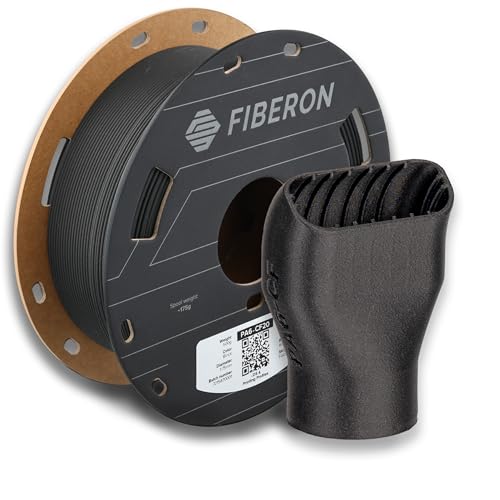
Nylon carbon fiber represents the top tier of FDM engineering materials — and Polymaker's Fiberon PA6-CF20 brings that level of performance to mainstream printers without the nightmare print profile that nylon usually demands. The 20% chopped carbon fiber content delivers exceptional stiffness, strength, and heat resistance in one package. With a Heat Deflection Temperature of 215°C (ISO 75, 0.45 MPa), it laughs at environments that would destroy PLA-CF and challenge PC-CF. Applications like drone frames, bicycle components, prosthetics, and industrial jigs aren't just possible — they're where this filament genuinely excels.
Polymaker's Fiberon line is specifically engineered for broad printer compatibility, which is a meaningful claim. Traditional PA-CF materials are notoriously finicky — moisture absorption ruins the print, warping pulls parts off the bed, and open-frame printers simply can't hold the environmental consistency these materials need. Fiberon PA6-CF20 addresses these pain points directly with a warp-free formulation that's been optimized for high-speed printing. If you want to understand more about how specialty filaments like this compare to standard materials in design workflows, our overview of the best tablet for Adobe Illustrator touches on how digital design tools support complex 3D-printed part design. The pairing of capable hardware and capable filament matters.
The spool is 0.5kg rather than the standard 1kg — something to factor into your cost-per-gram calculation. But for a material of this caliber, it's a reasonable way to test the filament on your specific printer before committing to a larger quantity. Store it in a sealed container with desiccant between sessions — nylon's moisture absorption is real, and wet filament will cause surface roughness and reduced mechanical properties.
Pros:
Cons:
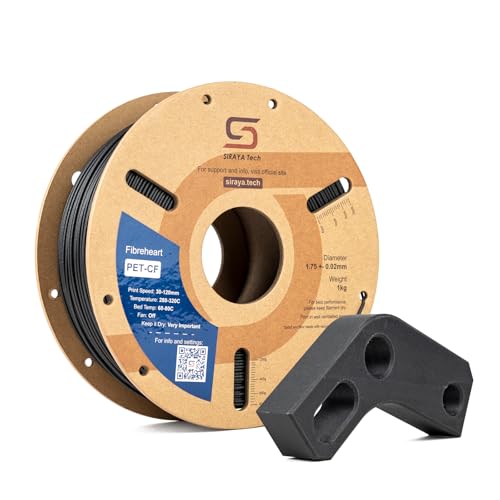
PET-CF sits in an interesting middle ground: more heat-resistant than PLA, less demanding than PC or nylon, and with dimensional stability that makes it genuinely useful for precision functional parts. Siraya Tech's Fibreheart PET-CF implements carbon fiber through a mesh skeleton structure within the PET matrix — this architecture significantly improves mechanical properties without making the material brittle. The result is a filament that prints without warpage, holds tight tolerances, and resists deformation under sustained load better than PA and PC alternatives according to Siraya's own testing data.
The aluminum foil sealed bag packaging tells you Siraya takes moisture management seriously — PET, while less hygroscopic than nylon, still benefits from controlled storage. Layer adhesion is described as "good interlayer adhesion," which in practice means your prints won't delaminate under stress, and the dimensional stability means parts that need to fit together actually do. For functional assemblies, enclosures, and precision mechanical components, PET-CF is often the overlooked sweet spot that gives you engineering-grade performance without engineering-grade print complexity.
Siraya Tech has a strong reputation in the resin printing community, and they've brought the same attention to material quality to their FDM filament line. The internal stress release mechanism that prevents warping is especially valuable if you're printing large flat parts or long beams that would normally lift at the corners. If nylon's moisture sensitivity frustrates you but PLA-CF doesn't have enough thermal headroom for your application, PET-CF is the gap-filler you've been looking for.
Pros:
Cons:
PETG-CF occupies a practical sweet spot for makers who want more abrasion resistance and strength than PLA-CF offers but prefer the print-friendliness of PETG over nylon or polycarbonate. NOVAMAKER's PETG-CF is reinforced with 20% carbon fiber, giving you a notable jump in stiffness and wear resistance compared to standard PETG. At print temperatures of 230–260°C and a bed temperature of 70–90°C, this filament works on most mid-range FDM printers without an enclosure — a significant usability advantage over PC-CF or PA-CF materials.
The claimed performance advantages hold up: clog-free feeding, minimal warping, and low stringing make this a genuinely low-drama print experience. PETG as a base material brings inherent toughness that pure CF materials sometimes sacrifice — you get rigidity from the carbon fiber combined with the impact resistance PETG is known for. This balance makes NOVAMAKER's PETG-CF particularly good for parts that need to survive drops, vibration, or repeated mechanical stress. Think enclosure panels, cable management clips, tool holders, and mechanical linkages.
At ±0.03mm dimensional accuracy, it's slightly less precise than the PLA-CF options above — but for most functional printing applications, that tolerance is more than adequate. The 2-pound (approximately 907g) spool gives you slightly less material than a standard 1kg, which is worth noting. Print speed can run up to 80mm/s without quality loss, making this a good option if you value throughput on larger print jobs. If you're looking to understand how this kind of material choice fits into broader creative workflows, the best screen printing ink guide offers a useful parallel on how material quality directly impacts output precision in creative production contexts.
Pros:
Cons:
Navigating the CF filament market in 2026 means understanding how base material, fiber content, and printer capability interact. Here are the key factors to evaluate before you buy. For a broader look at filament and material options across categories, our buying guide hub covers a wide range of products in depth.
The carbon fiber reinforcement in CF filaments improves stiffness and surface finish, but the base polymer sets the ceiling on thermal performance, chemical resistance, and print complexity. PLA-CF is the easiest to print — no enclosure, standard nozzle temperatures, forgiving profiles. PETG-CF and PET-CF step up thermal resistance modestly while remaining printer-friendly. PC-CF and PA6-CF20 push into true engineering territory with heat deflection temperatures of 140°C and 215°C respectively, but they demand enclosed printers and all-metal hot ends. Match the base material to your printer first, then to your application.
According to Wikipedia's overview of carbon-fiber-reinforced polymers, the primary mechanical benefit of short-fiber reinforcement in composites is increased tensile modulus and flexural rigidity — not raw tensile strength or toughness. This is important context: CF filaments make your prints stiffer, not necessarily tougher. If your part needs to flex and spring back without breaking, a non-CF flexible filament may be more appropriate than the stiffest CF blend.
CF filaments typically contain between 10% and 20% chopped carbon fiber by weight. Higher percentages deliver more stiffness but reduce elongation at break — the material becomes less forgiving under sudden impact. The Polymaker Fiberon PA6-CF20 uses 20% CF for maximum performance, while YXPOLYER's PC-CF uses 15% for a deliberate balance between stiffness and toughness. Fiber sourcing matters too: eSUN specifically calls out German-sourced carbon fiber for their PLA-CF. "Organic infiltrated" fiber distributions tend to produce more consistent mechanical properties than randomly distributed fiber in lower-quality blends.
This is the most overlooked purchasing consideration. Every single CF filament on this list is abrasive. A standard brass nozzle will wear out within a few hundred grams of CF filament, resulting in widening nozzle diameter, inconsistent extrusion, and eventual printing failure. Hardened steel nozzles (0.4mm minimum) are the standard recommendation. Ruby-tipped nozzles offer even longer lifespan and are worth the investment if you plan to print CF filaments regularly. Budget for the nozzle upgrade as part of your total cost when comparing options — it changes the true cost-per-kilogram calculation.
Carbon fiber filaments vary significantly in moisture sensitivity depending on the base material. PLA-CF is relatively tolerant of ambient humidity for short sessions. PETG-CF and PET-CF should be stored sealed with desiccant. PA-CF (nylon-based) is the most hygroscopic — even a few hours of exposure to normal room humidity can degrade print quality measurably. The difference between a wet and dry nylon-CF spool is audible (crackling from the hot end) and visible (surface roughness, bubbles). Invest in a sealed filament container or a dedicated filament dryer if you're working with engineering-grade CF materials regularly.
Yes, without exception. Carbon fiber particles in CF filaments are highly abrasive to soft metals like brass. A brass nozzle will show measurable wear within a few hundred grams of printing, leading to inconsistent extrusion and print failures. Hardened steel nozzles are the minimum recommendation, and ruby-tipped nozzles offer the longest service life. Treat the nozzle upgrade as a mandatory accessory cost when purchasing any CF filament — it's not optional if you want consistent results.
For PLA-CF, PETG-CF, and PET-CF, yes — open-frame printers handle these materials reasonably well. PLA-CF in particular is among the most printer-friendly CF materials available. For PC-CF and PA6-CF (nylon-based), an enclosure is strongly recommended to prevent warping and maintain thermal consistency. The all-metal hot end is also required for any filament printing above 240°C. Check your printer's maximum hot end temperature against the filament's recommended range before purchasing.
It's more accurate to say it's stiffer rather than stronger in all directions. Carbon fiber reinforcement primarily increases flexural modulus — resistance to bending and deflection — rather than raw tensile strength or impact toughness. A PLA-CF part will feel noticeably more rigid than standard PLA and resist bending under load better. However, it may be more brittle under sharp impact than standard PLA. For applications that need rigidity — brackets, frames, enclosures — CF filaments are excellent. For parts that need to flex and absorb impact, a toughened or flexible filament may serve better.
The Polymaker Fiberon PA6-CF20 is the standout choice for drone frames. Polymaker specifically lists drone frames as a target application, and the combination of 20% CF reinforcement, 215°C heat deflection temperature, and excellent toughness gives you the performance profile drone frames need. The warp-free formulation also makes it more accessible on mid-range printers than traditional PA-CF materials. If PA6-CF20 is beyond your printer's capabilities, YXPOLYER's PC-CF is a capable alternative with strong stiffness and decent thermal resistance.
Store CF filaments in a sealed container or zip-lock bag with fresh desiccant packets. The level of care depends on the base material: PLA-CF tolerates short ambient exposure reasonably well, but PETG-CF and PET-CF benefit from sealed storage after every session. Nylon-based CF filaments like PA6-CF20 are the most moisture-sensitive — they should be kept sealed at all times and dried before use if the spool has been exposed for more than a few hours. A dedicated filament dryer set to the manufacturer's recommended drying temperature is the most reliable long-term solution for frequent CF printing.
Most CF filaments print well at standard 0.2mm layer heights with 0.4mm hardened nozzles. For higher strength, a 0.3mm layer height can improve layer adhesion. Print speeds vary by material: PLA-CF handles 40–60mm/s comfortably; PETG-CF and NOVAMAKER's variant can push to 80mm/s; engineering-grade materials like PC-CF and PA6-CF typically benefit from slower speeds (30–50mm/s) for better layer bonding and dimensional accuracy. Always check the specific manufacturer recommendations first, as formulations vary between brands even within the same base material category.
Match the filament to your printer first, your application second — the best carbon fiber material in the world is useless if your hardware can't run it reliably.


About Editorial Team
The DigiLabsPro editorial team covers cameras, lenses, photography gear, and creative technology with a focus on helping photographers make informed buying decisions. Our reviews and guides draw on hands-on testing and research across a wide range of equipment, from entry-level beginner kits to professional-grade systems.
You can get FREE Gifts. Or latest Free phones here.
Disable Ad block to reveal all the info. Once done, hit a button below
