If you're serious about making stickers that actually look great — sharp edges, vivid colors, and ink that doesn't bleed or fade — the Epson SureColor P700 is the standout pick for 2026. It delivers professional-grade output that puts most home printers to shame. But it's not the only worthy option, and depending on your budget and workflow, one of the other printers in this guide might serve you better.
Printing stickers at home has become a legitimate alternative to ordering in bulk from print shops. Whether you're making custom labels for products, scrapbooking, planners, or just personalizing your gear, the right printer makes a huge difference. You need a machine that handles specialty media like sticker paper without jamming, lays down crisp detail, and uses ink that actually bonds to coated surfaces. That's a different set of priorities than your average office printer.
This guide covers seven of the best printers for stickers available in 2026, across a range of budgets and use cases. We've put together detailed reviews, a practical buying guide, and answers to the most common questions. Whether you're a crafter, small business owner, or someone who just wants to make a few custom stickers at home, there's a printer here for you. If you also print regular photos, you might find our roundup of the best printers for photographers useful for comparison.

Contents
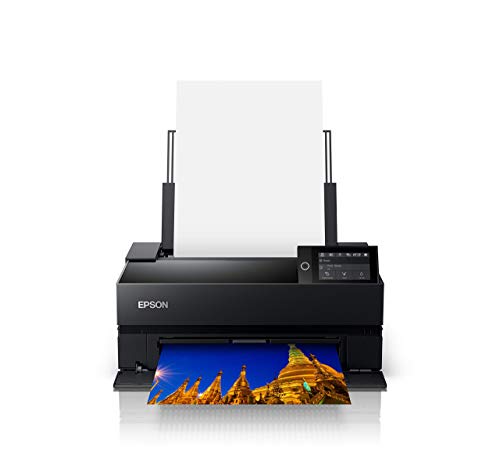





The Epson SureColor P700 is in a different league from most home sticker printers. It uses UltraChrome PRO10 ink with a dedicated Violet channel — that tenth color is what gives this printer its unusually wide color gamut (the full spectrum of colors it can reproduce). For sticker makers who need colors that pop — deep blues, vivid purples, accurate skin tones — the P700 delivers results that genuinely rival professional print shops. It handles media up to 13 inches wide, so you're not limited to standard sheet sizes.
What really separates the P700 from mid-range inkjets is the dual black ink system. Most printers have to switch between Photo Black and Matte Black ink depending on the paper you're using, which wastes ink and time. The P700 has dedicated nozzles for both — no switching, no purging, no waiting. If you print stickers on both glossy and matte sticker paper, this alone is worth serious consideration. The new 10-channel MicroPiezo AMC printhead also ensures extremely consistent ink drop placement, which translates to sharper text and finer detail on small sticker designs.
The trade-off? Price. This is a professional-grade machine, and it's priced accordingly. If you're making occasional stickers for personal use, it's probably overkill. But if you're running a small sticker business, selling on Etsy, or producing sticker sheets for planners and journals at any real volume, the quality and reliability justify the investment. Ink costs per page are also on the higher side for casual users, though the output quality is genuinely hard to match at home.
Pros:
Cons:
The Canon PIXMA TS9521Ca is a solid all-in-one option that balances print quality, scanning, and copying in a package that won't take over your desk. For sticker makers who also need to digitize hand-drawn artwork or scan reference materials, having a built-in scanner is genuinely useful. Setup is quick and straightforward out of the box, and the five individual ink tanks mean you only replace the color that runs out — no wasting a whole cartridge because one channel is empty.
Print speeds are respectable at approximately 15 pages per minute for black and 10 pages per minute for color. That's fast enough that you won't be sitting around waiting when you're running off a batch of sticker sheets. Wireless connectivity works reliably, and the interface is clean and approachable. Canon's app ecosystem also makes it easy to print from your phone or tablet, which is a real convenience if you design on mobile.
Where the TS9521Ca falls a bit short compared to dedicated photo printers is maximum output size and raw color depth. It's an excellent all-rounder for everyday sticker printing and crafting, but if you're chasing ultra-precise colors or printing large format sheets, you'll eventually hit its ceiling. For most casual sticker makers and crafters, though, it's more than capable and represents genuinely good value for what you get.
Pros:
Cons:
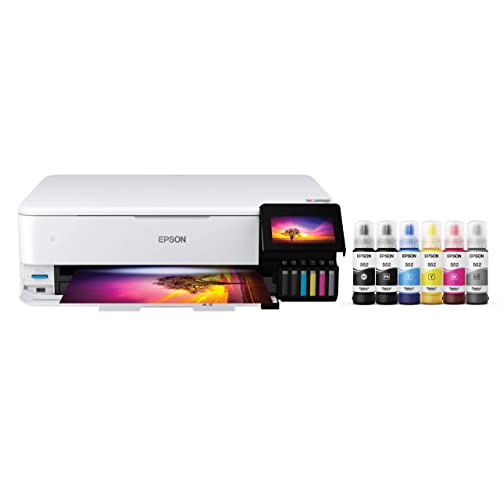
If you print stickers in any real volume and you're tired of constantly buying expensive ink cartridges, the Epson EcoTank Photo ET-8550 is worth a serious look. Instead of traditional cartridges, it uses refillable ink tanks — the "Supertank" system — that give you dramatically lower cost per print. Epson claims you can print 4×6-inch photos for about 4 cents each versus 40 cents with standard cartridges. Over time, that adds up fast, especially if you're printing full sticker sheets regularly.
Beyond the economics, the ET-8550 punches well above its price point on quality. The six-color Claria ET Premium ink system with Epson's high-accuracy printhead produces vivid, lab-quality results. It supports borderless printing up to 13×19 inches — genuinely wide format for a home printer — and can handle specialty media up to 1.3mm thick, which covers most sticker paper and cardstock you'd want to use. Auto duplex (two-sided) printing is a bonus for projects that need it, and the large 4.3-inch color touchscreen makes navigation easy.
The main friction point is the upfront cost. EcoTank printers are more expensive to buy than comparable cartridge-based models. You're essentially pre-paying for ink. If you print infrequently, the math doesn't work in your favor. But for regular sticker makers — say, anyone printing a few sticker sheets per week — the ET-8550 will likely pay for itself within a year. If you're also looking for a printer that handles zine-style prints or smaller format sticker rolls, check out our guide on the best Zink printers for a different approach to portable printing.
Pros:
Cons:
The Epson Expression Photo XP-8700 hits a sweet spot between quality and footprint. It's a compact all-in-one that doesn't sacrifice too much on image quality, thanks to its six-color Claria Photo HD ink system and a maximum print resolution of 5760×1440 dpi (dots per inch — essentially how fine the detail is). At that resolution, small text on sticker labels stays crisp, and gradient fills in artistic sticker designs look smooth rather than banded or blotchy.
Borderless printing up to 8.5×11 inches covers the most common sticker sheet sizes, so you can fill a full letter-size sheet without white borders ruining the look. The 4.3-inch color touchscreen is a genuine convenience — it's responsive and intuitive, and makes selecting media types or adjusting settings quick. Wireless connectivity and compatibility with Epson's mobile app round out a practical feature set for everyday use.
The XP-8700 does require Epson Genuine Cartridges, as the printing system is engineered around them — using third-party inks risks damage not covered under the warranty. That means ongoing ink costs are locked in. For someone who prints occasionally to moderately, that's manageable. If you're running a higher-volume sticker operation, you might find the per-page cost nudges you toward an EcoTank model instead. But for compact, quality-focused home sticker printing, the XP-8700 is a reliable daily driver.
Pros:
Cons:
The Canon PIXMA G620 takes a similar philosophy to the EcoTank — large refillable ink reservoirs instead of expensive cartridges — and applies it to a capable photo-quality printer. Canon's MegaTank system can yield up to 3,800 4×6-inch color photos on a full set of ink, which is an extraordinary volume for home printing. If you're making sticker sheets by the dozens, you'll spend a lot less time worrying about ink levels and a lot more time actually printing.
The Alexa integration is a genuinely useful touch. Connect the G620 to your smart home setup and you can receive ink-level alerts or even set up smart reorders through Amazon when supplies run low. No subscription required — it's optional convenience that some users will love and others will ignore entirely. The wireless setup is straightforward, and it works with Alexa-enabled devices seamlessly once configured.
Print quality is solid for sticker work. Colors are accurate and vivid, and the output handles the kind of fine-line detail that sticker designs often require. The trade-off compared to the Epson EcoTank ET-8550 is that the G620 tops out at letter-size printing (8.5×11 inches), so you can't do the 13×19-inch wide-format output that the Epson handles. But for the vast majority of sticker projects, that's not a limitation you'll hit. If you also want an AirPrint-compatible printer for printing from iPhone or iPad, this model supports it — see our best AirPrint printers guide for more options in that category.
Pros:
Cons:
The Canon IP8720 is an older model but still earns its place in this list thanks to one standout capability: it prints up to 13×19 inches at a price point well below the Epson SureColor P700. If you want to print large sticker sheets or banners without spending professional-printer money, the IP8720 is one of the few options that gets you there. The 6-color ink system includes a dedicated gray ink channel, which is particularly useful for achieving smooth gradients and accurate neutral tones in sticker artwork.
The maximum color resolution of 9600×2400 dpi is genuinely impressive on paper, and in practice it delivers photos and graphics with excellent detail and smooth color transitions. That level of precision is valuable for sticker designs with intricate patterns, fine lines, or photographic elements. Wireless printing over Wi-Fi works from any computer on your network, and AirPrint compatibility means iPhone and iPad users can print directly without extra apps.
The main thing to know going in is that this printer is print-only — no scanner, no copier. It's also a dedicated photo printer without duplex (two-sided) printing capability. If those features matter to you, you'll need to look at one of the all-in-one options in this guide. But if your priority is wide-format sticker output at a reasonable price, the IP8720 remains a capable and cost-effective choice in 2026.
Pros:
Cons:
The Epson Expression Premium XP-7100 rounds out this list as the most accessible entry point for sticker printing without completely sacrificing quality. It's a small all-in-one that handles print, copy, and scan, with a 30-page Auto Document Feeder (ADF) that's useful if you regularly scan multi-page artwork or reference sheets. Auto two-sided printing is included, which is handy for any project that needs content on both sides of the media.
Print quality is solid for a budget-friendly model. Superior photo quality output with sharp text means your sticker designs will look clean and professional, even if you're not working with a premium 10-channel ink system. The XP-7100 handles standard sticker paper sizes well and produces consistent results across a print batch. It's a dependable workhorse for moderate sticker production.
The printer is designed exclusively for Epson Genuine Cartridges, similar to the XP-8700, so third-party ink isn't a viable option without warranty risk. At lower volume use, the ink cost is manageable. The XP-7100 won't match the P700 or ET-8550 on sheer color depth or wide-format capability, but it's an honest, well-rounded choice for beginners or anyone who wants a capable sticker printer without a big upfront spend. For those considering other all-in-one setups, our list of best all-in-one printers for home use covers a wider range of options beyond photo-focused models.
Pros:
Cons:
Not every printer that makes great photos will make great stickers. Sticker media has its own quirks — coated surfaces, thicker stock, sometimes glossy or holographic finishes — and the printer you choose needs to handle those gracefully. Here are the key factors to weigh before you buy.
This is one of the most important decisions for sticker printing. Dye-based inks produce vivid, saturated colors with smooth gradients — excellent for bright, colorful sticker designs. The downside is they're more susceptible to fading over time and can bleed slightly on uncoated media. Pigment-based inks (used in printers like the SureColor P700) bond to media differently, offering better longevity and water resistance, but can look slightly less saturated on glossy paper.
For most home sticker makers using glossy sticker paper, dye inks work beautifully. If you're making stickers that need to last outdoors, in water, or under UV exposure — think product labels or outdoor decals — pigment inks or a UV-protective laminate over dye prints is the smarter call. The inkjet printing Wikipedia page has a solid breakdown of how dye and pigment systems differ at a technical level if you want to dig deeper.
Resolution is measured in dpi (dots per inch). For sticker printing, you generally want at least 1440 dpi to get crisp edges and readable fine text. Most of the printers in this guide exceed that. More color channels — meaning more individual ink colors beyond the basic CMYK (cyan, magenta, yellow, black) — let the printer reproduce a wider color gamut and more subtle tonal gradations. Six-color systems (adding light cyan and light magenta, or gray) deliver noticeably smoother results on photographic sticker designs compared to four-color systems.
Sticker paper comes in a variety of sizes and thicknesses. Check the printer's maximum media thickness — models that handle up to 1.3mm (like the ET-8550) accommodate thicker cardstock and specialty substrates without jamming. Maximum print size matters too: if you want to fill a full letter-size sticker sheet (8.5×11") you need a printer that supports borderless printing at that size. For larger sticker posters or oversized sheets, look at models that handle 13×17" or 13×19" media.
The sticker you see on the box is the purchase price — but the real cost of a printer is the ink. Cartridge-based printers often have a low upfront cost but higher per-page expenses. EcoTank and MegaTank models flip that equation: you pay more upfront but a fraction of the per-page cost over time. If you're printing sticker sheets a few times a month or more, the math typically favors a tank-based system within 12–18 months. If you print occasionally, cartridges are fine. Think about your realistic print volume before you decide.
Inkjet printers are generally the best choice for home sticker printing. They produce vivid colors on glossy and matte sticker paper, handle fine detail well, and support a wider range of specialty media than laser printers. Laser printers can work for simple stickers on certain media types, but inkjets give you more flexibility and typically better color quality for most sticker designs.
You don't necessarily need a special printer — most standard inkjet printers can handle printable sticker paper. What matters is that the printer supports the media thickness and finish you're using, and that you adjust your print settings to match the sticker paper type (usually "glossy photo paper" or "matte photo paper" in the print dialog). Some specialty media like holographic sticker paper may require a bit of trial and error with settings.
It depends on your use case. Dye inks produce more vivid colors and work beautifully on glossy sticker paper — great for indoor stickers, planner stickers, and decorative use. Pigment inks offer better longevity and water resistance, making them a smarter choice for stickers that will be used outdoors or exposed to moisture. Many home printers use dye inks, and for most everyday sticker projects they perform excellently.
Most printable sticker paper designed for inkjet printers will work with the models in this guide. However, you should always check the maximum media thickness your printer supports and match the paper type in your print settings. Avoid sticker paper that's thicker than your printer's limit, as it can cause jams or damage the paper feed mechanism. Look for sticker paper labeled "inkjet compatible" for the best results.
The easiest method is to laminate your stickers after printing with a self-adhesive laminate sheet, which creates a protective barrier against water and scratching. You can also use a clear acrylic sealant spray over the printed surface. Printers with pigment-based inks (like the Epson SureColor P700) produce more water-resistant prints natively, though a laminate is still recommended for stickers used in wet conditions. Choose a matte or glossy laminate to match the finish of your sticker paper.
An EcoTank printer uses large refillable ink reservoirs instead of small disposable cartridges. The upfront cost is higher, but the cost per page drops dramatically — Epson estimates about 4 cents per 4×6 photo compared to 40 cents with traditional cartridges. For sticker makers who print regularly, this adds up to significant savings over time. Standard cartridge printers cost less to buy but more to run. If you print infrequently, cartridges are the simpler choice; for regular sticker production, a tank system often makes more financial sense within a year or two.
You now have a clear picture of the best printers for stickers in 2026 — from professional-grade wide-format machines to budget-friendly all-in-ones. Take a look at your typical print volume, the kind of sticker projects you're planning, and how much you want to spend on ink over time, then pick the model that fits your real-world needs. Head over to Amazon, check current pricing on your top picks, and start printing stickers that actually look the way you imagined them.


About Editorial Team
The DigiLabsPro editorial team covers cameras, lenses, photography gear, and creative technology with a focus on helping photographers make informed buying decisions. Our reviews and guides draw on hands-on testing and research across a wide range of equipment, from entry-level beginner kits to professional-grade systems.
You can get FREE Gifts. Or latest Free phones here.
Disable Ad block to reveal all the info. Once done, hit a button below
