Which webcam actually looks good on a Mac in 2026? With so many options claiming "4K quality" and "Mac compatibility," picking the right one feels like a gamble. After comparing seven of the most popular models, the Logitech Brio 4K stands out as the best webcam for Mac overall — it delivers reliable 4K video, works flawlessly with macOS, and does not require any extra drivers to get started.
Mac users face a unique challenge: Apple's built-in FaceTime cameras have improved dramatically, so an external webcam needs to justify its existence. Whether you are streaming on Twitch, running Zoom calls all day, or creating content for YouTube, the right webcam transforms how you look on screen. The jump from a built-in 1080p sensor to a dedicated 4K camera with proper lighting correction is immediately noticeable — your skin looks natural, backgrounds stay sharp, and you stop looking like a shadow in low-light rooms.
We evaluated each webcam on image quality, low-light performance, Mac compatibility (plug-and-play matters), build quality, and overall value. If you are also shopping for a Windows setup, check out our best webcams for Windows 2026 guide. For now, here are the best webcams for Mac in 2026, ranked and reviewed in detail.

Contents







The Logitech Brio 4K is the webcam most Mac users should buy in 2026. It connects over USB-C, works immediately on macOS without any software installation, and delivers crisp 4K video at 30 frames per second. The autofocus is fast and accurate — it locks onto your face within a second and holds steady even when you lean forward or shift in your chair. Colors look natural out of the box, which matters when you do not have access to Logitech's Tune app features on Mac.
RightLight 3 technology is the real star here. It automatically adjusts exposure and contrast to handle tricky lighting situations. Sitting in front of a bright window? The Brio compensates so your face does not turn into a dark silhouette. Working in a dim room at night? It brightens the image without introducing excessive grain. This alone makes it more reliable than webcams that look great in perfect lighting but fall apart in real-world conditions.
The adjustable field of view gives you three preset options: 65°, 78°, and 90° diagonal. The 65° setting frames a clean head-and-shoulders shot perfect for professional calls. Bump it to 90° and you can show a whiteboard or include a second person in the frame. The 5x digital zoom is there if you need it, though like all digital zoom it trades resolution for magnification. Build quality is solid with a sturdy universal clip that grips both thin MacBook lids and chunky monitors without wobbling.
Pros:
Cons:
If you stream on Twitch or create YouTube content from your Mac, the Razer Kiyo Pro Ultra is built specifically for you. It packs a massive 1/1.2-inch Sony STARVIS 2 sensor — the largest sensor on any webcam in this roundup. Bigger sensors capture more light per pixel (each pixel measures 2.9 μm), and the difference is obvious. Your image looks closer to a DSLR camera than a typical webcam. Skin tones are rich, backgrounds have a natural depth-of-field blur, and fine details like hair texture and fabric patterns come through cleanly.
The custom F/1.7 aperture lens is a huge deal for streamers who record in bedrooms or basement setups. This webcam handles low light better than anything else on this list. Where other webcams crank up digital gain and introduce ugly noise, the Kiyo Pro Ultra keeps the image clean and well-exposed. The AI-powered face tracking holds focus on your face and automatically adjusts brightness as lighting changes — move your desk lamp and the webcam adapts in real time without blowing out highlights.
On Mac, the Kiyo Pro Ultra works out of the box with OBS, Zoom, and FaceTime. Razer Synapse (the configuration software) has macOS support, so you get access to HDR toggles, field-of-view adjustments, and image tuning. The physical privacy shutter is a nice touch for security-conscious users. The downside? This is a large, heavy webcam that looks a bit imposing on top of a MacBook screen. It is clearly designed for a desktop monitor setup.
Pros:
Cons:
The Elgato Facecam 4K is the webcam for people who want total control over how their video looks. It shoots 4K at 60 fps — the only webcam in this roundup that hits that mark — which means buttery smooth motion whether you are streaming gameplay or recording tutorials. The Sony STARVIS 2 CMOS sensor paired with Elgato's Prime Lens technology produces sharp, vibrant images with accurate colors right out of the gate.
What sets this webcam apart is the Camera Hub software, which gives you DSLR-level control over your image. You can adjust ISO (sensor sensitivity to light), shutter speed, white balance, saturation, and contrast manually. Want a warm, cinematic look? Dial it in. Prefer a clean, neutral image for professional calls? That is a few clicks away. Camera Hub works fully on macOS, which is a relief since many webcam apps treat Mac as an afterthought. The 49mm lens filter thread is a unique feature — you can attach ND filters (neutral density, which reduce light intake) or diffusion filters for a softer look.
The Facecam 4K sends uncompressed video over USB-C, which means your Mac processes the raw feed rather than receiving a pre-compressed stream. This gives you better quality in OBS and streaming software, but it does require a bit more CPU power. On an M1 MacBook Air or newer, you will not notice any performance hit. The HDR mode adds dynamic range in high-contrast scenes. If you are the type who fine-tunes every visual detail in your stream, this is your webcam. If you want something you just plug in and forget about, look at the Logitech Brio instead.
Pros:
Cons:
The Insta360 Link 2 does something no other webcam on this list can do: it physically moves to follow you. The PTZ (pan-tilt-zoom) gimbal tracks your face using AI and smoothly rotates the camera to keep you centered in the frame. Stand up from your desk, walk to a whiteboard, sit back down — the Link 2 follows the entire time without jerky movements or losing focus. For teachers, presenters, and anyone who moves during calls, this is a game-changer.
The 1/2-inch sensor delivers excellent 4K video with HDR support, and the Phase Detection Auto Focus (PDAF) is the fastest autofocus system in this roundup. Hold a product up to the camera and it snaps into focus almost instantly — no hunting or pulsing. The AI noise-canceling microphone does a solid job filtering out keyboard clicks, air conditioning hum, and background chatter. It is not studio-quality audio, but it is better than most built-in webcam mics.
Gesture control adds another layer of convenience. Wave your palm to trigger zoom, make a "V" sign to switch between tracking modes. It sounds gimmicky until you are mid-presentation and need to switch from face-tracking to overhead desk view without touching your mouse. The Insta360 Link Controller app works on macOS and gives you manual control over tracking sensitivity, zoom level, and image settings. The biggest limitation is the gimbal itself — it adds height and bulk, and the motorized movement produces a faint whirring sound that sensitive microphones might pick up.
Pros:
Cons:
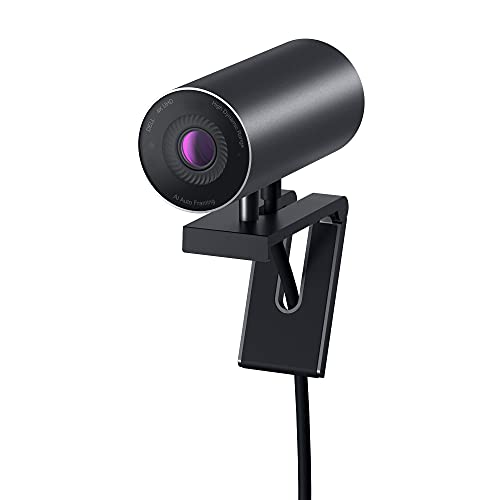
The Dell UltraSharp WB7022 is the most understated webcam on this list, and that is exactly the point. It is designed for professionals who need to look polished on Zoom, Teams, and Google Meet without fiddling with settings. The cylindrical aluminum body is compact and discreet — it sits on top of a monitor and blends in rather than screaming "gamer webcam." The 4K Sony STARVIS CMOS sensor produces sharp, color-accurate video that makes you look like you are in a well-lit conference room even when you are in a spare bedroom.
AI Auto Framing is the standout feature for business users. It keeps you centered in the frame and automatically adjusts the crop as you move. Lean back in your chair and the frame widens slightly. Lean forward and it tightens to a headshot. This happens smoothly enough that viewers on the other end barely notice — you just always look properly framed. The three field-of-view options (65°, 78°, 90°) give you control when you want it, but most users set it to auto and forget about it.
Dell's Peripheral Manager app works on macOS and lets you tweak brightness, sharpness, contrast, saturation, and zoom level. The HDR mode helps in mixed-lighting offices where overhead fluorescents fight with window light. If you use a Dell monitor with a built-in USB-C hub, cable management is clean — one cable from the webcam to the monitor, one cable from the monitor to your Mac. The webcam does not include a built-in microphone, which Dell assumes business users do not need since most will use a headset or external mic. For a deeper look at video calling setups, see our guide to the best webcams for video conferencing in 2026.
Pros:
Cons:
Not everyone needs 4K. The Anker PowerConf C200 shoots at 2K resolution (2560×1440 pixels), which is a noticeable step up from the 1080p cameras built into most Macs and costs a fraction of what the premium options on this list demand. For daily Zoom calls, Google Meet sessions, and casual streaming, 2K is more than enough — especially since most video calling platforms compress the signal to 1080p or lower anyway.
The built-in stereo microphones with AI noise cancellation are surprisingly capable for the price. They do a good job of isolating your voice from background noise like typing, pets, and household commotion. You will not get podcast-quality audio, but for meetings where you do not want to wear a headset, they work well. The built-in privacy cover is a physical slider — no software workaround, no LED indicator you have to trust. Slide it closed and the lens is physically blocked. Simple and effective.
Low-light performance is decent but not exceptional. The sensor handles dimly lit rooms better than a built-in MacBook camera, but it cannot compete with the larger sensors in the Razer Kiyo Pro Ultra or Dell UltraSharp. The adjustable field of view is a welcome feature at this price point — you can narrow the angle for a tight headshot or widen it to include your surroundings. Mac compatibility is plug-and-play: connect the USB cable, and macOS recognizes it immediately. No app required, though Anker's AnkerWork software is available for Mac if you want to fine-tune settings. If you are setting up a laptop webcam for the first time, this is the most wallet-friendly way to upgrade.
Pros:
Cons:
The Logitech MX Brio 705 is not really a consumer webcam — it is an enterprise tool that happens to produce excellent video. The "for Business" label means it is certified for Microsoft Teams, Zoom, and Google Meet, which guarantees that features like auto-framing and Show Mode work correctly within those platforms. If your company's IT department manages devices through Logitech Sync, this webcam can be configured, updated, and monitored remotely — a big deal when you are provisioning webcams for 200 remote employees.
The image quality matches the consumer Logitech Brio 4K. The advanced image sensor and custom lens deliver true 4K Ultra HD video with accurate colors and smooth autofocus. Show Mode is a unique feature that lets you point the camera downward to share documents, notebooks, or physical products on your desk — essentially turning the webcam into a document camera. Auto Light Correction handles the full range of home office lighting situations without requiring manual tweaks.
Security features set this apart from consumer alternatives. The secure boot design prevents unauthorized firmware modifications, which matters in regulated industries like healthcare and finance. Logitech Sync gives IT admins a dashboard to push firmware updates, lock settings, and verify that webcams across the organization are running approved configurations. For individual buyers, these features are overkill. But if you are recommending webcams for a business, the MX Brio 705 simplifies deployment and management. It works with macOS, Windows, and ChromeOS, so mixed-platform offices are covered. For webcam software recommendations that pair well with this hardware, we have a separate guide.
Pros:
Cons:
Resolution determines how sharp your image looks. A 4K webcam (3840×2160 pixels) captures four times the detail of a 1080p camera. But resolution alone does not tell the whole story — frame rate matters too. A webcam shooting 4K at 30 fps looks sharp but can appear slightly choppy during fast movements. Bump down to 1080p at 60 fps and motion looks silky smooth. For most Mac users on video calls, 1080p at 30 fps is the minimum you should accept in 2026. Streamers and content creators benefit from 4K at 30 fps or 1080p at 60 fps, depending on whether they prioritize detail or smoothness.
Keep in mind that video calling platforms compress your feed. Zoom maxes out at 1080p even on paid plans. Teams and Google Meet have similar caps. So while your 4K webcam captures stunning detail, your colleagues might only see a compressed 1080p version. The 4K advantage shows up in local recordings, streaming to Twitch (which supports higher resolutions), and future-proofing as platforms upgrade their limits.
The image sensor is the chip inside the webcam that converts light into a digital picture. Bigger sensors capture more light, which directly translates to better image quality — especially in dim rooms. Sensor size is measured in fractions of an inch. The Razer Kiyo Pro Ultra's 1/1.2-inch sensor dwarfs the typical 1/4-inch sensor found in budget webcams. A larger sensor means less digital noise (the grain you see in dark footage), more accurate colors, and a natural background blur that makes you stand out from your surroundings.
If your home office has good overhead lighting and a window, sensor size matters less — most webcams perform well with plenty of light. But if you take calls in the evening, work in a basement, or rely on a single desk lamp, invest in a webcam with a larger sensor and a wide aperture (the f-number on the lens). Lower f-numbers like F/1.7 let in more light than higher numbers like F/2.8. According to Wikipedia's overview of image sensor technology, sensor size remains the single most impactful factor in camera image quality across all device categories.
Every webcam on this list works with macOS, but "works" has different levels. True plug-and-play means you connect the USB cable and your Mac recognizes the webcam immediately — no drivers, no software downloads, no restarts. All seven webcams here achieve this basic level. The difference is in the companion software. Logitech Tune, Elgato Camera Hub, Razer Synapse, and Insta360 Link Controller all offer macOS versions, but feature parity with Windows varies. Some settings that are available on Windows might be grayed out or missing on Mac.
USB connectivity matters too. Newer MacBooks only have USB-C/Thunderbolt ports. Webcams with a USB-C cable connect directly. Webcams with USB-A cables need a dongle or hub, which adds cost and another potential point of failure. Check whether the webcam includes a USB-C cable in the box or if you need to buy one separately. For a more complete guide to webcam setup, including software configuration, check out our buying guide hub.
You will use your webcam every day, so build quality matters more than you might think. Cheap plastic webcams develop loose hinges after months of adjusting. Premium webcams use metal housings and sturdy clip mechanisms that hold their position. The mounting clip design determines how well the webcam sits on your display. MacBook screens are thin — not every webcam clip accommodates that. Desktop monitors are thicker and more forgiving. If you switch between a MacBook and an external display, look for a webcam with an adjustable clip that handles both.
Weight affects stability. Heavier webcams like the Razer Kiyo Pro Ultra stay put on a monitor but can tip a lightweight laptop screen backward. Lighter webcams are more portable but may feel less premium. Some webcams include a standard 1/4-inch tripod thread on the bottom, which lets you mount them on a desk tripod or boom arm for precise positioning. If your setup involves multiple camera angles for streaming, that tripod thread becomes essential.
Yes, all seven webcams in this roundup are plug-and-play compatible with macOS. You connect the USB cable and your Mac recognizes the webcam as a video input device immediately. You do not need to install drivers. However, to access advanced features like manual exposure control, custom presets, and firmware updates, you will want to install the manufacturer's companion app — Logitech Tune, Elgato Camera Hub, Razer Synapse, or the equivalent.
For live video calls, the honest answer is that you will not see the full 4K benefit because Zoom caps at 1080p and Teams has similar limits. However, 4K webcams still look better on these platforms because they start with more detail and the downscaled 1080p feed looks sharper than a native 1080p capture. You also get the 4K advantage when recording locally, streaming on Twitch, or creating YouTube content where the full resolution is preserved.
The Elgato Facecam 4K and Dell UltraSharp WB7022 intentionally omit built-in microphones. The reasoning is that serious streamers and professionals already use dedicated USB microphones, headsets, or lavalier mics that deliver far superior audio quality. By skipping the mic, these webcams can focus their engineering budget entirely on image quality. If you do not own a separate microphone and do not want to buy one, choose a webcam with built-in mics like the Logitech Brio 4K or Anker PowerConf C200.
USB webcams are designed for macOS on MacBook, iMac, Mac Mini, and Mac Pro computers. They do not work when plugged directly into an iPad or iPhone, even with a USB-C adapter. Apple's Continuity Camera feature actually works the opposite direction — it lets you use your iPhone as a webcam for your Mac. If you need a camera for an iPad, you are limited to the built-in front-facing camera or specialized apps that can use a connected iPhone.
Sensor size makes a dramatic difference in low-light performance and overall image quality. A webcam with a 1/1.2-inch sensor like the Razer Kiyo Pro Ultra captures roughly four times more light than a webcam with a 1/4-inch sensor. In a well-lit room, you might not notice the difference. But in typical home office lighting — a desk lamp, some window light, maybe overhead LEDs — the larger sensor produces noticeably cleaner, more natural-looking video with less grain and more accurate colors.
The Anker PowerConf C200 is the clear budget winner. It shoots at 2K resolution, includes built-in stereo microphones with AI noise cancellation, has a physical privacy cover, and works immediately on Mac with no software required. You give up 4K resolution and the superior low-light performance of premium options, but for daily video calls and casual use, the C200 delivers excellent quality at a price point that makes the 4K competition look excessive.
Buy for the lighting you actually have, not the lighting you wish you had — the best Mac webcam is the one that makes you look great in your real room, right now.


About James W.
A contributing writer at DigiLabsPro covering photography gear reviews, buying guides, and camera comparisons. Specializes in evaluating cameras, lenses, and accessories for photographers at the intermediate and enthusiast level looking to upgrade their kit.
You can get FREE Gifts. Or latest Free phones here.
Disable Ad block to reveal all the info. Once done, hit a button below
