You've spent an hour comparing specs on a dozen different scanners, and you still can't tell whether a 600 dpi sheetfed unit will handle your architectural drawings or whether you actually need a flatbed. Large format scanners are expensive, the category is genuinely fragmented, and buying the wrong one means either returning a heavy piece of equipment or living with a scanner that doesn't fit your workflow. This guide cuts through the noise so you can make a confident call in 2026.
Large format scanning covers everything from digitizing A3 engineering plans and legal documents to preserving original artwork, maps, and photographic prints. The scanners in this roundup range from compact A3 flatbeds under $500 to professional wide-format sheetfed units used in reprographics studios. Whether you're scanning one map a week or processing hundreds of technical drawings a day, there's a specific machine built for your volume and media type. Understanding where your use case falls is the first step — and that's exactly what this guide covers.
We've reviewed seven of the most capable large format scanners available in 2026, covering flatbed and sheetfed designs, consumer-to-professional tiers, and both document-focused and image-focused models. If you're also looking at smaller options, our best 11×17 scanner guide and best portable scanner printer combos round out the picture for compact and portable setups. For a broader overview of what to look for before spending, visit our complete buying guide.
Contents







If you're scanning original artwork, photographic prints, or high-resolution film, the Epson Expression 12000XL-GA is the flatbed most professionals reach for first. It handles reflective media up to 12.2" × 17.2", which means you can drop a full A3 sheet directly on the glass without cropping. The 2400 × 4800 dpi optical resolution is genuinely impressive — you're capturing detail at a level most commercial labs charge a premium for. Epson's micro step drive technology keeps the scan head moving smoothly, eliminating the banding artifacts that cheaper flatbeds struggle with at high resolutions.
The headline specification here is the 3.8 Dmax, which measures the scanner's ability to extract shadow detail from dense negatives and dark photographic prints. Most consumer flatbeds sit around 3.0 Dmax — the difference when you're scanning a dark landscape transparency or a black-and-white print is immediately visible. The ColorFi II imaging system pairs that optical depth with a fast-warmup LED lamp, so you're not waiting two minutes for the lamp to stabilize before your first scan. Epson's MatrixCCD technology processes color data in a way that avoids the color channel misalignment you sometimes see in lower-quality scanners.
On the practical side, this is a desk-sized piece of equipment — it's not light, and it deserves a dedicated surface. Setup is straightforward with bundled software that includes Epson Scan 2 and SilverFast SE Plus for more advanced users. It works on both Windows and macOS. Noise levels and vibration are minimal, which matters if you're scanning in a quiet studio environment. If you're scanning transparencies or negatives regularly, the optional transparency unit extends the 12000XL's usefulness considerably. For photographers and artists who need the absolute best flatbed quality at this size class, this is the benchmark.
Pros:
Cons:
The Contex SD One+ is built for a very specific job: scanning wide-format documents — blueprints, architectural drawings, site maps, technical schematics — quickly and accurately. At a 24-inch scan width with 600 dpi optical resolution, it handles the kinds of media that a standard flatbed simply can't accommodate. If you're working in an engineering firm, a reprographics shop, or an architecture office, this is the category of scanner that belongs on your workflow shortlist in 2026. Contex has been making wide-format scanners for decades, and that experience shows in the hardware design and firmware stability.
Sheetfed operation means documents feed through the scanner rather than resting on a glass platen. That's a fundamental trade-off: you can process large documents without needing a deep flatbed surface, but fragile or bound originals aren't a good fit. For flat, loose technical prints in good condition, the sheetfed design is actually a productivity advantage — you can process stacks of drawings far faster than opening and closing a flatbed lid for each one. The SD One+ connects via USB and integrates with standard TWAIN-based scanning software, so dropping it into an existing document management workflow is relatively painless.
Color accuracy at 600 dpi is more than sufficient for technical line drawings and reproductions where dimensional accuracy matters more than photographic fidelity. The compact footprint relative to its scan width is a genuine selling point — this scanner takes up far less floor space than older wide-format drum or flatbed alternatives. If your office regularly deals with D-size or E-size drawings and you're tired of folding them down to fit a standard scanner, the SD One+ resolves that frustration directly. Contex's support and driver ecosystem is well-regarded in professional reprographics circles.
Pros:
Cons:
The Epson DS-50000 occupies a practical middle ground: it's a professional-grade flatbed scanner built specifically for office document digitization at up to 11.7" × 17" — true A3 size. Unlike the 12000XL-GA, which is optimized for fine art and photographic media, the DS-50000 is designed around document throughput, compliance scanning, and institutional workflows. It ships with both TWAIN and ISIS drivers, which is a meaningful detail if your organization runs document management software that requires ISIS compatibility — many enterprise systems do, and not every scanner supports it.
The 4-line CCD sensor — covering red, green, blue, and black channels independently — is the technical core of this scanner's image quality. That fourth black channel gives you noticeably crisper text reproduction compared to RGB-only sensors, which matters when you're scanning contracts, legal filings, or any document where OCR accuracy downstream depends on clean line edges. Epson has positioned this scanner toward organizations with real liability around document quality, and the 3-year limited warranty with Advance Exchange and free next-business-day replacement reflects that. If the scanner fails, Epson ships a replacement before you return the defective unit — downtime stays minimal.
Speed isn't the DS-50000's primary selling point; this is a flatbed, not an ADF document feeder. But for the A3 format range, it delivers consistent, repeatable results with minimal operator effort. The build quality is solid and the software stack — including Epson Document Capture Pro — is mature and well-documented. If your organization digitizes large-format contracts, maps, architectural approvals, or oversized legal documents on a regular basis and needs a scanner that's going to stay running reliably for years, the DS-50000 makes a strong case. Pair it with good OCR software and you have a complete digitization workstation.
Pros:
Cons:
The Contex HD iFLEX approaches wide-format scanning from a different angle than the SD One+. Where the sheetfed SD One+ excels at processing flat technical documents in volume, the HD iFLEX is a flatbed design — meaning you can place fragile, bound, or irregular originals on it without feeding them through a transport mechanism. That distinction matters enormously if you're working with aged architectural drawings, hand-illustrated maps, oversized photographs, or any original document where mechanical transport would risk damage. Flatbed large-format scanners are inherently gentler on originals, and the HD iFLEX is one of the more capable options in that niche.
Contex's HD imaging technology is engineered for high-fidelity color reproduction across the full scan width — this scanner is used in museums, archives, and reprographics operations where color accuracy is a non-negotiable requirement. The wide-format flatbed form factor is less common than sheetfed alternatives because it's more mechanically complex and expensive to build well, and Contex is one of the few manufacturers that has consistently produced reliable hardware in this category. The iFLEX's scan head delivers consistent illumination across the full document width, avoiding the edge darkening that lower-quality wide flatbeds sometimes exhibit.
If you're considering the HD iFLEX, you're almost certainly working in a professional or institutional context — this is not a consumer purchase. The integration with wide-format workflow software is thorough, and Contex's driver and support ecosystem is among the most mature available for this type of equipment. For organizations that need to scan oversize originals that cannot be fed through rollers — posters, artwork reproductions, historical documents — the HD iFLEX fills a gap that no sheetfed scanner can. The investment is significant, but for the right use case, there's no reasonable substitute.
Pros:
Cons:
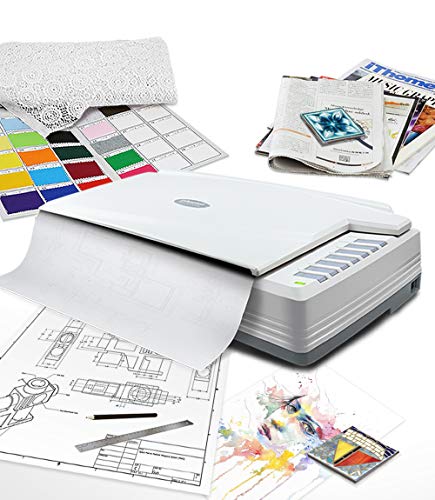
Not every office needs a five-figure reprographics solution. If your large-format scanning needs are moderate — occasional A3 documents, maps, bound books, or oversized forms — the Plustek OpticPro A320E delivers genuine value at a fraction of the cost of professional-tier options. The 12" × 17" scan area covers the A3 footprint comfortably, and the CCD sensor produces better image quality than the CMOS sensors used in many budget flatbeds. A 7.8-second scan speed at 300 dpi means you're not waiting painfully long between pages, which is a real workflow consideration when you're processing a stack of mixed documents.
The Doc Action software bundled with the A320E makes file management straightforward — you can scan directly to PDF (including searchable PDF via the built-in OCR function), send to email, push to FTP, or save to a Windows Public Folder. For small businesses and home offices that occasionally need to digitize large documents, that one-click workflow removes a lot of friction. Batch scanning is supported, so you can queue multiple images and save them as a multi-page PDF. The A320E is ICA and TWAIN compliant, which gives you broad compatibility with third-party scanning software on both Windows and Mac.
Where the A320E shows its budget positioning is in build quality and depth of image processing. The Dmax is lower than professional flatbeds, meaning shadow detail in dense prints or negatives won't be as well-recovered. It's not the right tool for fine art scanning or archival photography work. But for digitizing A3 contracts, engineering sketches, oversized forms, or large book pages, it performs reliably and costs significantly less than the competition. If you're exploring the large-format category and aren't sure you need professional-grade output, the A320E is a sensible entry point. You might also find our best pen scanner roundup useful if you need a companion device for quick on-the-go document capture.
Pros:
Cons:
The Fujitsu fi-7600 is a different kind of large-format scanner than the flatbeds and wide-format sheetfeds described above. It's an ADF-based document scanner built to handle A3 landscape documents — meaning oversized paper, legal-size sheets, and large portrait documents — at serious speed. Up to 100 pages per minute in color or monochrome positions this squarely in the enterprise document processing category. If your organization needs to digitize stacks of mixed documents, contracts, invoices, or large-format administrative records as quickly as possible, the fi-7600 is what a production environment actually looks like.
The 300-sheet paper chute capacity is the operational detail that changes daily workflow calculations. You load a large batch, walk away, and come back to finished scan files. The fi-7600 handles a wide variety of paper thicknesses and media types, including plastic card envelopes and long-page documents. Fujitsu's PaperStream IP image processing software is mature and genuinely useful — it includes automatic color detection, blank page removal, deskew, and de-punch capabilities that reduce the post-processing workload considerably. The fi series is one of the most widely deployed scanner families in enterprise environments for a reason.
Where the fi-7600 is not the right fit is in scenarios requiring flatbed-style scanning of artwork, photographs, or oversized prints wider than A3 landscape. This is a document throughput machine, not an image quality benchmark. Color reproduction is accurate and consistent for documents, but you're not going to use it to archive oil paintings. For the specific job of high-speed, high-volume large-format document digitization, however, the fi-7600 is one of the most reliable platforms available in 2026. Fujitsu's support and warranty programs for the fi series are well-regarded by IT and records management departments.
Pros:
Cons:
The Canon ImageFormula DR-6030C is a professional A3 ADF scanner that earns its place on this list through a combination of color accuracy and build reliability. Canon's CIS sensor technology in the DR-6030C is optimized for color documents — marketing materials, color-coded engineering documents, illustrated reports — where accurate hue reproduction matters as much as text sharpness. The A3 scan width handles most large-format document needs outside of true wide-format architectural work. For organizations that deal in mixed-color document archives, it's a credible alternative to the Fujitsu fi-7600.
The DR-6030C's duplex scanning capability means you can process two-sided A3 documents without manual flipping, which is a real time saver when working through large archives of double-sided prints. Canon's CapturePerfect software handles batch scanning, file routing, and basic image enhancement, and the scanner integrates with most major document management systems via TWAIN. Color consistency across long scan runs is one of the DR-6030C's genuine strengths — the sensor maintains accurate color from the first sheet to the last in a batch, which is harder to guarantee in lower-cost alternatives.
The DR-6030C is an older model in Canon's lineup, and that shows in some areas — notably the scanning speed, which is competitive but not at the top of the 2026 market. Driver support is stable on Windows, though macOS compatibility should be confirmed for your specific OS version before purchasing. The physical build is solid and designed for office environments rather than production floors. If you need reliable, color-accurate A3 document scanning with a proven track record and you don't need the absolute fastest throughput available, the DR-6030C delivers consistent results without surprises. It pairs well with a good document management setup, and if you're building out a full printing and imaging station, our best multifunction printer guide covers complementary output devices worth considering.
Pros:
Cons:
Large format scanners span an unusually wide range of designs, price points, and intended applications. Before you focus on specifications, it helps to get clear on what you're actually scanning — because the best scanner for digitizing original artwork is a completely different machine from the best scanner for processing hundreds of A3 contracts per day. The following criteria will help you map your specific requirements to the right category of hardware.
The single most important distinction in large format scanners is the transport mechanism. Flatbed scanners place documents or objects on a stationary glass platen, making them the safest option for fragile, bound, or delicate originals — artwork, photographic prints, aged documents, and irregular objects. The trade-off is that they're slower for high-volume work and typically max out around A3 or 12" × 17" in the consumer-to-professional tier.
Sheetfed and ADF scanners move documents through rollers, enabling much faster batch processing. They're ideal for flat, intact documents in good condition — technical drawings, contracts, records. But you should never feed an original you can't replace through a transport mechanism if there's any risk of jamming or edge damage. Wide-format sheetfed units like the Contex SD One+ can handle media up to 24 inches or more wide, which flatbeds at this price point simply cannot. Understanding whether your documents are better served by flatbed safety or sheetfed speed is the first decision to make. According to the Wikipedia overview of image scanners, CCD-based flatbeds generally provide superior image quality and depth of field compared to contact image sensor alternatives, which remains true in 2026.
Scanner resolution is expressed in dpi (dots per inch), and for most document scanning applications, 300–600 dpi is entirely sufficient. You need higher resolution — 1200 dpi or above — when you're scanning small originals that will be enlarged, or when capturing fine detail in artwork and photography. More important than the headline dpi figure is whether the scanner uses optical resolution (actual sensor capability) versus interpolated resolution (software-enhanced). Always compare optical resolution figures.
Dmax is a separate specification measuring the scanner's dynamic range — its ability to capture both bright highlights and deep shadows simultaneously. A Dmax of 3.8 (like the Epson 12000XL-GA) is excellent for photographic work. A Dmax of 2.8–3.0 is typical for document-focused scanners and is perfectly adequate for text and line art. If you're scanning photographic prints or film, Dmax matters significantly. If you're scanning printed documents and technical drawings, it's largely irrelevant — focus on resolution and color accuracy instead.
The scanner hardware is only half the equation. In professional environments, driver compatibility can be a dealbreaker. ISIS drivers are required by many enterprise document management and capture systems — if your organization runs software like Kofax, OpenText, or similar platforms, confirm ISIS support before purchasing. TWAIN is the more universal standard and is supported by virtually everything, but TWAIN-only scanners may not integrate cleanly with every enterprise workflow.
Consider what happens to your scan files after capture. If you need searchable PDFs, built-in OCR in the bundled software saves you an additional software license. If you're routing scans directly to a network share, FTP server, or document management system, verify that the bundled software supports those destinations. The best scanner for your environment is the one that fits into your existing workflow without requiring a new software stack around it.
Large format is a relative term. In this category, "large format" ranges from A3 (11.7" × 16.5") through true wide format (24", 36", 44" wide). Most office environments are well-served by an A3-capable scanner — it covers legal, tabloid, and architectural C-size documents. If you're digitizing D-size or E-size architectural drawings, site plans, or roll media, you need a wide-format sheetfed unit. Be realistic about your actual document sizes before spending on wide-format capability you won't use.
Physical footprint is worth planning for before purchase. Wide-format sheetfed scanners can be surprisingly long when the feed path is extended. Flatbeds at A3 size are manageable on a standard desk. True wide-format flatbeds require dedicated installation space. Measure your available space and confirm dimensions against the scanner's specifications — this is an easy oversight that leads to complicated returns on heavy equipment.
A large format scanner is generally defined as any scanner capable of scanning media larger than standard letter (8.5" × 11") or A4 size. In practice, this typically means scanners that can handle A3 (11.7" × 16.5"), tabloid (11" × 17"), or larger media — including wide-format units that scan documents 24 inches wide or more. The category spans everything from professional A3 flatbeds for photography to industrial-grade sheetfed units used in engineering and architectural offices.
For most document scanning applications — contracts, technical drawings, maps, records — 300 dpi is the standard resolution and produces files that are accurate and readable at full size. For color reproductions or documents that will be enlarged significantly, 600 dpi provides additional detail headroom. Fine art, photographic prints, and film scanning typically benefit from 1200 dpi or higher to capture subtle tonal gradations. For the vast majority of office large-format scanning workflows in 2026, 300–600 dpi optical resolution is more than sufficient.
It depends on the scanner type. Flatbed large format scanners are the safest option for fragile, aged, or irregular originals because the document rests stationary on the glass — there's no mechanical transport that could catch, crease, or tear delicate paper. Sheetfed and ADF scanners feed documents through rollers, which poses a real risk for brittle, torn, or irregularly shaped originals. If you're working with historical documents, original artwork, or anything that can't be replaced, a flatbed is the appropriate choice regardless of speed trade-offs.
Both TWAIN and ISIS are software interfaces that allow scanning software to communicate with scanner hardware. TWAIN is the universal standard — it's supported by virtually every scanner and scanning application, including consumer software like Adobe Photoshop and most document management platforms. ISIS is an enterprise-specific interface developed by Kofax (formerly EMC) that is required by some high-volume document capture and management systems used in large organizations. If your document management software specifically requires ISIS compatibility, confirm ISIS driver support before purchasing a scanner. For most individual and small-office users, TWAIN support is entirely sufficient.
The core question is whether your originals can safely be fed through a transport mechanism. If you're scanning intact, flat documents in good condition — printed technical drawings, copies, standard paper — a sheetfed scanner is faster and often handles wider formats. If you're scanning anything fragile, bound, thick, or irregularly shaped — artwork, old documents, books, maps on non-standard media — a flatbed is safer. Many professional environments that deal in both document types invest in one of each, using the flatbed for exceptions and the sheetfed for volume.
Most large format scanners offer macOS compatibility, but the depth of support varies considerably. Consumer and prosumer models from Epson and Plustek typically include full macOS drivers and bundled software. Enterprise-focused units like the Fujitsu fi-7600 and Canon DR-6030C have strong Windows support, but macOS compatibility — particularly for newer OS versions — should be confirmed on the manufacturer's website before purchase. ISIS drivers in particular are less commonly supported on macOS than on Windows. If macOS compatibility is a requirement for your workflow, verify current driver availability for your specific OS version before committing to a purchase.


About Editorial Team
The DigiLabsPro editorial team covers cameras, lenses, photography gear, and creative technology with a focus on helping photographers make informed buying decisions. Our reviews and guides draw on hands-on testing and research across a wide range of equipment, from entry-level beginner kits to professional-grade systems.
You can get FREE Gifts. Or latest Free phones here.
Disable Ad block to reveal all the info. Once done, hit a button below
