You're staring at a stack of oversized blueprints, legal-size contracts, or large-format artwork, and your standard letter-size scanner just isn't going to cut it. Finding the right 11x17 scanner — also called tabloid or A3 format — means balancing scan quality, speed, and the specific demands of your workflow. Whether you're in a busy office, a school library, or a creative studio, the wrong choice costs you time and money.
The good news: the 2026 market for large-format flatbed and document scanners is stronger than ever. From dedicated A3 flatbeds built for archival accuracy to high-speed sheetfed workhorses designed for daily document processing, there's a machine for every use case. We tested and researched the top options so you don't have to wade through spec sheets alone. If you're also comparing scanners with multifunction devices, our Best Multifunction Printer 2026 guide covers the crossover territory well.
Below you'll find our full breakdown of the best 11x17 scanners in 2026, including detailed reviews, a practical buying guide, and answers to the questions we hear most often. For additional context on how scanners fit into a broader imaging workflow, the Wikipedia overview of image scanners is a solid reference. Let's get into it.
Contents







If you need a true A3 flatbed that handles tabloid-size documents without compromise, the Plustek OS1180 is the most purpose-built choice on this list. Its scanning bed accommodates paper up to 11.7" x 17" (297 x 431.8 mm), making it equally comfortable with oversized blueprints, legal documents, school projects, and double-page book spreads. The fact that it completes an A3 scan in approximately 9 seconds is impressive for a machine in this class — you're not watching a progress bar crawl across the screen every time you hit the button.
The LED light source is a meaningful practical advantage. Unlike older cold cathode fluorescent lamp scanners, the OS1180 requires zero warm-up time. You press scan, and it scans. That efficiency adds up dramatically in a library or school environment where dozens of users are running quick jobs throughout the day. The pre-set one-touch function buttons let you configure common scan profiles — scan to PDF, scan to email, scan to folder — so non-technical users can operate it without opening software menus every time.
Build quality is solid and straightforward. Plustek designed this scanner with institutional environments in mind, so the chassis is robust without being flashy. It connects via USB and is compatible with Windows and Mac. If your primary need is large-format document digitization at a reasonable price, the OS1180 delivers exactly that without any unnecessary frills getting in the way.
Pros:
Cons:
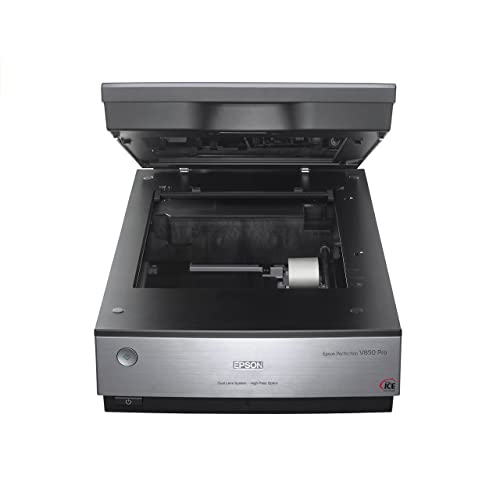
The Epson Perfection V850 Pro exists in a different category from every other scanner on this list. This is not a document workhorse — it's a precision imaging instrument designed for photographers, archivists, and print professionals who demand the absolute best in color accuracy and detail reproduction. With a 6400 dpi optical resolution and a 4.0 Dmax (dynamic range), the V850 Pro captures tonal gradations and shadow detail that consumer flatbeds simply cannot reach. If you're digitizing medium-format film negatives, large transparencies, or archival prints, this is where the conversation starts.
The dual lens system is Epson's signature differentiator here. The scanner automatically selects between two lenses — one optimized for reflective materials like prints and documents, and one calibrated for transparent media like film and slides. The result is consistently optimized sharpness across completely different scanning tasks without manual adjustment. Combined with the ReadyScan LED technology, the V850 Pro is ready immediately, and color accuracy is stable from the very first pass.
It's worth being direct: the V850 Pro is expensive, and that price is fully justified only if you have professional imaging needs. For pure document scanning, it's overkill. But if you're a working photographer who needs reference-quality scans, or a studio that handles fine art reproduction, it's one of the most capable flatbeds ever made. Pair it with a color-accurate display for the best results — our Best Printer for Photographers 2026 guide covers the output side of that workflow.
Pros:
Cons:
The Fujitsu fi-8170 is built for one thing: volume. With a rated daily capacity of 10,000 sheets and LAN connectivity baked in from the factory, this is the scanner for organizations that process serious document loads every single day. Law firms, financial institutions, healthcare providers, government offices — anywhere that digitizing physical records is a core operational requirement, the fi-8170 belongs on the shortlist. Fujitsu's document scanning pedigree is second to none, and the fi-8170 represents the current standard of that legacy.
The LAN connectivity is a particularly important feature in shared-office environments. Rather than tethering the scanner to a single workstation via USB, the fi-8170 can sit on the network and be accessed by multiple users simultaneously. The Automatic Document Feeder handles both standard and manual-feed documents, giving you flexibility for mixed media jobs. Fujitsu's PaperStream IP driver handles image processing with intelligent correction — skew correction, blank page removal, color drop-out — so your scanned files arrive clean without post-processing work.
If your operation demands consistent, high-throughput document digitization with enterprise-grade reliability, the fi-8170 justifies its price quickly through operational efficiency. It's not a device you buy for occasional scanning — it's infrastructure for organizations where scanning is a daily production task.
Pros:
Cons:
The Epson DS870 is a production-class document scanner that punches well above its price category. Running at 65 pages per minute in monochrome mode, it's one of the fastest scanners in the mid-tier professional segment. For busy offices where the scanner is in constant use — HR departments processing employment paperwork, accounting teams digitizing invoices, or medical practices scanning patient records — that raw throughput speed is the number that matters most in day-to-day operations.
The 30-bit color and 30-bit grayscale depth ensures that color documents scan with accurate, consistent color reproduction. While 30-bit is not the maximum available on the market, it's more than sufficient for the vast majority of business document workflows. The ADF handles mixed-size document batches reliably, and Epson's Document Capture Pro software adds workflow automation tools that let you route scanned documents directly to specific folders, cloud services, or applications based on document type.
One of the DS870's most practical strengths is its reliability at volume. Epson engineered this scanner for sustained daily use, and it shows in how consistently it feeds documents without jams or misfeeds — even with slightly curled or mixed-size paper. If you're currently running a consumer-grade scanner ragged and looking to step up to something that won't slow your operation down, the DS870 is the honest recommendation.
Pros:
Cons:
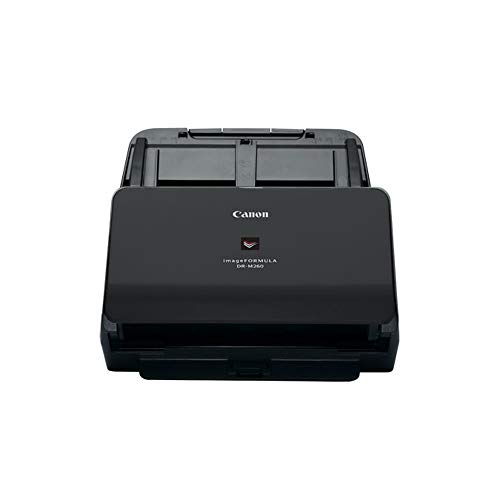
Canon's imageFORMULA DR-M260 occupies a smart middle ground between budget office scanners and full enterprise workhorses. At 600 dpi optical resolution and a compact form factor, it's designed to sit on a desk without dominating the workspace while still handling the wide range of documents a typical professional encounters daily. Business cards, receipts, legal contracts, ID cards, plastic cards, booklets — the DR-M260 accommodates a surprisingly diverse range of media for a scanner in this size and price range.
The reliable feeding mechanism is Canon's headline claim here, and it holds up. The U-turn document path handles delicate paper — thin documents, slightly fragile receipts — without the aggressive rollers that can cause damage in cheaper ADF scanners. The easy-to-operate design means minimal training for new users, and the accompanying CaptureOnTouch software provides a straightforward interface for setting up scan destinations and profiles without a steep learning curve.
Where the DR-M260 earns its place on this list is in mixed-use offices where the person using the scanner isn't always the same person every day. It's forgiving of different paper types, tolerant of inconsistent loading, and fast enough for moderate daily volumes. It won't keep up with an Epson DS870 in raw throughput, but for the office that doesn't need industrial-grade speed, it's a dependable choice that punches above its weight.
Pros:
Cons:
The HP ScanJet Pro 3600 f1 is the most practical all-around scanner on this list for small-to-medium businesses that don't want to choose between flatbed and ADF capabilities. At up to 30 pages per minute with a 60-page two-sided ADF, it handles the bulk feeding that most offices actually need. The flatbed surface adds flexibility for scanning bound books, irregular objects, and oversized pages that an ADF can't accommodate. You get both tools in a single device without the complexity or footprint of a large multifunction printer.
The software output options are genuinely useful rather than marketing bullet points. Scanning directly to searchable PDF, Word (DOC, DOCX), Excel (XLS, XLSX), and CSV formats means you're not just creating image files — you're creating usable, editable documents. OCR accuracy on standard business documents is solid, and the scan-to-cloud integration works reliably with major services. The 3,000-page daily duty cycle is appropriate for small office volumes without requiring constant maintenance.
HP's build on the 3600 f1 is clean and professional. The scanner fits neatly into an office environment, the UI is minimal, and setup takes minutes. If your office handles a mix of flat documents and bound materials — the kind of varied scanning workload that makes a pure ADF frustrating — the 3600 f1's combination of features at its price point makes it the practical default recommendation. It also pairs naturally with the devices covered in our Best Duplex Printer 2026 guide for offices building out a complete document workflow.
Pros:
Cons:
The RICOH fi-7300NX solves a specific problem that becomes very real in mid-size offices: how do you give multiple teams access to a quality scanner without running a cable to every desk? The answer is Wi-Fi and Ethernet network scanning, and the fi-7300NX implements it better than almost anything else in this price range. Place it anywhere in the office — near the copier, in a shared alcove, at reception — and every user on the network can access it. No USB tether, no dedicated workstation, no bottleneck.
The color touchscreen on the front panel is a genuinely useful feature, not a gimmick. Users can select scan destinations, adjust settings, and confirm jobs directly at the device without touching a computer. RICOH's NX Manager server software handles the back-end integration, connecting the fi-7300NX to on-premise servers, cloud storage, SharePoint, and other destinations through a web-based control interface. PC-less deployment is real — once configured, users can operate the scanner entirely from the touchscreen. PaperStream IP Net manages image quality automatically, applying consistent correction across every scan job.
The fi-7300NX makes most sense in organizations where the scanner is genuinely shared infrastructure — reception desks, HR departments, compliance teams, accounting pools. It's priced accordingly, but the reduction in IT overhead and the flexibility of placement make the premium worthwhile for the right buyer. If you're comparing this to dedicated workstation-attached scanners, factor in the value of not needing to schedule scanner access or route documents through a single machine.
Pros:
Cons:
Before you spend hundreds of dollars on a scanner, spend five minutes with this guide. The right scanner for your situation depends on how you answer a few key questions — and the wrong choice means living with daily frustrations that a bit of upfront clarity would have prevented. Check out our full buying guide section for more in-depth decision frameworks across product categories.
This is the first decision, and it shapes everything else. A flatbed scanner places documents face-down on a glass platen and scans them one at a time. It's the right choice when you need to scan books, bound documents, fragile originals, or anything larger than letter size — including the 11x17 tabloid format this guide focuses on. The trade-off is speed: flatbeds process one page at a time, which makes them slow for large batches.
An Automatic Document Feeder (ADF) pulls sheets through the scanner automatically, making it far faster for bulk document processing. Modern duplex ADFs scan both sides of a page in a single pass. The limitation is that ADFs require flat, individual sheets — no bound books, no oversized single pages, no curled originals. Many professional scanners combine both: a flatbed surface plus an ADF cover, giving you the flexibility to handle mixed document types without owning two separate machines.
Resolution, measured in dpi (dots per inch), determines how much fine detail your scanner captures. For standard business documents — contracts, invoices, forms — 300 dpi is sufficient for readable, archivable scans. For documents with small text or detailed graphics, 600 dpi is the practical standard. If you're scanning photos, film negatives, or artwork for professional reproduction, you need 1200 dpi or higher — which is where dedicated photo scanners like the Epson V850 Pro justify their price.
Color depth (measured in bits) determines how many distinct shades a scanner can distinguish. For everyday office documents, 24-bit color is the baseline. For accurate color reproduction and professional imaging, 30-bit or 48-bit depth makes a meaningful difference in the tonal range of your scans. Most users scanning business documents will never need more than 24-bit, but photographers and archivists should pay attention to this number.
Scanner speed is measured in pages per minute (ppm) or images per minute (ipm, which counts each side of a duplex scan separately). A 30 ppm scanner sounds fast until you're processing 500 pages a day — in which case you want something closer to 65+ ppm with a high daily duty cycle. Daily duty cycle is the manufacturer's rated maximum number of pages the scanner can process per day without excessive wear. Exceed it regularly and you'll shorten the device's lifespan and increase maintenance costs.
Match the scanner's capacity to your actual volume with some headroom. If you currently process 500 pages per day, don't buy a scanner rated for 500 pages per day — buy one rated for 2,000 to 3,000, so you have buffer for busy periods and the machine isn't running at maximum stress continuously.
USB connectivity is the standard baseline. Most scanners connect to a single workstation via USB and are accessed from that machine. For shared offices, Wi-Fi and Ethernet network connectivity remove the single-workstation bottleneck — any authorized user on the network can send jobs to the scanner. This is increasingly common in professional-grade scanners in 2026 and is worth the premium in any environment with more than two or three regular users.
Bundled software matters more than many buyers realize. Scan-to-searchable-PDF, OCR (optical character recognition), direct-to-Word or Excel export, and automated workflow routing can eliminate hours of post-processing work per week. Evaluate the software included with each scanner and weigh it honestly against tools you're already paying for. The best hardware combined with weak software creates daily friction; good integrated software turns a scanner into a document intelligence tool.
An 11x17 scanner refers to a device with a scanning area large enough to accommodate 11-by-17-inch paper, also known as tabloid size or A3 format (the international equivalent is 297 x 420 mm). Most standard office scanners top out at letter size (8.5x11 inches). An 11x17 scanner is specifically designed for oversized documents like blueprints, legal papers, artwork, and large spreadsheets.
No. A standard letter-size flatbed or ADF scanner physically cannot accommodate 11x17 paper — the glass platen or feed rollers simply aren't wide enough. Forcing oversized paper into a standard scanner can jam the mechanism and damage the document. You need a scanner specifically designed with an A3 or tabloid-size scanning area to reliably handle 11x17 documents.
For standard office documents — text, forms, contracts — 300 dpi produces clear, readable, archivable scans. For documents with fine print or detailed graphics, use 600 dpi. For photos intended for digital display, 600 dpi is a comfortable standard. For photographic prints you plan to reprint at the same size or larger, or for scanning film negatives and slides, 1200 dpi or higher is the appropriate starting point. The Epson V850 Pro supports up to 6400 dpi for the most demanding professional imaging work.
It depends on what your office actually scans. If you primarily process large batches of standard letter-size documents — invoices, HR forms, contracts — an ADF scanner is significantly faster and more practical. If you regularly scan oversized documents, bound books, fragile originals, or mixed-size pages, a flatbed is necessary. For most small-to-medium offices with varied scanning needs, a combination flatbed/ADF unit like the HP ScanJet Pro 3600 f1 gives you the best of both capabilities without requiring two separate devices.
If more than one or two people need to use the scanner regularly, network connectivity is a meaningful productivity upgrade. Without it, every user either needs to walk to the workstation connected to the scanner or have the scanned files transferred to them afterward — both of which create workflow friction. With Wi-Fi or Ethernet connectivity, the scanner becomes shared office infrastructure that any authorized user can access from their own workstation. For a single-user home office or a dedicated scanning station, USB connectivity is perfectly sufficient.
The most valuable software features for professional document scanning in 2026 are: searchable PDF output (which makes scanned text searchable and copy-able), OCR with direct export to Word and Excel formats, automatic blank-page removal, image correction (deskew, color correction, noise reduction), and workflow automation (routing scans to specific destinations based on document type or user selection). Cloud integration with Google Drive, SharePoint, Dropbox, and similar services is increasingly standard at the professional tier and eliminates the manual step of uploading files after scanning.
The right 11x17 scanner is out there for your specific workflow — whether that's the Plustek OS1180's straightforward A3 flatbed for a school library, the Epson V850 Pro's film-grade precision for a photography studio, or the RICOH fi-7300NX's network flexibility for a shared office environment. Use the specs and recommendations in this guide to match the machine to your actual daily needs, then click through to Amazon to check current pricing and availability. The sooner you get the right scanner in place, the sooner oversized documents stop being a friction point in your work.


About Editorial Team
The DigiLabsPro editorial team covers cameras, lenses, photography gear, and creative technology with a focus on helping photographers make informed buying decisions. Our reviews and guides draw on hands-on testing and research across a wide range of equipment, from entry-level beginner kits to professional-grade systems.
You can get FREE Gifts. Or latest Free phones here.
Disable Ad block to reveal all the info. Once done, hit a button below
