Picture this: you're browsing through a dense research paper at the library, wishing you could somehow pull the text directly into your laptop without retyping every line. Or maybe you're a student with dyslexia who needs words read aloud during an exam, and you've just discovered that a small pen-shaped device can do exactly that. In 2026, pen scanners have become serious productivity tools — not just novelties — and the market has expanded fast enough that picking the right one requires a clear head and a practical checklist.
A pen scanner, at its core, is a handheld device that slides across printed text and either captures it digitally, reads it aloud via text-to-speech, or translates it into another language in real time. The technology — broadly known as optical character recognition (OCR) — has matured considerably, and the best modern devices deliver accuracy rates above 95% across dozens of languages. Whether you're a student, a traveler, a classroom educator, or someone managing a paperwork-heavy workflow, there's likely a pen scanner designed precisely for your situation.
This guide breaks down seven of the most capable pen scanners available in 2026, covering their core features, real-world performance, and the kind of buyer who will get the most out of each one. If you're also considering traditional flatbed or portable document options, our roundup of best portable scanner printer combos covers that territory in depth. For now, let's focus on the pen-form factor and help you find your match. You can also browse the full buying guide hub for broader category comparisons.
Contents
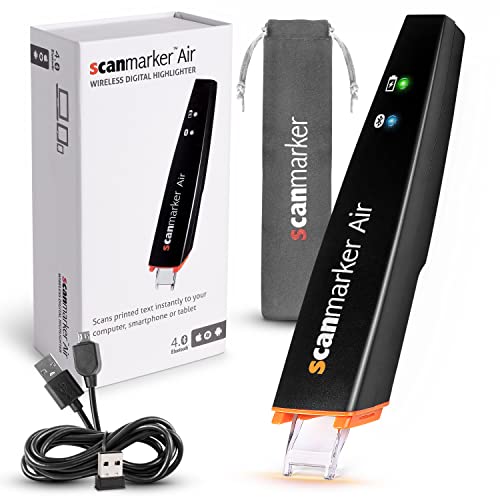






The Scanmarker Air is one of the most established names in the pen scanner space, and in 2026 it still holds up well against newer competition. You connect it wirelessly to your laptop, tablet, or smartphone, open the companion web app, and then slide the pen tip across a printed line — the text appears on your screen almost instantly. The workflow is genuinely fast once you get used to the sliding motion, and professionals who spend hours extracting quotes from physical documents will appreciate how much retyping it eliminates. The 140-language translation capability is a standout, covering virtually every major world language and many regional ones, and the integration with Microsoft Word means you can scan directly into the document you're already writing.
The text-to-speech functionality adds another dimension, reading scanned text aloud in real time through the app, which makes it a practical assistive tool for users with dyslexia or reading difficulties. One caveat worth noting upfront: the Scanmarker Air is not a standalone device — it requires an active connection to a computer or mobile device to function, which puts it in a different category than fully self-contained pens. If you primarily work at a desk with your laptop open, that dependency rarely matters; if you need a device you can use anywhere without pulling out a phone, look further down this list.
Build quality is solid without being exceptional — the pen is lightweight and comfortable to hold for extended sessions, though the physical scan head can wear down with very heavy daily use over months. For students building research notes or professionals compiling reports, the speed and accuracy the Scanmarker Air delivers make it a consistently reliable choice in its price range.
Pros:
Cons:
The PenPower WorldPenScan Go takes a notably different approach from most pen scanners by packing a built-in dictionary, thesaurus, audio recording, and live interpretation into a single device — all without requiring a smartphone connection for basic functions. When you scan a word or phrase, it doesn't just transcribe it; it defines the term, provides example sentences, and reads it aloud in your chosen language, making it particularly valuable for language learners who want context rather than just a raw translation. The 57-language text-to-speech engine delivers natural-sounding pronunciation that functions as a practical pronunciation coach, especially for less common languages where finding native-speaker audio online is difficult.
The AI Reading Buddy feature is specifically oriented toward younger users and kids struggling with reading comprehension, offering guided reading support that goes beyond simple word lookup. Audio recording is an underrated inclusion here — being able to record a lecture or meeting while simultaneously scanning key printed terms creates a genuinely multi-modal note-taking experience. The ScanNote Wi-Fi integration lets you push both text and recorded audio to a Chromebook, PC, or laptop wirelessly, which slots cleanly into classroom or conference room workflows where you'd rather not fiddle with cables.
The device does have a learning curve for first-time users, and its feature density can feel overwhelming until you've spent some time with it. If you're buying this for a younger child, plan on a short onboarding session. That said, once the workflow clicks, the WorldPenScan Go delivers a richer scanning experience than most comparably priced pens.
Pros:
Cons:
The Scanmarker Max is a newer entry in the Scanmarker lineup, and it's been clearly engineered with institutional and classroom use in mind from the ground up. The teacher lock function stands out as genuinely useful in supervised exam settings — instructors can restrict which features students can access, preventing the translation engine from functioning during assessments while still allowing basic text-to-speech. That level of administrative control is rare among consumer-grade pen scanners and makes the Max a serious candidate for schools looking to equip students with accessibility tools without creating a testing integrity problem.
Phonetics support is another classroom-relevant addition: as a student scans an unfamiliar word, the pen breaks it down phonetically and reads it aloud, actively supporting word recognition skills rather than just passively delivering audio. The photo scan mode lets users capture entire paragraphs at once by pointing the pen's camera at a block of text rather than sliding line by line — a significant workflow improvement for students reading dense textbooks. Multi-language text-to-speech means the same device can support students whose first language isn't English, making it genuinely versatile across diverse classrooms.
As a newer product, the Scanmarker Max has a shorter track record in the field compared to the original Air, and real-world user feedback over extended use is still accumulating. The phonetics engine works best on standard printed typefaces and can occasionally stumble on stylized fonts. For schools, educators, and parents seeking a structured, controllable reading support tool, the Max deserves strong consideration in 2026.
Pros:
Cons:
If you travel frequently or find yourself regularly navigating signage, menus, and documents in foreign languages, the VORMOR Translator Pen is built with your specific workflow in mind. The 3.5-inch touchscreen is the immediately obvious differentiator — rather than routing everything through a companion app, you interact with scanned text directly on the device's display, which makes it genuinely usable anywhere without pulling out your phone. The two-way real-time voice translation across 112 languages with under 0.3-second response time is ambitious, and in practical use it holds up well for common language pairs, making hotel check-ins and tourist navigation situations significantly less stressful.
The 98% claimed OCR accuracy rate tracks closely with real-world performance on standard printed text — newspapers, books, menus, and product labels all scan reliably. The photo translation mode, where you point the camera at a block of text rather than scanning line by line, adds flexibility for situations where sliding a pen across text isn't practical, such as wall-mounted signs or screen displays. The built-in audio recording function is a practical travel bonus, letting you capture conversations or directions without switching devices.
The VORMOR is clearly optimized for breadth of language support and standalone portability, and it delivers on both fronts. Where it gives back slightly is in the polish of the user interface — the touchscreen navigation can feel less refined compared to dedicated reading pens with simpler menus. USB-C connectivity for transferring scanned text to a computer is a welcome practical touch. If your primary use case is real-world translation while traveling, this device covers the ground exceptionally well.
Pros:
Cons:
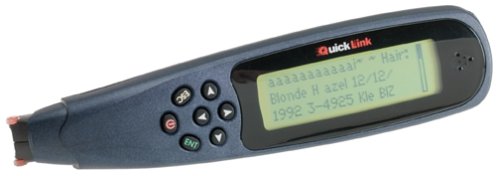
The WizCom QuickLink occupies a distinct position in this roundup: it's one of the oldest and most established pen scanner designs on the market, offering a no-frills portable scanning experience that prioritizes reliability and simplicity over feature density. You scan a line, it captures it, and it stores up to 1,000 pages of text on the device itself — ready to sync to your PC when convenient. There are no companion apps to configure, no Wi-Fi setup, and no subscription, which makes the QuickLink genuinely plug-and-play for users who find modern multi-feature devices unnecessarily complex.
Eight-language support is modest by 2026 standards, and the absence of real-time text-to-speech or translation means the QuickLink serves a narrower use case than the other devices on this list. What it does well is the core task of portable text capture: scan a passage from a book, magazine, or document, and retrieve it digitally later. Researchers, journalists, and note-takers who work in settings where pulling out a phone or laptop isn't convenient will appreciate the device's compact, unobtrusive form factor.
The trade-off is obvious — if you need translation, audio playback, or real-time sync to a screen, the QuickLink won't satisfy you. It's worth setting expectations clearly: this is a text-capture device first, a multi-tool second (or not at all). For buyers who want exactly that simplicity without paying for features they'll never use, the QuickLink remains a solid, proven choice in 2026.
Pros:
Cons:
The C-Pen Exam Reader 2 is purpose-built for a single high-stakes context: standardized testing and formal examinations, where accessibility tools must be reliable, self-contained, and free of any features that could constitute an unfair advantage. The fact that it requires no Wi-Fi or app connection during use is not just a convenience — it's a deliberate design choice that makes it acceptable in exam environments where internet-connected devices are prohibited. AI-based OCR reads complete sentences or individual words aloud via the built-in speaker or headphone jack, and the speed can be adjusted upward to let you move through reading material faster under time pressure.
The long-life battery is specifically engineered for back-to-back testing sessions, which is a detail that matters enormously on standardized test days when a device dying mid-exam would be catastrophic. The icon-based interface is thoughtfully designed for users with literacy differences or visual impairments, grouping all settings in one accessible location so you're not hunting through menus when you need to adjust a setting quickly. Ten-plus language support covers the major test-taking languages without trying to be a universal translator.
This is not a general-purpose pen scanner — it's a specialist tool, and that focus is its greatest strength and its obvious limitation. If you need translation, text capture, or connectivity, you'll want to look elsewhere. But for students with documented reading differences who sit exams regularly, or institutions building out their accessibility tool inventory in 2026, the C-Pen Exam Reader 2 is among the most trusted options in the category. You may also want to compare it against the best 11x17 scanners if your accessibility needs extend to larger document formats.
Pros:
Cons:
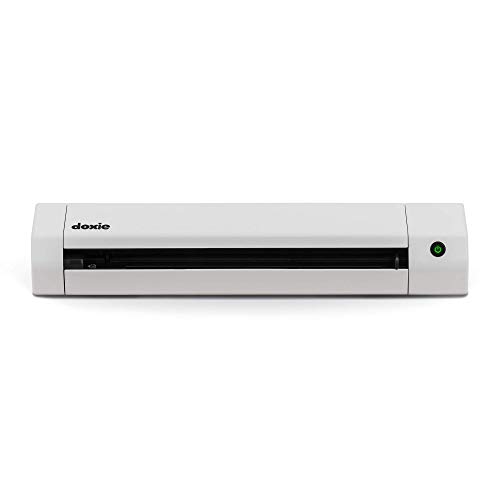
The Doxie Go SE is the one device in this lineup that operates differently from a traditional pen scanner — rather than sliding a pen tip across lines of text, you feed full sheets of paper through it like a miniature desktop scanner. It earns its place on this list because many buyers searching for pen scanners are ultimately looking for portable text capture, and the Doxie Go SE delivers that with a full-page feed that pen-form devices simply cannot match. At up to 600 dpi in full color, it captures documents with a fidelity that's well above what OCR pen scanners can achieve, making it ideal for archiving receipts, forms, business cards, and signed documents on the go.
The device scans a full-color page in approximately eight seconds, requires no computer connection during scanning, and stores up to 8,000 pages on built-in memory before needing to sync. The rechargeable battery supports up to 400 pages per charge, which covers a substantial batch scanning session without needing an outlet nearby. The Doxie companion software handles organization, export, and cloud sync once you connect, and the software is notably clean and intuitive compared to the utilities bundled with many portable scanners.
The obvious limitation is that the Doxie Go SE is a sheet-fed document scanner — it cannot scan bound books, text on physical surfaces, or items that can't be fed through a slot. It won't read text aloud, translate languages, or act as an assistive tool for dyslexia. If those capabilities matter to you, one of the pen-form devices above is your correct choice. But if you need a genuinely portable device for archiving paper documents in high quality while working away from your desk, the Doxie Go SE stands clearly apart from the pen-form competition.
Pros:
Cons:
With seven genuinely different devices on this list, the buying decision comes down to a handful of factors that vary significantly depending on how and where you plan to use your scanner. Working through these criteria before you buy will save you from returning a device that technically works but doesn't fit your actual workflow.
This is the most fundamental fork in the pen scanner market. Devices like the Scanmarker Air require a connected phone, tablet, or computer to function — they're essentially high-precision input devices that pass text into your existing software ecosystem. Devices like the VORMOR, WizCom QuickLink, and C-Pen Exam Reader 2 work entirely independently, storing and processing text without any companion device. If you need to use the scanner in environments where pulling out a phone isn't practical — exams, lectures, trade show floors, or travel — a standalone device is the correct choice. If you're almost always at a desk with a laptop open, app-dependent scanners typically offer a richer feature set for the price.
Language support ranges from 8 languages on the WizCom QuickLink to 140+ on the Scanmarker Air, and the quality of translation varies significantly between devices. Consider:
For international travel, the VORMOR's 112-language real-time voice translation is a strong choice. For academic language learning, the PenPower WorldPenScan Go's dictionary and pronunciation features add meaningful depth beyond raw translation.
If you're buying a pen scanner primarily as an assistive tool for dyslexia, reading difficulties, or visual impairment, the feature set matters in specific ways that general reviews don't always highlight clearly:
Pen scanners range from genuinely pocket-sized devices to scanner-pens that are more substantial due to built-in screens and batteries. For buyers who travel light, weight and form factor matter considerably:
A pen scanner is a handheld device that uses an optical sensor and OCR (optical character recognition) software to capture printed text as you slide the tip across a page. The captured text can then be displayed on a screen, read aloud via text-to-speech, translated into another language, or stored for later transfer to a computer. Modern pen scanners use AI-based recognition engines that achieve accuracy rates above 95% on standard printed text across dozens of languages.
Yes — several pen scanners in this guide include text-to-speech functionality specifically designed as assistive tools for dyslexia and reading difficulties. The C-Pen Exam Reader 2 is purpose-built for this use case and is approved in many formal exam settings, while the Scanmarker Air, Scanmarker Max, and PenPower WorldPenScan Go all offer text-to-speech through either the device itself or companion apps. The quality of the audio and the naturalness of the voice vary between devices, so it's worth watching video demos before purchasing if audio quality is a priority for you.
It depends entirely on the specific device. The C-Pen Exam Reader 2, WizCom QuickLink, and Doxie Go SE all operate completely offline without any internet or app dependency. The VORMOR Translator Pen works offline for basic OCR and text-to-speech but requires an internet connection for its real-time two-way voice translation feature. The Scanmarker Air and PenPower WorldPenScan Go require connections to companion apps or web platforms for most functions. If offline operation is critical for your use case — especially for exam or field use — verify the specific offline capabilities of any device before buying.
A pen scanner is a handheld device you slide across individual lines of text on a surface, capturing text without moving or feeding the document. A portable document scanner, like the Doxie Go SE in this guide, feeds full sheets of paper through a scanning slot to capture entire pages at once. Pen scanners are better suited for extracting specific passages from bound books, magazines, or non-removable documents, while portable document scanners produce higher-resolution full-page captures ideal for archiving, receipts, and forms. Our portable scanner printer combo guide covers the full-page scanning category in more detail if that's your primary need.
Language support ranges significantly across devices, from as few as 8 languages on the WizCom QuickLink to over 140 on the Scanmarker Air. The VORMOR Translator Pen supports 112 languages for two-way voice translation, while the PenPower WorldPenScan Go covers 57 languages for text-to-speech. It's worth distinguishing between languages supported for OCR scanning, languages available for translation, and languages offered for text-to-speech output — these can be different counts on the same device. Always check the specific language list for your target languages rather than relying on the headline number alone.
This depends on the specific exam authority, the device, and any documented accessibility accommodations. The C-Pen Exam Reader 2 is the device in this guide most specifically designed for and approved in controlled testing environments — its offline-only operation and deliberately limited feature set make it acceptable where internet-connected devices would not be permitted. Other pen scanners with translation capabilities or internet connectivity are generally not permitted in standard exam settings without specific prior authorization. Always verify the rules of your specific exam body before bringing any device into a testing room, and obtain any required accommodations documentation in advance.
The best pen scanner is the one built around your actual workflow — not the one with the longest feature list.


About Editorial Team
The DigiLabsPro editorial team covers cameras, lenses, photography gear, and creative technology with a focus on helping photographers make informed buying decisions. Our reviews and guides draw on hands-on testing and research across a wide range of equipment, from entry-level beginner kits to professional-grade systems.
You can get FREE Gifts. Or latest Free phones here.
Disable Ad block to reveal all the info. Once done, hit a button below
