Which receipt scanner actually plays nicely with QuickBooks — and is it really worth buying a dedicated device in 2026? If you've ever spent an afternoon manually keying in receipts, you already know the answer. The good news: the right scanner can turn that chore into a two-minute job. In this guide we've tested and reviewed seven of the top receipt scanners that work with QuickBooks, so you can stop guessing and start scanning.
Receipt scanners range from compact battery-powered wands you can toss in a laptop bag to high-speed desktop units with 100-sheet automatic feeders. The best one for you depends on how many receipts you process each month, whether you're in an office or constantly on the road, and whether you need deep QuickBooks integration out of the box. We've covered every angle below — including a full buying guide — so you can make a confident call.
According to document management best practices, digitizing financial records as soon as they're created reduces errors and audit risk significantly. A dedicated receipt scanner, paired with QuickBooks, is one of the simplest ways to build that habit without adding friction to your day. Let's get into the picks.

Contents







The Fujitsu ScanSnap iX1600 has been a top contender in the receipt scanner space for years, and the 2026 edition continues that tradition. It scans at up to 40 pages per minute (ppm) with a 50-sheet automatic document feeder (ADF), meaning you can load a stack of receipts, walk away, and come back to organized digital files. The 4.3-inch color touchscreen lets you set up profiles for different users — handy if your accounting team shares one device. Setup genuinely takes under five minutes, even for people who aren't particularly tech-savvy.
What really sets the iX1600 apart is its software ecosystem. ScanSnap Home handles file organization and can push scanned receipts directly into QuickBooks via cloud services. Optical character recognition (OCR — the technology that reads printed text and converts it to searchable data) is built in, so your receipts become searchable PDFs automatically. Build quality is solid; the white finish stays clean-looking on a desk and the paper feed mechanism is reliable even with crumpled or slightly torn receipts.
The main trade-off is price — the iX1600 sits at the higher end of the market. If you're a solo freelancer scanning five receipts a week, there are more affordable options below. But if you run a small business with multiple people feeding documents through the same scanner, the iX1600 earns its cost back quickly in saved time.
Pros:
Cons:
Epson built the RapidReceipt RR-600W specifically with accounting workflows in mind, and it shows. The bundled ScanSmart AI PRO software does something genuinely useful: it reads your receipts, extracts the merchant name, date, and amount, and formats that data for direct export into QuickBooks or TurboTax. You're not just getting an image of your receipt — you're getting structured data. That distinction matters a lot when you're reconciling dozens of transactions.
The 100-page ADF with TrueFeed Technology handles mixed batches confidently. You can throw in different sized receipts — long grocery tapes, standard letter invoices, small coffee shop slips — and the feeder handles them without jamming or skewing. Two-sided (duplex) scanning happens in one pass, so double-sided invoices don't require a flip-and-rescan. Wireless connectivity means you can place it anywhere on your desk without running a USB cable to your computer.
The RR-600W lands in the mid-to-upper price range but justifies it with software depth that cheaper scanners simply don't offer. If QuickBooks integration is your primary reason for buying a receipt scanner, this Epson deserves serious consideration. The only real friction point is the initial ScanSmart software setup, which can take 15–20 minutes and requires account creation.
Pros:
Cons:
If you spend more time on the road than at a desk, the Epson RapidReceipt RR-70W is the mobile scanner to beat in 2026. Weighing under 11 ounces — lighter than most water bottles — it fits easily in a laptop bag or briefcase. You can power it via USB from your laptop or from its built-in battery, making it completely cable-free when you need it to be. This is Epson's lightest receipt scanner, and it doesn't sacrifice scanning quality to get there.
The same ScanSmart AI PRO technology from the RR-600W is included here, which means you still get intelligent data extraction and QuickBooks export even in a pocket-sized device. Color scanning is sharp at standard receipt resolutions, and the scanner handles everything from tiny coffee shop receipts to standard letter-sized invoices. It pairs to your phone or laptop wirelessly, so you can scan a receipt at a client site and have it in QuickBooks before you leave the building.
You do give up the high-capacity document feeder — this scanner feeds one sheet at a time, which is fine for receipts but slower if you regularly process large batches of invoices. For someone who travels frequently and needs reliable QuickBooks sync without lugging a desktop unit, the RR-70W is hard to argue with. Also worth noting: if you need something for scanning film or older documents, check out our guide to the best 35mm film scanners for a different set of tools.
Pros:
Cons:
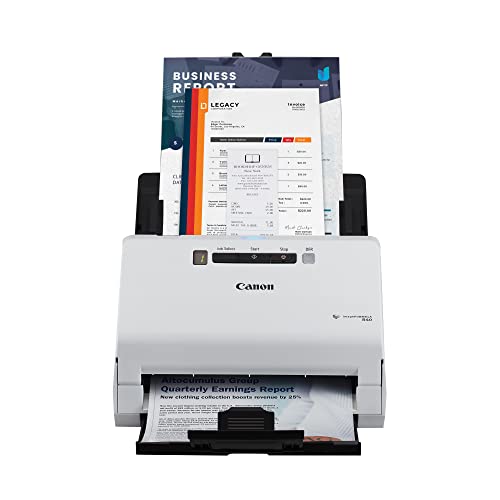
Canon's imageFORMULA R40 Receipt Edition was designed with one job in mind: get your receipts and invoices into QuickBooks Online as fast as possible. The included software scans a batch, extracts payee names, amounts, and dates using OCR, then pushes that structured data straight to Intuit QuickBooks Online. No manual data entry required. For a small business owner who dreads reconciliation day, this workflow is genuinely transformative.
The scanner itself is reliable and straightforward. Single-button operation means anyone in your office can use it without training — press the button, the document feeds through, data goes to QuickBooks. It handles a variety of document sizes and produces keyword-searchable files, so you can locate any receipt later by searching for a merchant name or amount. Duplex (double-sided) scanning is built in for invoices that have information on both sides.
The R40 is priced accessibly relative to its feature set, making it a smart pick if QuickBooks Online is already your accounting platform. It's worth noting this model is specifically the "Receipt Edition" — Canon sells a standard R40 without the specialized receipt software, so double-check you're getting this version. The ADF (automatic document feeder) holds fewer pages than some competitors, which can slow things down during a big batch reconciliation session.
Pros:
Cons:
The ScanSnap iX2500 is Fujitsu's most advanced consumer scanner yet — essentially the upgraded successor to the popular iX1600. The headline numbers are impressive: 45ppm duplex scanning, a large 5-inch touchscreen, a 100-sheet ADF, and Wi-Fi 6 (the fastest and most secure wireless standard available in 2026). If speed and reliability are non-negotiable for your workflow, this is the one to look at. The jump to Wi-Fi 6 alone makes a noticeable difference in how quickly files land on your computer or in cloud storage.
Customizable profiles on the touchscreen let each person in a shared office set up their own scan destinations — one tap sends receipts to QuickBooks, another sends contracts to a shared drive. The QUICK MENU feature lets you scan and then drag-drop the resulting file directly into whatever app is open on your screen. USB-C is available as a wired fallback if your wireless network is unavailable. Cloud service connections — Google Drive, Dropbox, OneDrive, and more — are set up through the ScanSnap Cloud platform.
The iX2500 commands a premium price, and honestly, most solo users or very small teams won't need everything it offers. But if your business processes a high volume of documents daily and you want the absolute best scanning experience with rock-solid reliability, the iX2500 is worth every dollar. It's also worth exploring options for scanning larger documents — our best large format scanner guide covers that territory if your needs extend beyond standard paper sizes.
Pros:
Cons:
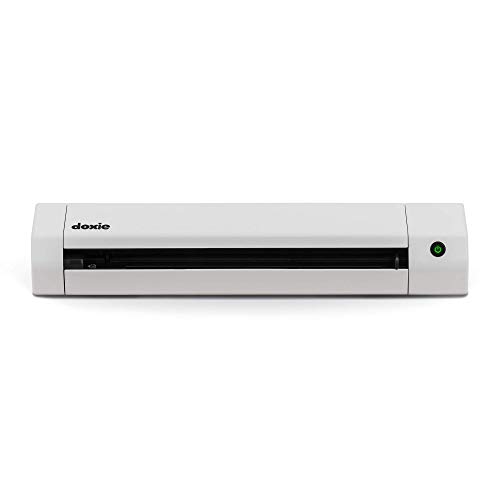
The Doxie Go SE takes a different approach from everything else on this list. There's no ADF, no touchscreen, and no direct QuickBooks integration built in. What you do get is a truly portable, completely standalone scanner that works without a computer at all. Insert a sheet of paper, wait eight seconds, done. It stores up to 8,000 pages internally before you need to sync, and a single charge gets you through about 400 pages.
Think of the Doxie Go SE as a capture device rather than a processing device. You scan throughout the month, then sit down at your computer and sync everything to Doxie's desktop software. From there, you can export to PDF or JPEG and upload manually to QuickBooks. It's an extra step compared to the Epson and Canon options above, but for someone who only scans a handful of receipts per week, the simplicity and portability more than make up for it. The scanner is roughly the size of a rolled-up magazine — it fits anywhere.
Scan quality at 600 dpi (dots per inch — a measure of image sharpness) is excellent for receipts. Colors reproduce accurately and text is crisp enough for OCR software to process reliably. If you're a freelancer, a student tracking business expenses, or someone who just needs to digitize receipts without a complicated setup, the Doxie Go SE delivers exactly what you need without overcomplicating things. For comparison shopping, our roundup of best portable scanner printers covers combo devices if you also need printing on the go.
Pros:
Cons:
The ScanSnap iX1300 solves a real problem: you want a desktop scanner with an automatic feeder, but your desk is already crowded. Fujitsu designed the iX1300 with a space-saving U-turn paper path — documents go in the front and come out the front, so you don't need clear space behind the scanner. When not in use, it takes up surprisingly little desk real estate. It's the right choice if space is your biggest constraint.
Scanning speeds hit up to 30ppm in duplex mode, which is quick enough for most small business workflows. The QUICK MENU lets you scan and drag the resulting file directly into any open application on your computer — no navigating through folder trees. Automatic de-skew (digital straightening of tilted documents), color optimization, and blank page removal all happen without any settings adjustments. Plastic cards, thick documents, and standard receipts all feed reliably through the manual feeder slot when they're too rigid for the ADF.
Compared to the iX1600 and iX2500, the iX1300 gives up some feeder capacity and processing speed, but it costs noticeably less and fits into tighter spaces. If you're a home-based freelancer or a small office where the scanner shares a crowded desk, the iX1300 hits the sweet spot between capability and practicality. It connects wirelessly or via USB and works with both Mac and PC.
Pros:
Cons:
Walking into this category without a clear picture of what you need is a fast way to overspend — or worse, buy something that doesn't actually solve your problem. Here are the four factors that matter most when choosing a receipt scanner for QuickBooks in 2026.
Not every scanner on this list connects to QuickBooks the same way. Some, like the Canon R40 and both Epson RapidReceipt models, include software that extracts structured data (merchant name, date, total) and pushes it directly into QuickBooks fields. Others, like the Fujitsu ScanSnap line, scan to organized PDFs and rely on QuickBooks' own receipt capture feature or third-party apps like Dext or AutoEntry to complete the handoff. Both approaches work — the Canon/Epson route requires less setup per receipt, while the ScanSnap route gives you more flexibility across different accounting platforms.
Ask yourself: do you use QuickBooks Online or QuickBooks Desktop? The Canon R40 is specifically optimized for QuickBooks Online. If you're on Desktop, the Epson or Fujitsu software pipelines are more reliable.
This single question shapes which scanner makes sense for your budget. If you're processing fewer than 50 receipts a month, a portable scanner like the Doxie Go SE or the Epson RR-70W gives you everything you need without paying for high-capacity hardware you'll never use. Between 50 and 300 receipts monthly, a mid-range desktop with a 50–100 sheet ADF (like the iX1300, Canon R40, or Epson RR-600W) hits the right balance. Above 300 receipts a month, you want the fastest, highest-capacity options — the ScanSnap iX2500 at 45ppm with a 100-sheet feeder or the iX1600 at 40ppm.
Think about peaks too. A retail business might scan 20 receipts most weeks but 200 the week after a trade show. Size for the peaks, not the average.
If you work from a fixed office, a desktop scanner with an ADF is almost always the better choice — faster throughput, better paper handling, and more reliable OCR. If you travel regularly for work, you'll either want a dedicated portable like the Epson RR-70W (under 11 oz) or the Doxie Go SE (no computer needed), or you'll end up with a desk scanner that just collects dust at home while receipts pile up in your briefcase.
Some people solve this with two devices: a portable for travel and a desktop for batch processing at month-end. That's a legitimate strategy if your volume justifies it. For most small business owners, one well-chosen scanner covers both scenarios adequately.
The scanner hardware will probably outlast the software subscription model around it. Before you buy, check whether the included software requires an ongoing subscription and what happens if you stop paying. Epson's ScanSmart AI PRO is currently included with purchase at no additional subscription fee — that's a genuine advantage. Fujitsu's ScanSnap Home is also free and regularly updated. Some third-party integration services charge monthly fees on top of the scanner cost, which can add up over a three-to-five year ownership period.
Also consider OCR quality for your specific receipt types. Thermal receipts (the shiny paper from most retail stores) can fade over time and scan with lower contrast than standard paper. Test your scanner with a few real receipts before committing to a workflow, and check that the OCR accuracy is acceptable for your needs.
The answer depends on your workflow. For direct QuickBooks Online integration, the Canon imageFORMULA R40 Receipt Edition is purpose-built for that connection. For the best combination of speed, software intelligence, and flexibility, the Epson RapidReceipt RR-600W stands out. For teams sharing one device, the Fujitsu ScanSnap iX1600 or iX2500 offer the best multi-user experience. There's no single "best" — match the scanner to your volume, portability needs, and which version of QuickBooks you use.
You can, but it's significantly slower and more cumbersome than a dedicated receipt scanner. Flatbed scanners require you to place each receipt individually on the glass, scan, then move to the next one. For more than a handful of receipts, an automatic document feeder (ADF) saves enormous time. Flatbeds also lack the specialized receipt software that extracts data automatically into QuickBooks. If you already own a flatbed, it can serve as a short-term solution, but a dedicated receipt scanner pays for itself quickly in saved hours.
Most do, but the integration method varies. QuickBooks Online has more direct API connections available, which is why the Canon R40 targets it specifically. For QuickBooks Desktop, the Fujitsu ScanSnap software and Epson ScanSmart can export to compatible file formats, and QuickBooks Desktop has its own receipt management feature that accepts PDF imports. Always verify compatibility with your exact version of QuickBooks before purchasing, as Intuit periodically updates their integration requirements.
Wireless (Wi-Fi) is more convenient for daily use — you can place the scanner anywhere without running cables, and multiple users can connect without swapping cables. USB provides a more stable, faster connection that doesn't depend on your network being up. The ScanSnap iX2500 uses Wi-Fi 6, the fastest consumer wireless standard available, which minimizes any speed gap between wireless and USB. For most office setups, wireless is the better choice. USB is useful as a backup or in environments with unreliable Wi-Fi.
For standard paper receipts, 300 dpi is sufficient for both readability and OCR accuracy. For thermal receipts (the shiny kind from grocery stores and gas stations), 600 dpi can improve OCR accuracy because the lighter print benefits from higher resolution capture. Most of the scanners in this guide default to 300 dpi for speed but offer 600 dpi as an option. You don't need more than 600 dpi for receipts — higher resolutions just create larger file sizes without meaningful quality improvement for text documents.
Yes, and for very low volumes it works reasonably well. QuickBooks has a built-in mobile receipt capture feature, and apps like Dext (formerly Receipt Bank) use your phone camera to photograph and extract receipt data. The practical limitations are speed and reliability — phone OCR accuracy on crumpled or faded thermal receipts is lower than a dedicated scanner, you have to process one receipt at a time, and your hands are occupied during scanning. If you process more than 20–30 receipts per month, a dedicated scanner will save you time and reduce errors. Phone capture is best for capturing receipts immediately in the field, complementing a desktop scanner rather than replacing it.


About Editorial Team
The DigiLabsPro editorial team covers cameras, lenses, photography gear, and creative technology with a focus on helping photographers make informed buying decisions. Our reviews and guides draw on hands-on testing and research across a wide range of equipment, from entry-level beginner kits to professional-grade systems.
You can get FREE Gifts. Or latest Free phones here.
Disable Ad block to reveal all the info. Once done, hit a button below
