Which 35mm film scanner will actually do justice to your old slides and negatives — and which ones are overpriced disappointments? If you've been sitting on a shoebox of irreplaceable film photos, you already know the stakes are high. After testing and researching across dozens of models for 2026, the Plustek OpticFilm 8300i Ai stands out as the top pick for anyone serious about quality. But the right scanner really depends on your budget, your workflow, and just how much resolution you need. This guide covers all of that.
Film photography has seen a remarkable resurgence in recent years, and with it comes the very real need to preserve decades of analog memories in digital form. Whether you're a hobbyist digitizing family slides from the 1970s or a working photographer archiving 35mm negatives, choosing the right scanner makes a dramatic difference in your final image quality. Resolution (measured in DPI, or dots per inch), dynamic range (how well a scanner captures shadow and highlight detail), and bundled software all play a role. We'll break each of those down in the buying guide below — but first, here are the seven best options you can buy right now in 2026.
If you've ever wondered about other ways to preserve or print your photos, our roundup of the best printers for photographers pairs well with this guide. And if you're interested in other scanning formats beyond 35mm film, check out our best large format scanner guide too. Now, let's get into what really matters: the scanners themselves.
Contents
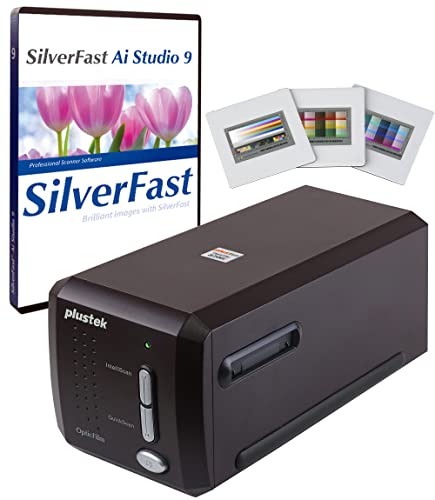






The Plustek OpticFilm 8300i Ai is the scanner you want if you're serious about getting the most out of your 35mm film collection. Plustek redesigned this model with a new-generation chip that delivers 38% faster scan speeds compared to its predecessor — which means less time waiting and more time actually looking at your digitized images. The hardware improvements are real, not just marketing language, and they show up immediately when you're moving through a batch of slides.
What really sets this bundle apart is the included SilverFast Ai Studio 9 software. SilverFast (developed by LaserSoft Imaging) is widely considered the gold standard in film scanning software. It comes loaded with over 100 functions, including multi-exposure blending, iSRD infrared dust removal, and intelligent automatic color correction. For most users, just learning the basics of SilverFast will produce noticeably better scans than what most budget scanners can deliver at their maximum settings.
The 8300i Ai also ships with three slides of the IT8 calibration target — a professional color calibration tool that costs around $99 separately. This target (ISO 12641-2 compliant as of 2019) gives you far more color measurement points than older calibration methods, meaning your scans will have accurate, consistent colors right from the start. If you've ever scanned film only to find the colors look slightly off, this calibration workflow is why dedicated film scanners produce better results than flatbeds. You're getting a complete professional digitization setup out of the box.
Pros:
Cons:
If your priority is raw resolution and you want the highest pixel count possible from your 35mm film, the Pacific Image PrimeFilm XE Plus delivers something very few scanners at any price point can match: 10,000 DPI optical resolution. That's not interpolated — it's the real optical output from the RGB linear array CCD sensor. Combined with a 3.9 dynamic range (which is exceptional, allowing it to pull detail out of very dark or very bright areas of your negatives), this scanner is genuinely in a class of its own for image quality.
The image processing features are equally impressive. You get Auto Exposure, Auto Contrast, Auto Color, and Magic Touch — Pacific Image's dust and scratch removal system — all built in. Multipass exposure captures the same frame multiple times and blends the results to reduce digital noise (think of it like HDR for film scanning), and the Digital Noise Reduction (DNR) adds another layer of clarity. The result is that even old, slightly damaged negatives come out looking clean and detailed.
The film holder system uses a manual insert design with sturdy plastic carriers and pressure strips to keep your film flat. Film flatness matters more than most people realize — a bowed negative loses sharpness at the edges, no matter how good your scanner is. Pacific Image clearly understands this. The 48-bit output (16 bits per color channel) gives you maximum flexibility in post-processing, and it works with both Mac and Windows. This is the scanner for photographers who want the absolute best digital files from their 35mm archive.
Pros:
Cons:
Not everyone needs a dedicated film-only scanner, and that's exactly where the Epson Perfection V550 earns its place on this list. This is a flatbed scanner — meaning it lies flat on your desk and scans documents, photos, and film from a glass bed — but it handles film surprisingly well thanks to a built-in transparency unit (TPU) and 6400 DPI optical resolution. That's enough to produce prints up to 17 x 22 inches with solid sharpness and detail.
Epson's Digital ICE technology is the star feature here for film users. Digital ICE uses infrared light to detect and remove the appearance of dust and scratches on film, so you spend less time retouching in Photoshop afterward. It works on 35mm slides and negatives, and it's effective enough that most casual digitization projects won't need much manual cleanup at all. The software also includes automatic exposure and color correction tools that produce good results without requiring you to understand color profiles or scanner calibration.

The real advantage of the V550 is versatility. You can scan documents, old prints, photos, slides, and negatives all with one device. If you only have a moderate amount of film to digitize and you also want a general-purpose scanner for everyday use, this is genuinely the smart choice. It won't match the pure resolution of dedicated film scanners like the PrimeFilm XE Plus, but for most home users archiving family memories, the difference is rarely visible at standard viewing sizes. It's also one of the more affordable options on this list, which makes the versatility even more compelling.
Pros:
Cons:
The Plustek OpticFilm 8100 is the dedicated film scanner you buy when you want professional-quality results without paying professional prices. It scans 35mm negatives and slides at 7200 DPI with 48-bit output, producing image files equivalent in detail to a 69-megapixel full-frame DSLR shot. That's not marketing hype — at 7200 DPI, you genuinely have enough resolution to make sharp prints at 20 x 24 inches or larger from a standard 35mm frame.
The dynamic range captures both shadows and highlights well, meaning you'll recover detail in the dark corners of backlit slides and the blown-out highlights of overexposed negatives. It comes bundled with Plustek's QuickScan software and SilverFast SE Plus 9 — a step below the full Ai Studio version included with the 8300i Ai, but still a genuinely capable scanning package. SilverFast SE Plus handles the core tasks well: color correction, dust removal, and basic batch scanning workflows.
Where the 8100 wins over the pricier 8300i Ai is straightforward: cost. If you don't need the absolute latest chip, the faster scan speed, or the professional IT8 calibration targets, the 8100 gives you the same Plustek build quality and scanning pedigree at a lower entry point. It's a strong choice for enthusiasts who shoot film regularly and want a proper dedicated scanner but aren't running a professional digitization studio. You'll be very happy with the results, especially once you spend a little time learning the SilverFast interface.
Pros:
Cons:
The KODAK Slide N SCAN is built for a completely different type of user than the Plustek or Pacific Image scanners above. If you just want to take a box of old family slides and negatives, convert them to digital files quickly without installing any software, and share the results on your phone or TV — this scanner does exactly that with minimal friction. It's a standalone device with a 5-inch LCD screen, which means you can preview and select your images right on the unit before saving them to an SD card. No computer required.
The 22MP resolution (achieved via interpolation — the actual optical sensor captures less, then upscales) is good enough for sharing on social media and viewing on screens. It handles 135, 110, 126, and 50mm slides and negatives, making it one of the more versatile budget options for film formats beyond just standard 35mm. The quick-feeding tray technology allows for continuous loading, which is a genuine time-saver if you have hundreds of slides to get through. Saves directly to SD card as JPEG files.
Be honest with yourself about your goals before buying this one. If you want archival-quality files for large prints or professional use, this is not the right tool — the interpolated 22MP figure doesn't reflect true optical detail at the level a dedicated scanner provides. But if your goal is simply to get family memories off old film and onto a screen or shared drive, the KODAK Slide N SCAN does that job efficiently and without the learning curve. It's genuinely the most approachable option on this list for non-technical users.
Pros:
Cons:
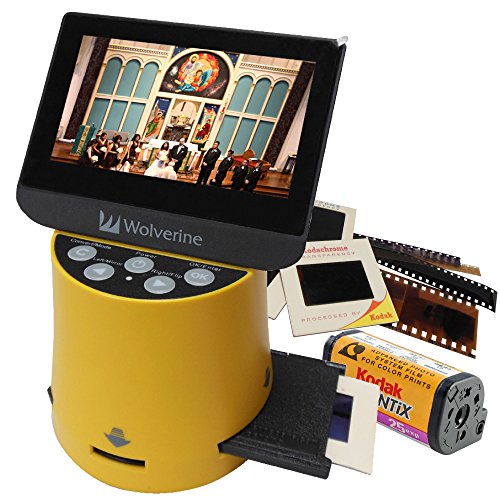
The Wolverine Titan earns its spot on this list through sheer format versatility. If you have a mixed collection that includes not just 35mm but also 127, 126, 110, and APS (Advanced Photo System) film — all common formats from the 1960s through the 1990s — the Titan converts all of them in a single device. Most scanners on this list handle 35mm and not much else. Eight film and slide formats in one machine is a genuine advantage if your family archive spans multiple camera types and eras.
The large 4.3-inch color screen makes it easy to preview what you're scanning without needing to connect to a computer, and the HDMI output means you can hook it up to your TV to share images on a large screen — great for a family gathering where you're all looking at old slides together. Conversion happens in approximately three seconds per frame, which is fast enough to get through a large batch without feeling like a chore.
The trade-off, as with most all-in-one budget converters, is resolution. The Titan isn't going to produce the kind of detail you'd get from a dedicated scanner like the OpticFilm 8300i Ai — it's optimized for convenience and coverage, not maximum quality. But if your goal is to preserve and share memories rather than produce gallery-print files, that's a trade-off worth making. It's also a solid choice if you don't know exactly what formats your old film collection includes — the Titan handles whatever you throw at it. Take a look at our best pen scanner guide if you also need something portable for on-the-go document capture.
Pros:
Cons:
The Magnasonic FS71 is a strong contender in the budget standalone scanner category, going head-to-head with the KODAK Slide N SCAN but offering a few meaningful differences. The 24MP output (again, interpolated) is slightly higher than the KODAK, and the feature that really stands out is the built-in 128MB internal memory — so you can start scanning even without an SD card in hand. The 5-inch LCD is sharp and wide-angle, making it easy to review your images and use the scanner as a mini digital picture frame when you're done.
Format support covers 35mm, 110, 126, and Super 8 film negatives, plus 135, 126, and 110 slides. Super 8 support is relatively rare in this price range and useful if you have old home movie film you want to digitize. The SD card slot supports up to 128GB of expanded storage, which is plenty for thousands of scanned images. All files save as JPEG, which keeps things simple and compatible with any device you own.
Compared to the KODAK Slide N SCAN, the Magnasonic trades the KODAK's quick-feeding tray system for built-in memory and slightly higher stated resolution. Neither is a truly professional film scanner, but both serve the casual user well. The Magnasonic wins on value if you want Super 8 compatibility or prefer to scan without a card ready. You'll find the learning curve virtually nonexistent — if you've ever used a flatbed scanner or a smartphone, you can figure out the FS71 in under five minutes.
Pros:
Cons:
Before you spend your money, it's worth understanding the specifications that actually matter — and which ones are just marketing numbers. Our full buying guide covers this in more depth, but here are the four factors that will most directly affect your scanning results in 2026.
DPI stands for dots per inch, and it measures how much detail a scanner can capture from your film. Optical DPI is the only number that matters — ignore "enhanced" or "interpolated" DPI figures, which are just software upscaling and add no real detail. For 35mm film, 2400 DPI gives you enough resolution for standard screen viewing and small prints. At 4000 DPI you can make 8x10 prints comfortably. At 7200 DPI and above — like the Plustek OpticFilm 8100 and 8300i Ai — you have enough data for large prints and serious archival work. According to Wikipedia's overview of film scanner technology, 35mm film can theoretically resolve around 4000–5000 DPI worth of information, so scanners at 7200+ DPI are capturing everything the film has to offer.
Dynamic range (sometimes called Dmax) measures a scanner's ability to distinguish detail in the darkest shadows and brightest highlights of your film. A higher number is better. Budget scanners typically have a dynamic range of around 2.8–3.2. The Pacific Image PrimeFilm XE Plus hits 3.9, which is exceptional. Why does this matter to you? If you've ever scanned a slide and found the shadows look like a muddy black smear with no detail, that's a low dynamic range problem. A scanner with a higher Dmax pulls actual tonal information out of those dark areas, giving you more to work with in post-processing.
Dedicated film scanners — like the Plustek and Pacific Image models — are designed specifically for 35mm film and slides. They typically deliver higher resolution, better dynamic range, and more accurate color from film. Flatbed scanners like the Epson V550 are multipurpose: they scan documents, prints, photos, and film. For casual users with mixed scanning needs, a flatbed makes sense. For anyone focused primarily on film and wanting the best possible output, a dedicated scanner is worth the extra investment. The choice isn't always about quality — it's also about how you work and what else you need the scanner to do.
The scanner hardware is only half the story. The software that controls your scanner and processes the raw scan data has a massive impact on your final image quality. SilverFast (included with both Plustek models) is the industry benchmark — it gives you grain reduction, multi-exposure blending, and color calibration tools that basic bundled software simply can't match. If you're buying a scanner and ignoring the software bundle, you're missing a significant part of what makes one scanner better than another. Beginners can start with basic automatic settings, but as your skills grow you'll appreciate having professional tools available. For context on what great digital output looks like, our guide to the best printers for photographers also covers output quality standards worth understanding.
The KODAK Slide N SCAN and the Magnasonic FS71 are both excellent choices for beginners. They require no computer connection, save files directly to an SD card, and have a minimal learning curve. If you want to step up to better quality without complexity, the Epson Perfection V550 is easy to use and delivers noticeably better results thanks to its Digital ICE dust removal technology.
For sharing images on screens and social media, 1800–2400 DPI is sufficient. For printing up to 8x10 inches, aim for at least 3200–4000 DPI. For large prints at 16x20 or bigger, you want a scanner that delivers 7200 DPI or higher optical resolution, like the Plustek OpticFilm 8100 or 8300i Ai. Avoid "interpolated DPI" claims — only optical DPI reflects real captured detail.
Yes, but only if the flatbed includes a built-in transparency unit (TPU) — a backlight that illuminates the film from above. The Epson Perfection V550 includes one. Standard flatbed scanners designed for documents do not have this feature and cannot scan film at all. Even with a TPU, most flatbeds won't match the resolution or dynamic range of a dedicated film scanner.
SilverFast is a professional scanning software suite developed by LaserSoft Imaging. It's widely regarded as the best scanning software available for film and slide digitization. It includes features like multi-exposure HDR scanning, iSRD infrared dust removal, IT8 color calibration, and advanced grain reduction. The Plustek OpticFilm 8300i Ai bundles the full Ai Studio 9 version, which is the most feature-complete edition. Having SilverFast versus basic bundled software can make a significant visible difference in your final scan quality.
For occasional digitization of a few hundred frames, a lab can make sense — you pay per scan and avoid buying equipment. But if you have hundreds or thousands of frames to digitize, buying your own scanner pays for itself quickly. You also get unlimited rescans, full control over settings, and no shipping risk for irreplaceable film. A scanner like the Plustek OpticFilm 8100 or the Epson V550 makes home scanning practical and cost-effective for most people.
Most dedicated 35mm scanners on this list handle standard 35mm negatives and positive slides (135 format). The KODAK Slide N SCAN also handles 110 and 126 film. The Wolverine Titan 8-in-1 is the most versatile, covering 35mm, 127, 126, 110, and APS film formats. The Magnasonic FS71 adds Super 8 film support. If your archive includes multiple film formats, the Wolverine Titan or Magnasonic FS71 are the most practical options without needing separate scanners.
Your irreplaceable film memories deserve a scanner that captures every grain of detail — buy the best optical resolution you can afford, and you'll never have to rescan the same roll twice.


About Editorial Team
The DigiLabsPro editorial team covers cameras, lenses, photography gear, and creative technology with a focus on helping photographers make informed buying decisions. Our reviews and guides draw on hands-on testing and research across a wide range of equipment, from entry-level beginner kits to professional-grade systems.
You can get FREE Gifts. Or latest Free phones here.
Disable Ad block to reveal all the info. Once done, hit a button below
