Which light timer actually keeps your home looking occupied when you're not there — and which ones are just frustrating plastic clocks you'll stuff in a drawer? If you've ever come home to a dark house that was supposed to look lived-in, or tried to wrestle a mechanical dial timer at 11 PM, you already know the stakes. After testing and researching the top options available in 2026, the Kasa KP401 Outdoor Smart Plug stands out as our overall top pick for anyone who wants reliable, app-controlled scheduling without an expensive smart home hub. But it's not the right fit for every situation — and that's exactly why we've put together this complete guide.
Light timers have evolved well beyond the simple twist-dial plugs your grandparents used. Today you can choose from analog mechanical timers that need no Wi-Fi, compact 4-packs perfect for every room, weatherproof outdoor units rated for harsh climates, and full smart plugs with voice assistant integration. The right choice depends on where you're installing the timer, how complex your schedule needs to be, and whether you want to manage everything from an app or prefer a set-it-and-forget-it mechanical approach. For more on choosing the right home automation gear, check out our full buying guide.
Home security experts consistently point out that the appearance of an occupied home is one of the most effective deterrents against break-ins. Light timers are a simple, affordable way to create that impression. Whether you're protecting a vacation property, managing outdoor landscape lighting, or just tired of coming home to a dark house, the seven products in this review cover every need and budget you're likely to have in 2026. Read on — we've done the legwork so you can buy with confidence.
Contents





When you need a no-fuss indoor timer that just works, the Intermatic TN111K is the definition of reliable simplicity. This 24-hour mechanical timer runs on a rotating dial system — no batteries, no Wi-Fi setup, no app to download. You press the trippers down for the hours you want the device on, and you pull them up for the hours you want it off. That's genuinely it. The 2-prong design means it fits a wide range of lamps and small appliances without needing a grounded outlet, which is a real advantage in older homes where three-prong outlets aren't always available.
The 15-amp rating gives you solid headroom for LED and CFL lighting, standard lamps, and most small appliances. Intermatic has been making timers for decades, and you can feel that manufacturing experience in the TN111K — the dial turns smoothly, the trippers snap firmly into place, and the housing feels solid. The manual override switch is a standout feature: you can toggle the device on or off instantly without disturbing your programmed settings, which is something cheaper timers often get wrong. Coming as a 2-pack, this is an excellent value if you're setting up timers in multiple rooms to simulate occupancy. Bear in mind that you get up to two on/off cycles per 24-hour period, so if you need more granular scheduling — say, lights on at 6 PM, off at 10 PM, on again at 2 AM — you'll want a different model. But for most bedroom lamp and living room setups, two daily cycles is exactly what you need.
The single-cycle limitation is worth thinking through before you buy, but for straightforward home security lighting on a tight budget, the Intermatic TN111K delivers genuine value. The 2-pack pricing makes it one of the most cost-effective ways to cover your whole home with automated lighting.
Pros:
Cons:
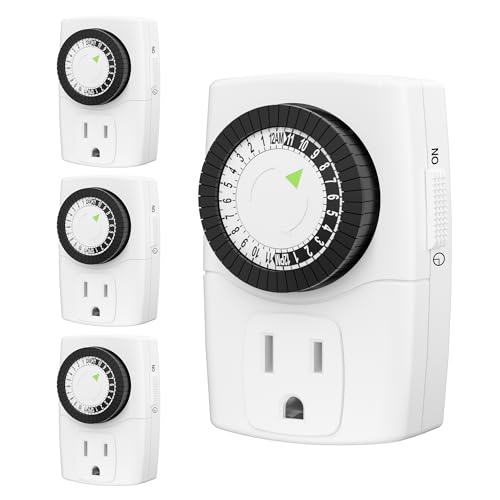
If you're equipping an entire floor of your house — or setting up a vacation rental — the BN-LINK BND-60/U47 4-pack delivers exceptional coverage per dollar. These compact mechanical timers use a pin-based system: pins up means off, pins down means on. The interface is intuitive once you understand the concept, though the packaging does note that pins arrive pressed down from the factory, so you'll pull pins up first to begin programming. That small detail trips up a lot of first-time users, so keep it in mind when you unbox them.
What sets the BN-LINK apart from the Intermatic TN111K above is the dramatically expanded scheduling capability. You get up to 24 on/off settings per day, programmable in 30-minute intervals. That means you can create a genuinely convincing pattern of natural-looking light activity — lights on for 30 minutes, off for an hour, back on in the evening — the kind of randomized variation that makes a home look realistically occupied rather than obviously automated. The 3-prong grounded design accommodates a wider range of devices than 2-prong alternatives. Once your schedule is programmed and the unit is plugged in, it repeats daily without any further intervention. These are compact units too, so they won't block adjacent outlets on your power strip or wall plate.
The mechanical simplicity is both a strength and a limitation. You don't need Wi-Fi, an app, or a hub. But you also can't adjust your schedule remotely, and if you want different schedules on different days of the week, you'll need to step up to a digital or smart timer. For consistent daily scheduling across multiple rooms, though, the BN-LINK 4-pack is hard to beat. If you're also looking to upgrade your home's lighting setup, check out our review of the top LED flame bulbs for a great pairing with these timers in decorative fixtures.
Pros:
Cons:
The Kasa KP401 is our top overall pick in 2026, and the reasons are clear from the moment you start using it. No hub required, no complicated pairing, no frustrating manual programming — you plug it in, connect to your home's 2.4GHz Wi-Fi through the Kasa app, and you're scheduling within minutes. The app is genuinely excellent: clean interface, reliable connectivity, and the ability to adjust your schedule from anywhere. Away on vacation and want to turn on the porch light early because of a storm? You do it from your phone. That level of control is something no mechanical timer can match.
The IP64 weatherproof rating means it handles rain, dust, and humidity without issue. The attached waterproof cover protects the second outlet when not in use, which is a thoughtful design detail that cheaper smart plugs often skip. At 15A/1875W capacity, it handles landscape lighting systems, pool equipment, and high-draw outdoor appliances without strain. The Wi-Fi range of up to 300 feet is genuinely useful for garages, back yards, and outbuildings — you won't need a range extender in most standard home setups. Voice control integration with Alexa, Google Home, and SmartThings covers virtually every major smart home ecosystem, so you're not locked into a single platform.
The one real limitation is the Wi-Fi dependency. If your router goes down or your internet connection drops, the timer continues on its last programmed schedule, but remote control is unavailable until connectivity returns. You also need a 2.4GHz network — many modern routers handle this automatically, but some dual-band setups require manual configuration. For outdoor home security lighting in 2026, though, the KP401's combination of smart scheduling, weatherproofing, and platform compatibility makes it the clear recommendation for most buyers. Pair it with a good atomic alarm clock for synchronized whole-home automation and you'll have a genuinely smart daily routine.
Pros:
Cons:
GE has been a household name in electrical products for over a century, and the 15138 mechanical timer reflects that heritage. The standout feature here is the dual grounded outlet design, which lets you control two separate devices on the same timer schedule — think porch lights and a lamp visible from the street, running in sync without needing two separate timers. That alone makes this a smarter buy than single-outlet mechanical timers when you're covering an entryway or patio setup.
The 30-minute interval programming runs on a straightforward dial system with 48 segments covering the full 24-hour period. The weather-resistant housing is rated for both indoor and outdoor use, which adds genuine versatility — you can deploy it at an exterior outlet for landscape lighting, then move it inside if your needs change. It's compatible with LED, CFL, incandescent, and halogen bulbs, so you won't need to think twice about whether your current fixtures will work with it. The 24-hour daily cycle repeats automatically once set, making this a true set-it-and-forget-it solution.
The 30-minute minimum interval is the most significant limitation for buyers who want granular scheduling. If you need lights to switch on at 6:15 PM precisely, this timer can't deliver that — you're rounding to the nearest half-hour. For most home security applications, that imprecision is completely acceptable, and the dual-outlet design compensates significantly for the scheduling limitation. If you're running a full home security lighting system across multiple zones, the GE 15138 is one of the most cost-effective ways to control two points from a single outlet.
Pros:
Cons:
The DEWENWILS outdoor mechanical timer is built for people who need something genuinely rugged. The heavy-duty SJTW 14-3 grounded cord is the detail that separates this from lighter-duty outdoor timers — this cord is rated for wet locations and tough outdoor environments, not just occasional light rain. The weatherproof cover gives you solid protection from the elements, and the 15A/0.5HP motor rating means you can run not just lights but outdoor pumps and motorized equipment without worry.
The programming system gives you 48 on/off settings across 24 hours in 30-minute intervals, with your schedule repeating daily once configured. The dual grounded outlets let you control two outdoor devices at once — useful if you're running string lights and a pathway spotlight from the same unit, for example. UL listing confirms the unit meets North American safety standards, which is worth paying attention to for outdoor electrical equipment. The design prioritizes simplicity and durability over features: you won't find app control or even manual override here, but the unit does what it does with a level of weather resistance that cheaper alternatives can't match.
Where this timer truly earns its keep is in demanding outdoor applications: holiday light displays on exposed eaves, garden string lights that run in rain and wind, seasonal decorative setups that need to survive from October through January. If you're setting up a heavy-duty outdoor lighting system, the DEWENWILS handles the physical environment that would shorten the life of flimsier timers. It's a smart pick for anyone prioritizing durability over digital features.
Pros:
Cons:

The Southwire Woods digital timer is the step up you reach for when a simple 24-hour mechanical schedule no longer cuts it. Seven-day programmable scheduling with up to 20 on/off settings per week means you can create genuinely varied lighting patterns — lights that turn on earlier on weekdays, later on weekends, or that follow your actual weekly routine rather than a generic daily cycle. That level of customization is a significant security advantage over daily-repeat timers, because varied patterns look far more like real human behavior to anyone watching your home.
The digital display and button-based interface make programming more precise than any mechanical dial — you set exact times down to the minute, not just the nearest 30-minute mark. The weatherproof housing and dual grounded outlets make it equally at home on an exterior outlet or indoor power strip. Southwire is a professional-grade electrical brand with a strong reputation in both consumer and contractor markets, and the build quality here reflects that positioning. The unit feels solid, the buttons have satisfying tactile feedback, and the display is readable in direct sunlight.
The tradeoff for this added programmability is slightly more complex initial setup. You'll spend more time with the manual during first configuration compared to a mechanical pin timer. But once your weekly schedule is dialed in, the timer runs reliably without further attention. For home security applications specifically, the 7-day programming capability makes this the most convincing "occupied home" simulator in this roundup. If you're serious about varying your light patterns to deter opportunistic break-ins, the Southwire Woods belongs on your shortlist.
Pros:
Cons:
Intermatic's outdoor HB31K is a different kind of mechanical timer — one designed with a specific engineering insight that makes it genuinely better in outdoor conditions. Captive trippers mean there are no loose pieces to lose. If you've ever set up a mechanical dial timer outdoors in wind or rain and had a tripper blow away mid-programming, you understand exactly why this matters. Every on/off segment stays attached to the dial, making outdoor setup dramatically less frustrating. The rainproof housing keeps the internals protected from typical weather exposure, and the 15-amp rating handles standard decorative and security lighting loads without issue.
The manual override switch is present and functional, letting you turn connected devices on or off instantly without wiping your programmed schedule. This is especially useful during holidays or special events when you want lights on at unusual hours without reprogramming the daily cycle. The 24-hour mechanical operation requires no batteries or power source — the timer draws power directly from the outlet — so there's no battery replacement to worry about even after months of outdoor deployment.
Where the HB31K lands in this lineup is as the premium mechanical outdoor choice — it costs a bit more than the GE or DEWENWILS units, but the captive tripper design and Intermatic's brand reliability justify that premium if you're setting up outdoor timers that you won't want to babysit. It's not as feature-rich as the Southwire Woods or as smart as the Kasa KP401, but for a pure mechanical outdoor timer that holds up season after season, this is the one to buy. If you're also thinking about other smart home timing gadgets, our review of the best alarm clocks covers related scheduling devices worth pairing with your home automation setup.
Pros:
Cons:
The most important decision you'll make when buying a light timer in 2026 is choosing between mechanical, digital, and smart technology. Each approach has a fundamentally different value proposition, and getting this decision right matters more than any individual feature comparison.
Mechanical timers — like the Intermatic TN111K, BN-LINK BND-60/U47, GE 15138, DEWENWILS, and Intermatic HB31K reviewed above — are the simplest and most reliable option. They require no power backup, no batteries, and no internet connection. Once programmed, they run indefinitely with zero maintenance. The tradeoffs are limited scheduling flexibility (usually 30-minute minimum intervals and the same schedule every day) and no remote control capability. If you want a timer you never have to think about, mechanical is your answer.
Digital timers like the Southwire Woods add day-of-week programming and minute-level precision without requiring Wi-Fi or an app. They're the middle ground: more flexible than mechanical, simpler than smart. They do typically require battery backup to retain programming during power outages, which adds a minor maintenance requirement. Smart timers like the Kasa KP401 give you full remote control, integration with voice assistants, and the ability to randomize schedules — but they depend on your home's Wi-Fi network and add cost. Match the technology tier to your actual needs rather than defaulting to smart features you won't use.
A timer rated for indoor use will fail — and potentially create a fire hazard — if you install it in an exposed outdoor location. When you're buying for outdoor use, look specifically for a weatherproof or weather-resistant housing rating. The Kasa KP401's IP64 rating is the gold standard in this category: IP64 means the unit is protected against dust ingress and water splashing from any direction. The Intermatic HB31K and DEWENWILS both offer rainproof housings adequate for typical outdoor deployment. The GE 15138 is dual-rated for indoor and outdoor use with its weather-resistant housing.
For purely indoor applications, a basic housing without weatherproofing is entirely adequate — and you'll often save money by not paying for outdoor ratings you don't need. The Intermatic TN111K and BN-LINK BND-60/U47 are both designed for indoor use only, and that's perfectly appropriate for lamp timers in living rooms and bedrooms. Never install an indoor-only timer in a location exposed to rain, humidity, or temperature extremes — the consequences range from a failed timer to a genuine electrical hazard.
Single-outlet timers control one device. Dual-outlet timers let you manage two devices from one wall plug — a significant advantage when you're trying to maximize the number of lights you can automate from a limited number of exterior outlets. The GE 15138, DEWENWILS, and Southwire Woods all offer dual grounded outlets, making them more versatile per installation point than single-outlet models.
Load capacity matters when you're running anything beyond basic decorative lighting. The 15A/1875W rating on timers like the Kasa KP401 and Intermatic models gives you enough headroom for landscape lighting systems, higher-draw security floods, and pool or fountain pumps. For simple LED lamp setups, any 10A or higher rating is more than sufficient. The half-horsepower (0.5HP) motor rating on the DEWENWILS specifically indicates it can handle small outdoor motors — a detail worth noting if you're running a pump or motorized gate alongside your lighting.
A home security timer that turns your lights on at exactly 6:00 PM and off at exactly 11:00 PM every single day is better than nothing — but it's not convincing. An experienced burglar who watches a property for even a few days will identify a perfectly predictable pattern. The most effective home security lighting creates variation: different on and off times on different days, occasional midday or early morning activity, patterns that look like real people living in the space.
This is where digital and smart timers earn their premium over mechanical units. The Southwire Woods' 7-day programming lets you build a genuinely varied weekly schedule. The Kasa KP401's app lets you adjust your schedule in real time from anywhere. If home security is your primary use case — not just convenience automation — invest in a timer that lets you vary the pattern. For vacation property protection especially, varied scheduling is the single highest-impact feature you can prioritize.
Yes, and the evidence is well-established. Homes that appear occupied are significantly less likely to be targeted by opportunistic burglars. Light timers — especially those programmed to create varied, realistic patterns of activity — are one of the most cost-effective security deterrents available. A smart timer that lets you randomize schedules or adjust them remotely provides even stronger deterrence than a fixed daily cycle. Combined with other security measures, automated lighting is a proven layer of home protection.
Mechanical timers use a physical rotating dial with removable pins or trippers to set on/off times. They operate in 30-minute intervals, repeat the same schedule every 24 hours, require no batteries, and need no programming beyond pushing pins down. Digital timers use an electronic display and buttons to set schedules, allow minute-level precision, can store different programs for different days of the week, and typically need battery backup to retain settings during power outages. Digital timers offer more flexibility; mechanical timers offer more simplicity and zero maintenance.
No. Indoor timers are not weatherproofed and can fail — or create a fire or shock hazard — when exposed to moisture, rain, and outdoor temperature swings. Always check the product rating before installing a timer outdoors. Look for terms like "weatherproof," "weather-resistant," or an IP rating (IP44 or higher for typical outdoor use; IP64 for more demanding conditions). Every timer in this review clearly specifies whether it is rated for outdoor use. When in doubt, choose a unit explicitly designed for outdoor installation.
Start by locating the arrow or "current time" marker on the dial — rotate the dial clockwise until the marker points to the current time on the 24-hour scale. Then set your on/off schedule: push pins down for the hours you want the device to be ON, and leave pins up (or pull them up) for the hours you want it OFF. Plug the timer into your wall outlet, then plug your device into the timer. The connected device will automatically turn on and off as you've programmed. For BN-LINK timers specifically, note that pins arrive pressed DOWN (on) from the factory, so pull them all up first, then push down only the hours you want on.
Mechanical timers stop during a power outage and resume when power returns, but they will be off-schedule by the duration of the outage — you'll need to realign the dial to the current time. Digital timers with battery backup retain their programming but may pause the clock if battery backup isn't included, requiring time reset after a power restoration. Smart timers like the Kasa KP401 typically retain their programmed schedules in the app's cloud, so once power and Wi-Fi are restored, they resume operating on the correct schedule automatically without any manual intervention.
Security professionals generally recommend activating lights in at least two to three different zones that are visible from outside — typically the living room, a bedroom, and an exterior light. This creates the impression of a home where someone is moving between rooms. One timer per visible window or exterior fixture is the practical guideline. A 4-pack like the BN-LINK BND-60/U47 is specifically well-suited for this multi-room approach, giving you enough units to cover the most visible areas of a typical home without needing multiple purchases. Add a smart outdoor plug like the Kasa KP401 for the most visible exterior point if your budget allows.


About Editorial Team
The DigiLabsPro editorial team covers cameras, lenses, photography gear, and creative technology with a focus on helping photographers make informed buying decisions. Our reviews and guides draw on hands-on testing and research across a wide range of equipment, from entry-level beginner kits to professional-grade systems.
You can get FREE Gifts. Or latest Free phones here.
Disable Ad block to reveal all the info. Once done, hit a button below
