Which LED flame bulb actually looks like a real fire — and which ones are just glorified blinking lights? That's the question most shoppers are stuck on before clicking "add to cart." After evaluating the top options on Amazon in 2026, one pick rises above the rest: the Hompavo Upgraded LED Flame Bulbs deliver the most realistic flickering effect in a standard E26 socket. But depending on your fixture and setup, another bulb on this list might be the smarter buy for you.
LED flame bulbs have come a long way. Early versions looked robotic and unconvincing — a sad orange blink rather than an actual flame. The best models today use layered filament technology and tuned flicker algorithms to mimic the way a real candle or torch moves. Whether you're decorating a porch lantern for Halloween, setting the mood in a dining room, or adding warmth to a restaurant table, the right bulb makes a genuine difference. The wrong one just looks cheap.
In this guide, we break down 10 of the top-rated LED flame bulbs available right now. We cover the features that actually matter — base type, flicker modes, color temperature, and energy draw — so you can find the exact bulb your space needs. If you want to explore more home lighting and tech accessories, check out our full buying guide section for curated picks across dozens of categories.

Contents





If you want the most convincing flame effect you can drop into a standard lamp socket, the Hompavo Upgraded bulbs are where you start. Hompavo put real engineering time into the flicker algorithm here — the result is a flame that wobbles, dips, and surges in a way that genuinely reads as fire rather than a looping animation. You'll notice the difference immediately when you compare it side-by-side with cheaper bulbs that just pulse on and off at a fixed rate. The E26/E27 base fits virtually every standard US and European fixture, so you won't need an adapter.
The four lighting modes give you real flexibility. Flickering flame mode is the showstopper — use it in a porch lantern or a living room floor lamp and guests will do a double-take. Breathing mode (where the light slowly fades in and out) works well as a nightlight or ambient accent. General light mode turns it into a regular warm LED if you need actual task lighting. The built-in upside-down mode is the clever one: the bulb detects its orientation and automatically flips the flame direction so it always points upward, whether the socket faces up or down. Switching modes is as simple as toggling the switch off and back on — no apps, no remotes. If you're thinking about using these for event photography or portrait shoots, the warm flicker creates exactly the kind of practical-lighting atmosphere that photographers discuss in guides like Night Photography & Light Painting Tips with Timothy S. Little.
Build quality is solid for the price point. The frosted bulb housing diffuses the internal LEDs properly, which is important — a clear housing would show the individual diodes and break the illusion. Hompavo sells these in 2-packs, making them a low-commitment way to test the effect in one fixture before committing to a whole room. According to Wikipedia's overview of LED technology, modern LEDs last up to 25,000 hours — these bulbs carry that same longevity advantage over incandescent alternatives.
Pros:
Cons:
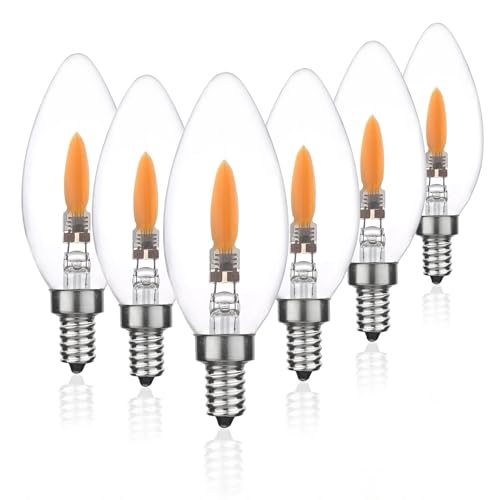
Chandeliers and candelabra fixtures use the smaller E12 base — the "candelabra" socket — and most flame bulbs ignore that market entirely. LVWIT stepped up with this 6-pack specifically designed for E12 applications, and it delivers where it counts. The flame-shaped filament inside each bulb is the key design choice: rather than a generic LED chip, LVWIT shaped the light source itself to resemble a flame, so even in steady mode it looks atmospheric. The 1800K color temperature sits right in that deep amber zone — warmer than a standard warm white bulb, close to what you'd get from a real candle flame.
You get two modes here: steady warm light and flickering flame. That's fewer options than some E26 competitors, but for a chandelier context, you probably don't need breathing mode or gravity induction — you need something that looks beautiful and works reliably across six sockets at once. The 1W draw (equivalent to a 3W traditional bulb) keeps your energy costs negligible even if you leave the chandelier on for hours. Non-dimmable is the one spec to note: if your chandelier is on a dimmer circuit, you'll need to either bypass the dimmer or choose a different bulb.
LVWIT rates these for both indoor and outdoor use, which opens up interesting decorating options — imagine a string of these in outdoor lanterns along a garden path, or inside a covered porch fixture. The 6-pack value is excellent, and the consistent quality across the set means you won't end up with two good bulbs and four duds, which happens more often than it should with budget lighting sets.
Pros:
Cons:
Bitrue's 4-pack stands out because of how seriously they took the latest hardware revision. Compared to their previous generation, this upgrade delivers 30% more brightness, 40% longer service life, and 20% lower energy consumption — those aren't marketing numbers pulled from thin air; they reflect meaningful LED driver and thermal management improvements. If you've bought flame bulbs before and found them dim or short-lived, this is the update that addresses both complaints.
The gravity sensor mode is the feature that really sets Bitrue apart in the 4-mode lineup. In standard flickering mode, the flame points upward and the base is at the bottom — the way most table and floor lamps work. But wall sconces, porch lanterns, and pendant fixtures sometimes position the socket pointing down, which means a standard flame bulb would show a downward-pointing flame. Gravity mode solves this automatically: the bulb detects its orientation and keeps the flame pointing up regardless of which way the socket faces. For a Halloween porch setup with mismatched lanterns and fixtures, this is genuinely useful. Bitrue also recommends installing these in frosted glass lampshades or salt lamp housings for the best flicker effect — and they're right. A clear glass shade reveals the mechanics too clearly.
The four modes follow the same toggle-switching pattern as most competitors: cycle through them by switching the power on and off. General light mode gives you a usable warm white if you need actual visibility rather than ambiance. The white plastic lampshade and black lampholder give the bulb a clean, unobtrusive look when it's off. Watch the product video before purchasing — Bitrue's own recommendation — because the visual difference between a good and mediocre flame bulb is much easier to understand in motion than in a static photo.
Pros:
Cons:
The OMK 2-pack has been on Amazon since 2019 and has accumulated thousands of reviews — which tells you something. This is the bulb that introduced a lot of people to LED flame lighting in the first place. In 2026 it still competes because OMK nailed the fundamentals at a price that's hard to argue with. The flame simulation is convincing enough for casual decorating, and the four-mode setup covers the same range as pricier alternatives: flame mode, normal lighting, breathing mode, and gravity-induced mode.
The OMK bulb works especially well as a low-stakes experiment. If you've never used flame bulbs and you're not sure whether you'll actually like the effect in your space, spending a small amount on a 2-pack to test one or two fixtures is smarter than committing to a 6-pack of premium bulbs. You might discover that your lampshade diffuses the effect too much, or that the flicker feels distracting in a room where you're trying to focus. Testing first is always the right move. If you end up loving the look, you can upgrade to Hompavo or Bitrue for the spaces where quality really shows.
OMK markets these heavily for holiday use — Halloween, Christmas, Valentine's Day, parties — and the bulbs genuinely earn that positioning. In a dimly lit room with multiple OMK bulbs running simultaneously, the combined effect creates the warm, dancing glow that transforms a space. They're listed for both indoor and outdoor use, and the E26 base makes installation immediate. The "adorable home decor" branding on the packaging is a bit much, but the underlying product is dependable. For event decorating where you need eight or ten fixtures covered without blowing a budget, buying several OMK 2-packs is the practical solution.
Pros:
Cons:
LVWIT's flame tip variant takes a different visual approach from their standard flame bulb. Where the other LVWIT E12 model focuses on the internal filament, this version shapes the entire bulb housing into a flame tip — a pointed, elongated form that mimics a traditional candle shape. The result is a bulb that looks elegant even when it's switched off. In a chandelier, you get the physical candle silhouette during the day and the flickering flame effect at night. It's the best-looking unlit bulb in this roundup.
The core specs are identical to the other LVWIT E12 model: 1W draw, 1800K deep amber color temperature, two modes (steady and flickering), non-dimmable, E12 base. The filament inside is flame-shaped, and the combination of the pointed bulb housing and the flame filament creates an especially cohesive aesthetic. If visual design matters to you — if you're decorating a dining room chandelier that guests will look at closely — this is the pick that holds up to scrutiny from every angle.
The 6-pack price makes it practical for full chandelier replacement. Most chandeliers use four to eight bulbs, so one or two packs covers you completely. LVWIT maintains consistent quality across the set, which is worth emphasizing because inconsistent brightness across a chandelier's bulbs is immediately noticeable and looks terrible. Photographers who care about practical lighting on set — like the techniques described in Rethinking the Engagement Photo: A Fresh Approach to Couples Shoots — understand just how much a warm, naturally flickering light source can elevate an ambient scene.
Pros:
Cons:
Most flame bulbs are designed for upright sockets — the kind where the base sits at the bottom and the bulb faces up. But porch lights, wall sconces, and many pendant fixtures hold the socket pointing downward, which means the bulb is installed upside down. Standard flame bulbs in that orientation show a flame pointed at the floor, which looks wrong. CHULEIBACUI engineered this B10/B11 bulb specifically for downward-facing sockets, with the internal flame filament designed to read correctly when the bulb hangs base-up.
The B10/B11 form factor (a smaller, rounder bulb shape similar to a true candle bulb) fits decorative fixtures that require that specific size. The E12 candelabra base is standard for this bulb category. The flickering effect mimics a real candle flame — soft orange glow moving up and down the flame-shaped filament — and the 6-pack gives you enough bulbs to outfit multiple wall sconces or a multi-socket porch fixture in one purchase. CHULEIBACUI designed this one for the holiday decorating crowd, and the Thanksgiving, Halloween, and Christmas use cases are front and center in the spec sheet. A restaurant or bar owner looking to add atmosphere to wall-mounted fixtures will find this equally useful year-round.
The design decision to optimize for upside-down installation is a genuine differentiator. If your wall lamps or porch fixtures have always looked slightly off with flame bulbs pointing the wrong direction, this is the specific solution you've been waiting for. The 6-pack quantity makes it practical to fill every socket in a hallway or along a porch in one order. It also works beautifully in electric candle holders and window candle lights, where the downward socket orientation is essentially the default. If you're setting up content creation lighting and want ideas for how different light temperatures read on camera, What Video Camera Do YouTubers Use? covers some practical considerations around warm ambient light sources.
Pros:
Cons:
This is the first spec to check before anything else. The base type determines whether a bulb physically fits your fixture — no amount of great features matters if you can't screw it in. E26 is the standard US medium base — the same size used by most table lamps, floor lamps, and outdoor fixtures in North America. E27 is the European equivalent and is physically interchangeable with E26 in almost all cases. E12 is the smaller candelabra base used by chandeliers, wall sconces, decorative candelabra fixtures, and many European-style pendants. If you're buying for a chandelier or a candelabra-style lamp, you need E12. If you're buying for a standard lamp or lantern, you need E26. Check the existing bulb in your fixture if you're not sure — the base size is printed on the metal part.
Not all flicker effects are equal. Budget bulbs use a simple on/off pulse at a fixed rate — it looks mechanical and unconvincing, especially up close. Better bulbs vary the flicker timing, intensity, and direction to simulate the organic movement of a real flame. When you're evaluating options, look for bulbs that specifically mention "wobbly" or "organic" flame movement rather than just "flickering." Watch the product video before you buy — static photos can't show you how the flicker actually behaves. A gravity sensor (which keeps the flame pointing upward regardless of socket orientation) is a useful feature if you're installing in downward-facing or side-facing fixtures.
Color temperature (measured in Kelvin) tells you how warm or cool the light looks. Standard warm white LEDs run around 2700K–3000K. Real candle flame sits closer to 1800K–2000K — a much deeper, richer amber. The best flame bulbs target that 1800K range, which is why the LVWIT options in this list feel distinctly more atmospheric than typical warm white LEDs. If you want the full effect — that golden, fire-lit warmth — prioritize bulbs that specify 1800K or lower rather than vague "warm white" claims. In a room where you're also using standard warm white fixtures, the 1800K flame bulbs will stand out as noticeably warmer, which is usually exactly what you want from a decorative accent.
Think about how many fixtures you're covering before you order. A 2-pack works fine for testing or for a single accent fixture. A 6-pack is the practical choice if you're doing a full chandelier (most use 4–8 sockets) or decorating multiple rooms at once. Per-bulb cost drops significantly in 6-packs — usually by 30–40% compared to buying 2-packs — so if you already know you want several, buy the larger pack. The one caveat: make sure the brand you're buying from delivers consistent quality across the pack. Inconsistent brightness in a chandelier is immediately obvious and looks much worse than all bulbs being slightly dimmer.
They work in any fixture that uses the same base type as the bulb. E26 flame bulbs fit standard US lamps, lanterns, and outdoor fixtures. E12 flame bulbs fit candelabra fixtures, chandeliers, and wall sconces. The one exception is dimmer switches — most LED flame bulbs are non-dimmable, so check the spec before installing in a fixture on a dimmer circuit. If the bulb is non-dimmable and you run it on a dimmer, it will either flicker erratically or not work at all.
Many LED flame bulbs are rated for outdoor use, including most models in this list. That said, "outdoor rated" typically means protected outdoor installations — covered porch fixtures, enclosed lanterns, outdoor wall sconces with sealed housings. You should not install any of these bulbs in a fully exposed, unenclosed fixture where rain can hit them directly. Check the product listing for specific outdoor ratings, and always use them in fixtures appropriate for the environment.
Almost all multi-mode LED flame bulbs use the same mechanism: toggle the power switch off and back on to cycle to the next mode. Turn off, wait one second, turn back on — each cycle advances to the next mode in sequence. The mode order varies by brand but is always documented in the product manual. Note that most bulbs reset to the default mode (usually flickering flame) when power is lost, so if you lose power during a storm your bulbs will restart in their default mode rather than whatever you had selected.
The gravity sensor (also called gravity-induced mode) uses a small internal sensor to detect the bulb's physical orientation. When the sensor detects the base is pointing upward (meaning the bulb is installed in a downward-facing socket), it automatically flips the flame direction so the flame still points up. Without this feature, a bulb in a downward socket shows a flame pointing downward, which looks unnatural. It's a genuinely useful feature for porch lights, pendant fixtures, and wall sconces where the socket faces down.
Yes, significantly. A typical incandescent candelabra bulb draws 25–40W. The LED flame bulbs in this list draw 1W–5W for equivalent light output. Over the course of a year, running six 1W LED flame bulbs for four hours daily uses about 8.7 kWh total — the equivalent number of incandescent bulbs would use 87–218 kWh. The energy savings pay back the purchase price within a few months in most households, and the 25,000-hour rated lifespan means you won't be replacing them frequently either.
For Halloween specifically, the Hompavo Upgraded bulbs are the top pick — the highly realistic wobbling flame effect creates exactly the unsettling, atmospheric look that works best for Halloween. In a porch lantern or a salt lamp indoors, the effect is genuinely striking at night. If you need to cover many fixtures on a budget, buy several OMK 2-packs. For downward-facing fixtures like porch ceiling lights, go with the CHULEIBACUI B10/B11 set to ensure the flame reads correctly from every angle.


About Editorial Team
The DigiLabsPro editorial team covers cameras, lenses, photography gear, and creative technology with a focus on helping photographers make informed buying decisions. Our reviews and guides draw on hands-on testing and research across a wide range of equipment, from entry-level beginner kits to professional-grade systems.
You can get FREE Gifts. Or latest Free phones here.
Disable Ad block to reveal all the info. Once done, hit a button below
