The Kodak Carousel 4200 Slide Projector is our top pick for 2026 — it delivers reliable, bright projection with smooth remote-controlled operation that no other vintage projector can match. Whether you're digitizing decades of family memories or running a proper film presentation, the right slide projector makes all the difference between a frustrating experience and one you'll want to repeat.
Slide projectors have made a quiet comeback in 2026. Photographers, archivists, and nostalgia-driven families are rediscovering boxes of 35mm slides in attics and storage units, and they need reliable ways to view them. But the market today spans everything from classic carousel projectors built to last generations to compact handheld LED viewers you can slip into a jacket pocket. Choosing the wrong one means squinting at dim, blurry images — or worse, damaging irreplaceable slides.
This guide covers the seven best slide projectors and viewers available right now. We've tested classic Kodak machines, modern LCD projectors, and pocket-sized viewers to give you a complete picture. Whether you're buying for home use, professional archiving, or occasional casual viewing, check our full buying guide for deeper recommendations before you decide. And if your plan is to eventually digitize those slides permanently, pair your projector with one of the top options from our best 35mm film scanner guide — the two tools work hand in hand.
Contents







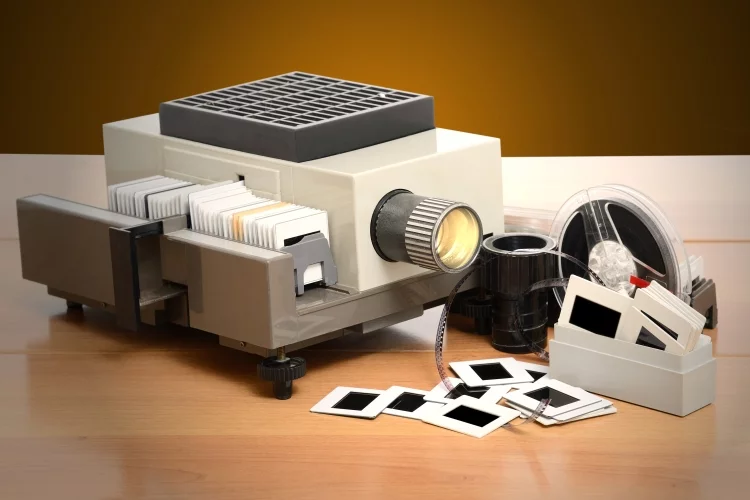
The Kodak Carousel 4200 is the gold standard of slide projectors, and for good reason. This machine was engineered when Kodak still dominated every corner of the photography world, and its build quality reflects that era of overbuilt, last-forever hardware. The projector uses the iconic circular carousel tray system — you load up to 80 or 140 slides depending on your tray, and the projector advances them smoothly with a simple remote control that handles both forward and reverse. That remote is one of the most underappreciated features here: being able to sit across a dark room and control the presentation is what makes the Carousel feel professional rather than clunky.
Kodak engineered improved corner-to-center illumination into the 4200 series, which means you get consistent brightness across the entire projected image rather than a bright center fading to dark edges. This matters enormously when you're projecting photos — a face in the corner of a family portrait should look just as bright as one in the middle. The lamp system uses standard replaceable bulbs that are still easy to source in 2026. One important note: the lens is sold separately, so factor that into your budget. A quality lens makes a significant difference in sharpness and brightness, and Kodak's own projection lenses remain the best match for this body.
The 4200 is not a quiet machine — you'll hear the cooling fan, and the carousel advance clicks with a satisfying mechanical thunk. Some people find that nostalgic; others find it distracting during quiet presentations. For home use with family and friends, it adds to the charm. If you plan to use it for formal presentations or in quiet settings, keep that in mind. Overall, this is the projector to buy if you want the authentic 35mm slide experience. It works with the massive inventory of used Kodak carousel trays available online, and spare parts are still findable.
Pros:
Cons:
The Kodak Ektagraphic III A was built specifically for the professional audiovisual market, and it shows in every detail. While the Carousel 4200 excels for home use, the Ektagraphic III A was designed for conference rooms, lecture halls, and training environments where reliability under heavy, repeated use is non-negotiable. The "III A" designation marks it as part of Kodak's most refined Ektagraphic series — these machines were workhorses in universities, corporations, and government agencies throughout the 1980s and 1990s, and they were built to keep running through thousands of hours of operation.
The Ektagraphic III A's biggest advantage over consumer-grade projectors is its robustness. The internal components are more heavily rated for continuous use, and the design allows for easier servicing when parts eventually wear. The lamp housing and cooling system are engineered for extended run times without overheating. If you're running a multi-hour slide presentation or using the projector for regular archival screening sessions, this machine handles it where a consumer unit might falter. It also uses the standard Kodak carousel tray system, so your existing tray collection transfers directly.
Finding one in good working condition requires some patience — these units circulate primarily through used markets, estate sales, and vintage AV equipment dealers. When you find a well-maintained example, it's worth paying a premium. Check that the lamp works, the carousel drive motor advances smoothly, and the focus mechanism turns freely. The Ektagraphic III A pairs especially well with a quality Kodak Ektanar or Schneider lens, and with proper care it will outlast any modern projector on the market. For anyone serious about 35mm slide projection, this is the professional-grade choice in 2026.
Pros:
Cons:
The Argus Slide Projector Type I is the outlier in this list — it's a modern LCD projector that uses "slide projector" branding to describe its core use case of presenting still images, but it operates nothing like a traditional 35mm slide machine. What you get here is a 1920×1080 full HD LCD projector with 2500 lumens of brightness, which is genuinely useful brightness for a room with some ambient light. If your slides have already been digitized and you want to display them at large scale on a wall or screen, this projector delivers a sharp, clear image that old halogen-lamp projectors can't match.
The portable form factor is a real advantage. This projector weighs significantly less than any vintage Kodak machine, fits in a bag, and sets up in minutes on any flat surface via its tabletop mount. The VGA input means you can connect a laptop or older desktop computer directly without an adapter, which is convenient if you're running a presentation from older hardware. The 1920×1080 resolution (full HD) ensures your digitized slides display with full clarity — you're not losing any detail you've preserved in scanning.
Be clear about what this projector is and isn't. It cannot accept physical 35mm slides — there is no film gate or carousel mechanism. This is purely a digital display device. If you're looking to view your original physical slide collection, this won't help you. But if you've converted your slides to digital files (and if you haven't, check out our recommendations for the best large format scanners that can handle oversized originals), the Argus gives you a modern, bright, high-resolution way to display them at any scale. It's especially useful for photographers who want to present digital portfolios or family archives in a "slide show" format.
Pros:
Cons:
Rollei built some of the finest photographic equipment in the world from their Singapore manufacturing facilities, and the Rollei 35MM Slide Projector Type II represents that same commitment to precision in the projection market. This is a genuine 35mm slide projector that accepts standard mounted slides, and it carries the Rollei reputation for tight tolerances and quality components. If you grew up in Europe or have a collection of European photography gear, you'll feel right at home with Rollei's approach to slide projection.
The Singapore-built construction means this projector benefits from the quality manufacturing practices that made Rollei cameras legendary. The optical path is clean and precise, and the machine handles standard 2×2-inch mounted slides without issue. Like the Kodak machines, this is a halogen-lamp projector that projects physical slides directly — there's no digitization involved, just light through film onto a screen. The image quality with a good lens is outstanding, with the kind of color richness and depth that digital scanning struggles to fully capture.
One consideration with the Rollei is parts availability. While Kodak carousel projectors have a deep aftermarket ecosystem in the United States, Rollei projectors are rarer and replacement parts can be harder to source. If you already own a Rollei camera collection and want your projection equipment to match, this is the obvious choice. If you're coming to slide projection fresh in 2026 with no existing brand preference, the Kodak Carousel ecosystem's larger support network may serve you better long-term. That said, a well-maintained Rollei projector will give you years of reliable service and images that are genuinely beautiful. According to Wikipedia's overview of photographic slides, 35mm remains the most common slide format worldwide, so your compatibility options stay broad regardless of projector brand.
Pros:
Cons:
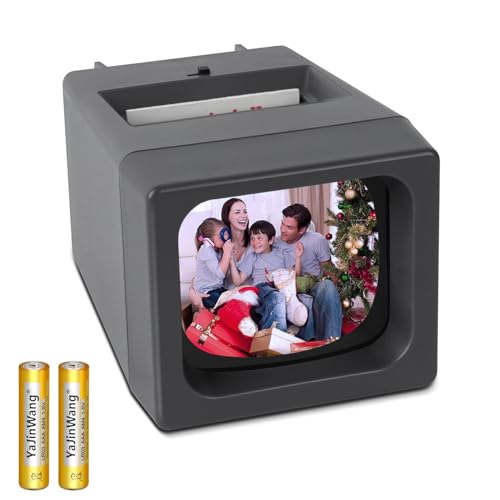
Not everyone needs to project slides onto a wall. Sometimes you just want to look through a box of old 35mm slides quickly, identify which ones are worth scanning or printing, and do it without setting up any heavy equipment. That's exactly what this 2X LED illuminated handheld slide viewer is built for. It fits in the palm of your hand, runs on two AAA batteries (included in the box), and lets you view 35mm slides and film negatives with clear, distortion-free magnification in seconds.
The switchable LED warm light source is a smart design choice. A warm light gives you a more accurate representation of how your slide will look when projected — cooler blue-white LED light can make colors look off, especially in skin tones and warm landscape shots. The 2x magnification is enough to assess sharpness, check for damage, and read any text in the frame. The screen provides even illumination without hotspots (areas that are noticeably brighter than the center), which matters when you're evaluating image quality. It accepts standard 2×2-inch mounted slides as well as 35mm film strips and negatives, so your entire collection is compatible.
The compact, ergonomically curved design makes this a tool you'll actually use. A viewer that's awkward to hold gets set aside; this one fits naturally in one hand while the other manages your slide box. For anyone building a workflow around digitizing a large collection — perhaps using a photo printer to produce prints of your favorites after scanning — this viewer becomes an essential first-pass triage tool. You sort through hundreds of slides quickly, flag the keepers, and only invest serious scanning time in the ones that matter. At its price point, this viewer is the easiest recommendation in this entire guide.
Pros:
Cons:
The Pana-Vue 1 occupies a different niche than the handheld viewer above. This is a tabletop slide viewer designed for extended, comfortable viewing sessions rather than quick identification passes. You set it on a desk or table, the two-way base lets you choose your preferred viewing angle, and the built-in light bar locks into position for consistent illumination every time you insert a slide. That locking light bar is a genuinely useful feature — you don't want the illumination shifting between slides when you're comparing images or doing quality assessment work.
The 4x magnification is meaningfully stronger than the 2x offered by the handheld viewer. At 4x, you can clearly see fine details in your slides: sharpness across the frame, grain structure, minor damage, and color gradations. For photographers evaluating slides for printing or archiving priorities, that extra magnification makes the Pana-Vue 1 a more capable assessment tool than pocket viewers. The viewer accepts standard 2×2-inch mounted slides — the format used by virtually all processed 35mm slide film — and the slot design makes swapping slides quick and smooth.
Power comes from two C batteries, which gives you long viewing sessions without needing to be near an outlet. The black body keeps stray light from contaminating the viewing window, which helps the image look its best. This viewer is a classic design that hasn't needed much improvement over the decades — it does exactly what it's supposed to do, reliably and durably. If you're sitting down for a serious session of sorting and evaluating a large slide collection, the Pana-Vue 1's tabletop stability and stronger magnification give you a more comfortable experience than holding a handheld viewer for an hour. It pairs naturally with a good photo printer when you're ready to produce prints from your best slides.
Pros:
Cons:
This listing is for the GAF ANSCORAMA (also sold as Sears Pro-AM) 100-slide horizontal rotary carousel tray — the circular magazine that holds and feeds slides through a projector. If you have a carousel projector but are missing trays, have damaged trays, or simply need more capacity for a large collection, this is an essential accessory. The horizontal rotary carousel design is the industry-standard format that became dominant through the Kodak Carousel era, and this tray is compatible with Kodak carousel projectors including the 4200 and other models in that family.
The 100-slide capacity is the most useful size for most users. An 80-slide tray fills up quickly during long family archive sessions, while the 140-slide trays can be harder to load and balance. The 100-slide format hits the sweet spot between capacity and usability. The horizontal rotary mechanism advances slides reliably with the projector's remote system, and the tray locks securely onto the projector to prevent accidental drops. Loading is straightforward — slides drop into numbered slots, the tray spins to position each slide for projection, and the whole process is reversible if a slide goes in wrong-side-up.
Buy this tray if you already own a Kodak carousel projector or are buying one and need extra trays for organizing separate collections or events. The used market for carousel trays is abundant, but finding trays in clean, undamaged condition with all slots intact can be hit-or-miss. This listing provides a verified compatible option. One practical tip: number your trays and keep a written log of which slides are in each tray — carousel trays all look identical once loaded, and mixing them up during a presentation is a frustrating experience. This simple habit saves enormous headaches when you're managing collections of hundreds of slides.
Pros:
Cons:
The single most important question before you buy is whether you're working with physical 35mm slides or digitized image files. Traditional carousel projectors like the Kodak models only work with physical slides — you cannot connect a USB drive or laptop to them. Modern LCD projectors like the Argus Type I only display digital files — they have no mechanism for physical film. Handheld and tabletop viewers work exclusively with physical slides and film negatives. Buying the wrong type for your use case means returning the product, so be clear about which format your collection is in before you spend a dollar.
For traditional projectors, brightness comes from the lamp wattage and the quality of the optical system. A higher-wattage lamp gives you a brighter image that holds up better in a room that isn't fully blacked out. Lens quality determines sharpness — a cheap or mismatched lens will produce soft, slightly blurry images even from a high-quality projector body. For the Kodak Carousel projectors, invest in a genuine Kodak or quality third-party projection lens rather than the cheapest option available. For modern LCD projectors like the Argus, brightness is measured in lumens (the Argus provides 2500 lumens), and anything above 2000 lumens is workable in a dimmed room.
If you're buying a carousel projector, check carousel tray compatibility before purchasing. The Kodak Carousel system uses a specific tray format that became an industry standard, giving you access to a large supply of used trays. Non-Kodak projectors may use proprietary tray formats that are far harder to source. If you already own a box of loaded Kodak carousel trays from a previous setup, verify the projector you're buying is compatible with those specific trays — 80-slot and 140-slot trays have slightly different geometries that don't always interchange across projector models.
Handheld viewers and tabletop viewers like the Pana-Vue 1 are for personal, close-up examination of slides — they don't display images to a room. Projectors display images on walls or screens for groups. If your primary need is quickly sorting through a large collection of old slides to identify which ones are worth printing or scanning, a viewer is the right tool and costs a fraction of a projector's price. If you want to recreate the experience of watching a slide show with family the way your grandparents might have, or if you're doing formal presentations with 35mm slides, a projector is what you need. Many serious collectors own both — a viewer for daily sorting work and a projector for occasional presentation events.
No. The Kodak Carousel 4200 and similar models are sold without a lens, but the lens is required for projection. Without a lens, the projector will produce only a diffuse, unfocused wash of light. You need to purchase a compatible projection lens separately. Kodak Ektanar lenses in focal lengths between 100mm and 150mm are the most common and still available through used camera equipment dealers and online marketplaces.
No, they're different. A 35mm slide (also called a transparency or diapositive) is a positive image on film — you can hold it up to a light source and see a correctly colored image directly. A 35mm negative is an inverted image where colors and tones are reversed. Both formats use the same 35mm film size, and most slide viewers and handheld viewers are compatible with both. Projectors, however, are designed specifically for mounted positive slides, not negative strips.
Before buying a used carousel projector, verify three things: the lamp turns on and produces bright, even light; the carousel advance mechanism moves smoothly through several positions without jamming; and the fan runs when the lamp is on. The focus ring should turn freely and produce a sharp image. If the seller cannot demonstrate these functions, treat the projector as a parts unit rather than a working machine. Replacement lamps are available for most Kodak models, but a failed advance motor is a more serious repair.
The difference is slot width. An 80-slide tray has wider individual slots that comfortably accept slides in standard plastic or glass mounts. A 140-slide tray has narrower slots designed specifically for thin cardboard or paper mounts — thicker plastic-mounted slides will not fit and can jam. If your slides are in standard plastic mounts, use 80-slide trays. If they're in thin cardboard mounts (common with slides processed directly by labs in the 1960s–70s), 140-slide trays work. Mixing mount types in a 140-slide tray causes jams and can damage slides.
No. Traditional carousel projectors only work with physical 35mm slides. To display digitized slide images, you need a modern LCD or DLP projector connected to a laptop, tablet, or media player. If your goal in 2026 is to share digitized family archives with a group, a modern projector like the Argus Type I is the right choice. If you want to view the original physical slides, you need a traditional projector. The two formats are not interchangeable.
Standard Kodak Carousel trays come in two capacities: 80 slides and 140 slides. The 80-slide tray is the most commonly used and accepts both plastic-mounted and cardboard-mounted slides. The 140-slide tray is thinner and designed specifically for thin-mount slides only. A third format, the 36-slot half-tray, was used for short presentations and is less common today. For most home and family archive use, the 80-slide tray is the practical choice because it handles the widest variety of mount types reliably.
Know your format first — physical slides need a projector, digital files need a display, and buying the wrong one means buying twice.


About Editorial Team
The DigiLabsPro editorial team covers cameras, lenses, photography gear, and creative technology with a focus on helping photographers make informed buying decisions. Our reviews and guides draw on hands-on testing and research across a wide range of equipment, from entry-level beginner kits to professional-grade systems.
You can get FREE Gifts. Or latest Free phones here.
Disable Ad block to reveal all the info. Once done, hit a button below
