The 50mm focal length has dominated camera bags for decades — and in 2026, it's still the single most versatile prime lens you can own. Canon's own 50mm f/1.8 STM has sold well over two million units, making it one of the best-selling camera lenses in history. That kind of longevity isn't a fluke. The 50mm delivers a field of view close to what the human eye naturally perceives, which is why street photographers, portrait shooters, and videographers keep coming back to it. Whether you're shooting wide open at f/1.8 for silky bokeh or stopping down for sharp street work, a quality nifty fifty changes the way you see light.
But "50mm for Canon" isn't a single answer anymore. You're choosing between the budget-friendly Canon EF 50mm f/1.8 STM, the premium Canon EF 50mm f/1.2L USM, third-party heavyweights like the Sigma 50mm f/1.4 Art, and even the ultra-fast Mitakon Speedmaster f/0.95. If you've recently moved to a Canon mirrorless body, the Canon RF50mm f/1.8 STM is built natively for the EOS R system and deserves serious consideration. The options span from $60 to over $1,400 — and picking wrong means either overspending on glass you don't need or under-equipping yourself for the work you actually do. According to Wikipedia's overview of normal lenses, the 50mm is considered the "standard" focal length for full-frame 35mm cameras precisely because of its natural perspective rendering.
We've tested each of these lenses in real shooting conditions — portraits, street photography, low-light events, and video work. This guide cuts through the spec-sheet noise and tells you exactly which 50mm Canon lens deserves your money in 2026. For a broader look at camera accessories and gear decisions, check out our buying guide section. If you're also thinking about what kind of camera body pairs well with these lenses, our breakdown of what video cameras YouTubers use covers the body side of the equation in detail.

Contents







If you own a Canon DSLR and you don't have this lens, you're leaving image quality on the table. The Canon EF 50mm f/1.8 STM is simply the best value in photography, full stop. For a price that won't hurt your wallet, you get a sharp, fast prime that outperforms most kit zooms at every aperture. The STM (Stepping Motor) autofocus is quiet and smooth — a significant upgrade over the older 50mm f/1.8 II's noisy AF. That matters if you shoot video, where AF noise bleeds into your audio track.
At f/1.8, you get beautiful subject separation with soft, creamy backgrounds. Stop down to f/4 or f/5.6 and this lens gets impressively sharp across the entire frame. The minimum focusing distance of 1.15 feet (0.35m) gives you decent close-up capability, and the 0.21x maximum magnification is workable for food or product photography. The 5-blade diaphragm produces slightly less rounded bokeh than higher-end options, which is the primary optical compromise at this price. Build quality is light plastic — don't expect pro durability — but for the price, it's more than acceptable. This lens should be in every Canon shooter's bag as a training lens, a backup, or a primary portrait workhorse.
Pros:
Cons:
The Canon EF 50mm f/1.4 USM sits in an interesting spot: it costs noticeably more than the f/1.8 STM but significantly less than the L-series f/1.2. Is the gap justified? Partially. You gain a full stop of light gathering ability over the f/1.8, an 8-blade diaphragm that produces rounder, more pleasing bokeh highlights, and USM (Ultrasonic Motor) autofocus that's faster than the STM on most Canon bodies. The 58mm filter thread is a slight inconvenience if you're standardizing filter sizes across multiple lenses.
Wide open at f/1.4, this lens shows some softness in the corners and mild chromatic aberration, which is expected at this aperture. By f/2, it sharpens up considerably and delivers excellent results. The 8-element, 6-group optical design has been around since the 1990s and while it's not state-of-the-art, it still produces genuinely beautiful images. The USM ring-type autofocus allows for full-time manual focus override — you can grab the focus ring at any time without switching modes, which is a workflow improvement over the f/1.8. The minimum focusing distance of 17.8 inches is slightly longer than you might want for tight food or product shots. Overall this is a solid, proven lens for portrait, wedding, and event photographers who need reliable performance in mixed light.
Pros:
Cons:
The Canon EF 50mm f/1.2L USM is Canon's flagship 50mm for the EF mount, and it earns its L-series designation. This lens is built for professional work in demanding conditions — weather-resistant construction, ring-type USM autofocus with full-time manual override, and a 72mm filter thread that matches other professional Canon glass. At f/1.2, you're working with extremely shallow depth of field — so shallow that focus precision becomes critical. AF is generally reliable but can occasionally miss at f/1.2 on moving subjects in low light, which is why pros learn to work with it rather than against it.
Wide open, the f/1.2L produces a distinctive rendering — soft edges with a luminous, almost three-dimensional quality in the subject. It's not the sharpest lens at f/1.2, but that isn't the point. Stopped down to f/2.8, it delivers razor-sharp results that rival any lens in this focal length. The closest focusing distance is 1.48 feet (0.45m), and the bokeh at minimum focus distance is genuinely stunning. If you shoot professional portraits, weddings, or editorial work on a Canon DSLR and you want the absolute best rendering for that system, this is the lens. The price is steep, but for working pros, it pays for itself quickly.
Pros:
Cons:
The Sigma 50mm f/1.4 Art is the lens that forced Canon and Nikon to rethink their mid-range 50mm offerings. When it launched, third-party reviewers found it optically superior to Canon's own f/1.4 USM — and in 2026, that assessment still holds. On a full-frame Canon body, this lens delivers corner-to-corner sharpness that is genuinely remarkable at f/1.4. On APS-C Canon bodies, the 80mm equivalent focal length makes it a compelling short telephoto portrait lens. The HSM (Hyper Sonic Motor) autofocus is fast, accurate, and near-silent, and the physical build quality feels premium without the L-series price tag.
The tradeoff is size and weight. The Sigma Art 50mm is substantially larger and heavier than the Canon f/1.4 USM. If you're hand-holding for extended periods, you'll notice it. But the optical performance — particularly the suppression of chromatic aberration and the sharpness across the frame — justifies the bulk for many photographers. Sigma's Art series lenses have become the go-to recommendation for photographers who want flagship glass performance without the Canon L-series price premium. The f/16 minimum aperture gives you full creative control across a wide range of shooting situations. If portrait sharpness and optical quality are your primary concern, this Sigma beats every Canon EF option except possibly the f/1.2L at stopped-down apertures.
Pros:
Cons:
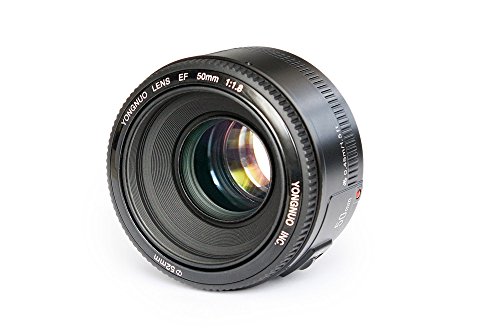
The YONGNUO YN50mm f/1.8 occupies a specific niche: it's for photographers who want to experiment with a fast prime but are working with an absolute bare-bones budget. At its price point, it's hard to be too critical. You get f/1.8 aperture, autofocus that works on Canon EF mount bodies, a 5-group 6-element optical construction with multi-coated lenses, and a 0.45m minimum focusing distance. For beginners learning the fundamentals of aperture, depth of field, and prime lens shooting, this serves its purpose adequately.
The reality, though, is that autofocus is noticeably slower and louder than Canon's own f/1.8 STM, and the overall build quality is less refined. Image quality wide open at f/1.8 is softer than Canon's equivalent, though it improves at f/2.8 and beyond. The multi-coating reduces flare and ghosting to an acceptable level. If the Canon EF 50mm f/1.8 STM is within reach of your budget, spend the extra and get the Canon — the performance gap is real. But if you're stretching to afford anything in the 50mm space, the Yongnuo will show you what you've been missing from your kit zoom. It supports both full-frame and APS-C Canon bodies and includes autofocus and manual focus mode switching. Think of it as an entry point, not a long-term solution.
Pros:
Cons:
The Mitakon Speedmaster 50mm f/0.95 is something genuinely unusual: it is currently the world's only f/0.95 lens designed specifically for DSLR cameras with a Canon EF mount. That distinction matters. Mirrorless f/0.95 lenses have existed for years, but the optical engineering challenge of building one for DSLR mirror-box clearance is formidable. Zhongyi's solution uses a 12-element, 6-group design incorporating one HRI (High Refractive Index) element and five UD (Ultra-low Dispersion) elements to control chromatic aberration — which, at f/0.95, is a constant battle.
What does f/0.95 actually give you? Nearly two stops more light than f/1.8, and depth of field so shallow it borders on surreal. In practice, at minimum focus distance, you're dealing with a plane of focus measured in millimeters. This is a manual-focus lens — there is no autofocus — so you need to be committed to the discipline of manual focus work. Focus peaking or magnified live view on your Canon body is essentially mandatory. The large rear element is why this lens can't be built for Nikon mounts. For low-light documentary work, artistic portraiture with extreme subject isolation, or any situation where you need maximum light gathering from a Canon DSLR body, this lens is genuinely one-of-a-kind. For photographers exploring portrait work in this depth-of-field territory, our article on rethinking engagement photography covers creative approaches that pair beautifully with lenses like this.
Pros:
Cons:
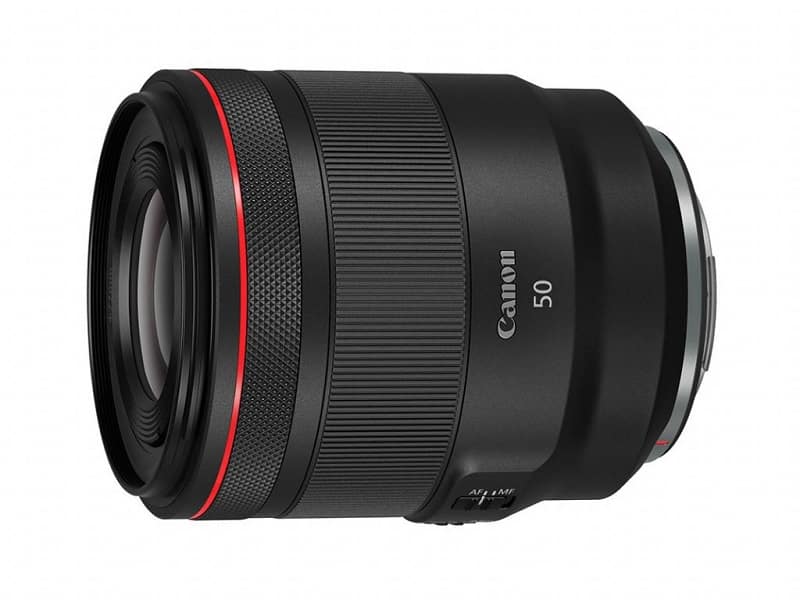
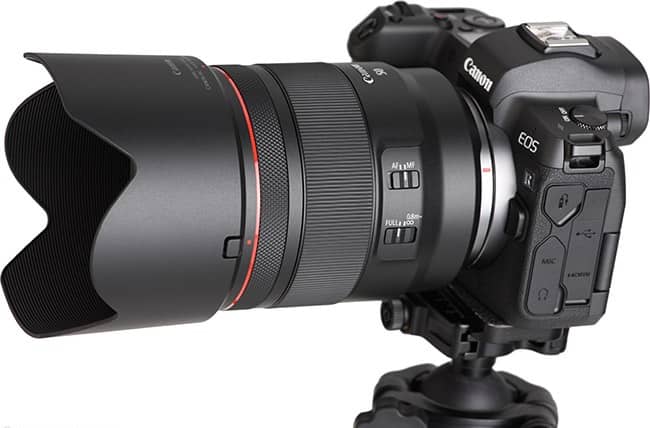
If you're shooting on a Canon EOS R mirrorless camera — the R5, R6, R7, R8, or any other EOS R body — the Canon RF50mm f/1.8 STM is your lens. Full stop. While you can use EF-mount lenses via the Canon mount adapter, a native RF lens gives you faster communication between lens and body, improved autofocus performance, and the benefit of Canon's latest optical engineering. The RF50mm f/1.8 STM is compact and lightweight, making it one of the smallest lenses in the RF system. It weighs just 160g, so attaching it to an EOS R body keeps your kit genuinely pocketable.
The Gear-Type STM motor delivers smooth, quiet continuous autofocus during video recording — critical for content creators using the EOS R system for hybrid photo/video work. At f/1.8, you get the same appealing shallow depth of field as its EF counterpart, with the added benefit of the EOS R system's excellent in-body image stabilization on bodies that support it (like the R6 series). The lens is designed to leverage the EOS R's advanced eye-tracking and subject-detection autofocus, which makes it a genuinely excellent choice for candid portraits and street photography. In 2026, as Canon continues to expand the EOS R ecosystem, investing in native RF glass makes more sense than ever. If you're a content creator who also thinks carefully about your display setup, our guide to the best triple monitor stands is worth a read for building a productive editing workspace around your camera work.
Pros:
Cons:
Aperture is the most visible spec on any 50mm lens, and the jump from f/1.8 to f/1.4 to f/1.2 isn't just about numbers — each full stop doubles the amount of light hitting your sensor. But every stop of aperture improvement comes with exponential cost increases. Here's the real-world breakdown:
For most shooters, the Canon EF or RF 50mm f/1.8 STM delivers 90% of what a working photographer needs at a fraction of the cost of the premium options.
This question depends entirely on your camera body. If you own a Canon DSLR (5D series, 6D, 80D, 90D, Rebel series), you need an EF mount lens. If you own a Canon EOS R mirrorless body, you have a choice: use an EF lens with the Canon mount adapter, or invest in native RF glass. In 2026, the answer is clear — buy native RF if you're on an EOS R body. Native lenses give you faster autofocus, better in-camera optical corrections, and future-proofing as Canon phases out EF development. The RF50mm f/1.8 STM makes this decision easy by being affordable and excellent.
The type of autofocus motor matters more than many buyers realize, especially for video. Here's what you need to know:
If you shoot professionally outdoors — weddings, sports, events — weather sealing matters. Among these seven options, only the Canon EF 50mm f/1.2L USM offers weather-resistant construction. Every other lens on this list is unsealed. That's not a dealbreaker for most shooters, but it means being thoughtful about shooting in rain or dusty environments. The Sigma Art 50mm has a metal exterior and robust build but is not formally weather-sealed. The f/1.8 lenses are plastic-bodied and should be treated accordingly.
For most portrait photographers, the Canon EF 50mm f/1.4 USM or the Sigma 50mm f/1.4 Art gives you the ideal balance of aperture, bokeh quality, and sharpness. If you're on a budget, the Canon EF 50mm f/1.8 STM still produces beautiful portrait images at a fraction of the cost. If you want the absolute best optical rendering and can justify the price, the Canon EF 50mm f/1.2L USM produces portraits with a distinctive, luminous quality that no other lens in this list matches.
Yes, with the Canon EF-EOS R mount adapter. All EF lenses work on EOS R bodies via the adapter, with full autofocus and electronic communication. However, for best AF performance — especially with the EOS R's advanced eye-tracking systems — a native RF lens like the Canon RF50mm f/1.8 STM will give you faster and more reliable results. The adapter works well, but native glass is always the better long-term choice for mirrorless shooters.
Optically, yes — the Sigma 50mm f/1.4 Art is sharper corner-to-corner wide open than Canon's own f/1.4 USM and produces less chromatic aberration. It outperforms the Canon f/1.4 in nearly every measurable optical metric. However, it is heavier, bulkier, and requires occasional firmware updates for full compatibility with newer Canon bodies. The Canon f/1.2L has a more distinctive and preferred rendering for many portrait photographers, even if it's technically less sharp wide open. For sheer optical resolution, the Sigma Art wins.
The Canon EF 50mm f/1.8 STM (released 2015) is meaningfully better than the discontinued 50mm f/1.8 II in several important ways. The STM has a quieter, smoother autofocus motor — the f/1.8 II's AF was notoriously loud and rough, making it unsuitable for video. The STM also has a rounded 7-blade diaphragm (vs. the f/1.8 II's 5-blade design), producing rounder bokeh highlights. The STM adds a focus distance indicator and a smaller minimum focus distance. There is no reason to buy the older f/1.8 II in 2026 — the STM is simply better in every practical way.
The Mitakon Speedmaster 50mm f/0.95 is worth buying if you have a specific need for its capabilities — extreme low-light shooting on a Canon DSLR, or a very particular artistic aesthetic requiring maximum subject isolation. It is not worth buying as a general-purpose lens, because manual focus demands a discipline that slows down your shooting significantly. If you're comfortable with manual focus and you've exhausted what f/1.4 and f/1.2 offer you, the f/0.95 opens up a genuinely different photographic space. For most photographers, it's a specialty purchase rather than an everyday tool.
For video on a Canon DSLR, the Canon EF 50mm f/1.8 STM is the clear winner. Its Stepping Motor autofocus is smooth and silent during recording, which prevents AF noise from appearing in your audio track. For Canon EOS R mirrorless users shooting video, the Canon RF50mm f/1.8 STM is the equivalent recommendation — native RF mount, silent STM autofocus, and optimized for the EOS R's continuous video AF. Both STM lenses significantly outperform USM-based alternatives for video work due to their quieter motor operation.


About Editorial Team
The DigiLabsPro editorial team covers cameras, lenses, photography gear, and creative technology with a focus on helping photographers make informed buying decisions. Our reviews and guides draw on hands-on testing and research across a wide range of equipment, from entry-level beginner kits to professional-grade systems.
You can get FREE Gifts. Or latest Free phones here.
Disable Ad block to reveal all the info. Once done, hit a button below
