Which motorcycle dash cam actually holds up when a car cuts you off at 60 mph — and gives you usable footage to prove it? That's the question every rider needs answered before spending money on a camera. After evaluating the top options available in 2026, the VIOFO A229 Plus stands out as the overall best choice for most riders who want dual-channel clarity without compromise. But the right cam for you depends on what you ride, how you ride, and what you need to protect.
Motorcycle dash cams have come a long way. Early models were little more than repurposed car cams with flimsy mounts. Today's purpose-built motorcycle cameras deliver 4K resolution, IP67 waterproofing (meaning fully dust-tight and water-resistant up to 1 meter), electronic image stabilization, GPS logging, and app connectivity — all in compact packages built to survive vibration, heat, and rain. Whether you commute daily, tour on weekends, or track your rides for insurance purposes, there's a camera in this list built for your situation.
This guide covers seven of the most capable motorcycle dash cams on the market right now. We break down specs, real-world performance, and who each model suits best. If you're still figuring out what features matter most, jump to our buying guide section below. For a broader look at how cameras handle motion and low light, you might also find our guide on how to choose a video camera useful before diving in.

Contents





The VIOFO A229 Plus earns the top spot in 2026 by doing something no other dash cam in this category does: it pairs two Sony STARVIS 2 IMX675 sensors — one front, one rear — for dual-channel recording that's a full generation ahead of the competition. STARVIS 2 (Sony's second-generation low-light imaging technology) delivers 2.5 times better dynamic range and 2.5 times higher light sensitivity than the original STARVIS. In plain terms: your night footage actually looks like night footage, not a blurry soup of headlights and shadows.
Both channels record at 1440P (2K), and the front camera hits up to 60fps when HDR is disabled — giving you silky-smooth motion capture on fast-moving rides. Switch HDR on and the camera captures dramatically more detail in high-contrast situations, like riding from a dark tunnel into bright sunlight. The 5GHz Wi-Fi connection is noticeably faster than the 2.4GHz found on older models, making footage transfer quick and painless. Ultra-precise GPS logs your route, speed, and coordinates embedded in the video — solid evidence if you ever need to dispute a claim. Voice control lets you trigger recording, lock clips, and take photos without lifting a hand from the bars.
The A229 Plus is primarily designed as a car dash cam, which means you'll need a mounting solution suitable for your handlebars or fairing — check your bike's setup before ordering. That said, its performance in video quality, low-light capability, and connectivity puts it ahead of dedicated motorcycle cams that cost the same or more. If image quality is your top priority and you're willing to sort out mounting, this is your camera.
Pros:
Cons:
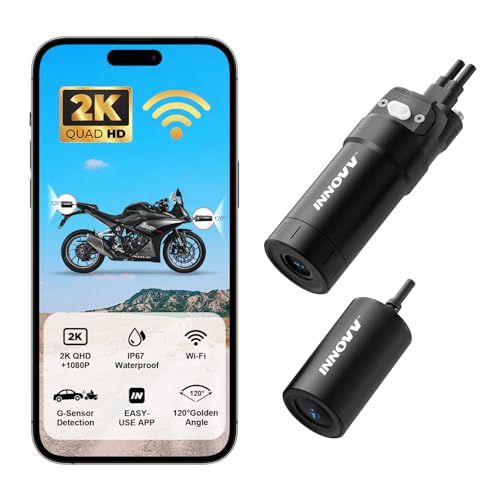
The INNOVV K6 is what a motorcycle dash cam should look like from the ground up. It's small, it's tough, and it's built specifically for two-wheel life. The front camera shoots 2K QHD (1440P at 30fps) with a Sony STARVIS sensor, while the rear captures 1080P at 30fps — a practical combination that prioritizes front-facing detail where you need it most. The full aluminum alloy body handles both extreme heat and extreme cold without warping or cracking, and it dissipates heat far better than plastic-bodied rivals that can overheat in summer traffic.
The IP67 waterproof rating is the real headline here. IP67 means fully sealed against dust and able to survive submersion in up to half a meter of water for 30 minutes. That's not just rain protection — that's genuine all-weather resilience. You can ride through a downpour, power-wash your bike, and the K6 keeps working. The 120-degree field of view is marketed with INNOVV's "Golden Angle" branding — wide enough to capture adjacent lanes and intersections without the fisheye distortion that extreme wide-angle lenses introduce. Wi-Fi connectivity lets you review and download clips from your phone without pulling SD cards.
The K6 supports cards up to 256GB, which gives you roughly 4–6 hours of dual-channel footage before it loops and overwrites old files. Setup is clean and discreet — the cameras are small enough to tuck into most fairings or mount on the handlebars without looking out of place. For commuters who want a set-it-and-forget-it solution that's genuinely weatherproof, the K6 is hard to beat at its price point.
Pros:
Cons:
If you want 4K resolution on a motorcycle dash cam without spending a fortune, the Vantrue F1 is the answer. The front camera records at 4K 30fps using Sony STARVIS technology, while the rear covers 1080P — and both cameras are wrapped in a full IP67 waterproof body. Every accessory in the box, including cables and mounts, is also waterproof. That's a level of detail most competitors skip. The 160-degree field of view on both cameras is wide enough to cover three lanes of traffic, making it especially useful for filtering through city traffic or navigating complex intersections.
GPS logging is integrated and does more than just track your route. The Vantrue app and desktop GPS player let you overlay speed, coordinates, elevation, and even mileage statistics onto your footage — data you can export as a PDF if you ever need to submit it as evidence. Average speed, max speed, and trip start/end times are all recorded automatically. For touring riders who document their routes or want ironclad records for insurance purposes, that data logging is genuinely useful, not just a marketing checkbox.
The wired remote is a standout feature missing on most competitors. You can trigger emergency clip locking and toggle recording from the handlebars without reaching for your phone or fumbling with camera buttons. Parking mode rounds out the feature set — a G-sensor (a gyroscope-based impact detector) triggers recording if someone bumps or tampers with your parked bike. The F1 supports cards up to 512GB, making it one of the most generous storage options in the category. If you tour long distances and don't want to manage storage frequently, that matters.
Pros:
Cons:
The INNOVV K7 is the upgraded sibling of the K6, and the key improvement is right there in the name: EIS (Electronic Image Stabilization). When EIS is active, the K7 records 2K+2K front and rear at 30fps — and the stabilization actually works. On rough pavement, cobblestones, or gravel, the K6's footage can shake noticeably. The K7's footage stays smooth. Disable EIS and you can push to higher bitrates, but for most riders leaving EIS on is the right call. The 160-degree field of view on both cameras covers the same three-lane width as the Vantrue F1, maintaining that competitive standard.
The 24-hour Sentry Mode is well implemented. In parking mode, the built-in G-sensor watches for impacts or movement. If triggered, it records a 30-second protected clip that won't be overwritten by the loop recording cycle. In the event of an actual crash while riding, the G-sensor automatically locks the footage as a protected file the moment impact is detected — so you don't lose the most critical clip. This is standard on most good dash cams, but the K7's implementation is reliable and configurable through the INNOVV app.
The 5.8GHz Wi-Fi connection is twice the speed of the 2.4GHz found on older models and on the K6, making app connectivity noticeably faster. If you're used to waiting for footage to transfer, the K7 speeds that up considerably. It supports up to 512GB storage, and the app gives you full control over settings, clip management, and sharing. For riders who prioritize smooth stabilized footage and want genuine dual-2K recording front and rear, the K7 is the strongest dedicated motorcycle cam in this comparison.
Pros:
Cons:
The Sena 50C is a fundamentally different product from everything else on this list. It's not just a camera — it's a complete helmet-mounted communication and recording system. The 4K camera is integrated into a Mesh intercom headset with Harman Kardon premium speakers and microphone. If you already need a high-end intercom for group rides, the 50C lets you add 4K camera capability without mounting a second device. That's a meaningful advantage for touring riders and group-ride regulars.
Sena's Mesh 2.0 technology allows rider-to-rider communication with virtually no range limit in a group — each unit in the mesh relays signal forward, so your group can theoretically span miles and still talk clearly. Bluetooth is also included for calls, music, and pairing with a phone. The Harman Kardon-tuned speakers are genuinely premium — this isn't a compromise audio experience bolted onto a camera. You get great sound for both communication and music, plus a quality microphone that captures your narration cleanly. That Smart Audio Mix feature means you can talk while riding and the camera records your voice naturally, with no post-production needed.
As a standalone dash cam, the 50C has limitations — it captures one angle (forward-facing from your helmet), and helmet mounting means the camera moves with your head, not your bike's chassis. That's not ideal for capturing license plates behind you in an accident. But as a multi-function device for riders who want intercom, music, GPS compatibility, and 4K recording in one helmet unit, nothing else on this list competes with it. Sena is the established leader in motorcycle helmet communication — the 50C is their flagship, and it shows.
Pros:
Cons:
The Sena 10C EVO is the accessible entry point into Sena's camera-plus-intercom lineup. It records video at up to 4K/30fps — the same maximum resolution as the flagship 50C — and adds Bluetooth communication for connecting with other riders or pairing with your phone. The Smart Audio Mix feature is included, so you can narrate your rides, record phone conversations, or capture ambient sound without any follow-up editing. It also supports still photos in regular, burst, and time-lapse modes, which makes it more versatile than a pure dash cam for riders who like documenting their journeys visually.
Group Intercom allows you to stay connected with up to three other riders simultaneously. It's Bluetooth-based rather than Mesh-based like the 50C, which means range is more limited — but for most riding groups, Bluetooth intercom is plenty for a weekend ride. The HD speakers deliver solid audio quality for music and communications, though they don't hit the premium level of the Harman Kardon-tuned units in the 50C. Installation is straightforward — Sena designs its systems to integrate cleanly with most full-face and modular helmets.
For new riders entering the camera-intercom combo market, or for riders who don't need Mesh range but want reliable Bluetooth communication with recording capability, the 10C EVO represents strong value. You get 4K footage, quality audio mix, and proven intercom in a simpler package than the 50C. If you also want to understand how camera technology applies to content creation on the road, our article on what video camera YouTubers use offers some interesting perspective on what makes footage compelling.
Pros:
Cons:
The DRIFT Ghost XL PRO takes a different approach than every other camera on this list. It's an action camera — designed to be worn on your body or helmet, mounted on handlebars, or attached to your bike for cinematic footage. IPX7 waterproofing means fully waterproof out of the box with no housing needed, and DRIFT even offers a waterproof charging cable so you can record and charge simultaneously on marathon rides. At 4K resolution, footage is sharp and detailed enough for social sharing, vlogging, or serious documentation.
The 3000mAh battery is the standout specification here. That translates to up to 7 hours of continuous recording — longer than any dedicated dash cam on this list by a significant margin. For adventure riders doing remote trails or cross-country touring without frequent access to power, that runtime is a genuine advantage. Wi-Fi connectivity enables live streaming directly from the camera, a feature that touring content creators will appreciate. The action cam form factor also means you can remove it from your bike and use it handheld, clipped to a backpack, or mounted on a helmet — flexibility none of the fixed dash cams offer. If you're interested in how action cameras compare to traditional video cameras for capturing motion, our piece on the TomTom Bandit action camera explores that topic in detail.
The trade-off is obvious: as a motorcycle dash cam specifically, it lacks loop recording, automatic incident detection, a rear camera, and built-in parking mode. It's not a set-and-forget safety device — it's a camera you actively use. If you want both dash cam functionality and action camera flexibility, you'd need to combine the Ghost XL PRO with a dedicated dash cam. But for riders who primarily want to document their rides, create content, or capture adventure footage with excellent battery life, it earns its place in this comparison.
Pros:
Cons:
This is the single most important spec for a motorcycle camera, because your bike is exposed to rain, spray, humidity, and sometimes full washdowns. IP67 is the gold standard for motorcycle dash cams: the "6" means fully dust-tight, and the "7" means the device can survive being submerged in up to 1 meter of water for 30 minutes. IPX7 means waterproof to the same depth but without the dust-tight rating — still very solid for most riding conditions. Cameras with no weatherproofing rating should be avoided for motorcycle use entirely, no matter how good their video specs look. Water damage voids warranties and can corrupt critical footage at the worst possible moment.
In 2026, 2K (1440P) is the practical minimum for a front-facing motorcycle dash cam if you need to read license plates clearly. 4K is better, but file sizes are significantly larger. More important than raw resolution is the image sensor quality — a 2K camera with a Sony STARVIS 2 sensor will outperform a 4K camera with a generic sensor in low-light conditions. Night recording capability matters more than daytime specs, because most accidents involving other vehicles happen in conditions of reduced visibility — dawn, dusk, and night. Look for STARVIS or STARVIS 2 sensor mentions specifically.
Where a camera mounts on your bike determines what it can capture. Handlebar or fairing mounts give you a stable, bike-fixed angle — good for license plates and following distances. Helmet mounts move with your head, which can be useful for capturing what you're looking at but makes footage harder to use as objective evidence. A dual-channel system with front and rear coverage is the most complete safety solution, since rear-end collisions are a constant risk for motorcyclists. Look for a minimum 120-degree field of view — narrower than that, and the camera misses too much of what's happening around you.
A dash cam without loop recording will fill your SD card and stop recording — at which point you lose footage of any subsequent incident. Loop recording continuously overwrites the oldest files as the card fills up, keeping the camera always recording. Parking mode extends that protection to when your bike is stationary, using a G-sensor to detect impacts or tampering and automatically lock those clips from being overwritten. If you park on public streets or in shared lots, parking mode is worth having. The G-sensor (which detects sudden acceleration changes, including collisions) is also what triggers automatic emergency clip locking in motion — a feature worth confirming is present on any cam you consider for safety use.
You can use a car dash cam on a motorcycle, but you'll face two challenges: mounting and weatherproofing. Car dash cams typically use suction mounts designed for windshields, so you'll need to source a handlebar or fairing mount separately. More critically, most car dash cams are not waterproof — expose them to rain and they'll fail. If you choose a car dash cam like the VIOFO A229 Plus, verify your mounting plan and consider whether the lack of waterproofing is acceptable for your riding conditions before buying.
For day-to-day commuting, a 64GB or 128GB card is sufficient — that covers several hours of dual-channel 2K footage before the loop starts overwriting. If you tour long distances or want to keep footage for multiple days without managing your card, go with 256GB or 512GB. The INNOVV K7 and Vantrue F1 both support up to 512GB, which gives you exceptional headroom. Always use a high-endurance SD card rated for dash cam use — standard cards aren't designed for the constant write-and-erase cycles that loop recording demands.
For legal evidence purposes, a bike-mounted camera is generally more reliable. It provides a fixed, consistent angle that represents what a reasonable observer at that position would see — courts and insurers find this more objective. A helmet-mounted camera is more dynamic and can capture more of your visual perspective, but because it moves with your head, the angles change constantly. For pure documentation and content creation, helmet mounting is often more interesting footage. For safety and insurance evidence, mount the camera on the bike.
IP67 is an International Protection rating — the "6" means completely dust-tight (no dust ingress), and the "7" means the device can be submerged in up to 1 meter of water for up to 30 minutes without damage. For motorcycle riding, IP67 is more than sufficient for any weather condition you're likely to encounter: heavy rain, road spray, mist, and pressure washing your bike. It's the standard you should require for any camera mounted on the exterior of your motorcycle.
Yes, and in many cases it's decisive. Dash cam footage has been used successfully in insurance claims and civil litigation to establish fault, disprove false claims, and document the behavior of other drivers. GPS data embedded in the footage (available on cams like the Vantrue F1 and VIOFO A229 Plus) adds speed and location context that strengthens the evidentiary value. The key is having a camera with reliable loop recording and G-sensor auto-lock so critical footage isn't overwritten before you can retrieve it.
Most dedicated motorcycle dash cams like the INNOVV K6 and K7 are hardwired to your bike's electrical system with a smart fuse tap — they draw power only when the ignition is on, and automatically shut off when you turn the bike off. For parking mode to work, you need a connection to a circuit that stays live with the ignition off, but the cam should include a low-voltage cutoff to prevent draining your battery below a safe threshold. Follow the manufacturer's wiring diagram precisely, and if you're not comfortable with motorcycle electrical work, have a shop handle the installation.


About Editorial Team
The DigiLabsPro editorial team covers cameras, lenses, photography gear, and creative technology with a focus on helping photographers make informed buying decisions. Our reviews and guides draw on hands-on testing and research across a wide range of equipment, from entry-level beginner kits to professional-grade systems.
You can get FREE Gifts. Or latest Free phones here.
Disable Ad block to reveal all the info. Once done, hit a button below
