You've spent twenty minutes reading specs on a scanner manufacturer's website, and you still can't tell whether the ADF capacity is 50 pages or 100, or whether "wireless" means Wi-Fi or just Bluetooth. That confusion is completely normal in a product category where marketing copy often obscures the details that actually matter. Whether you're digitizing stacks of old family photos, processing client contracts, or running a small office that moves paper daily, the right automatic document feeder photo scanner transforms a tedious chore into a two-click workflow.
In 2026, the market has matured considerably, with top-tier options from Fujitsu, Brother, Epson, Canon, and Ricoh covering every price point and use case. The best ADF photo scanner for your situation depends on three core factors: scan speed, ADF capacity, and how you connect the device to your existing workflow. A home user digitizing shoeboxes of photos needs something different from a legal office scanning 1,000 pages per day. This guide cuts through the noise and gives you direct, spec-backed recommendations for each scenario.
Before you dive into individual reviews, it helps to understand what separates a capable ADF scanner from a great one. For deeper context on multi-page document workflows, our guide on how to scan multiple pages into one PDF walks you through the software side of the equation. You can also explore our broader buying guide for tech and imaging gear across all categories. According to Wikipedia's overview of image scanners, optical resolution and color depth remain the two most technically significant specifications when evaluating any flatbed or sheet-fed scanner for photo work.

Contents






The Fujitsu ScanSnap iX1600 has earned its reputation as the go-to ADF scanner for teams and shared workspaces, and the 2026 model continues that tradition with a polished, user-friendly experience that doesn't require a technical background to operate. At 600 dpi optical resolution, it captures text and images with the clarity you need for both archival photo work and everyday document digitization. The large 4.3-inch color touchscreen lets multiple users store personal scan profiles directly on the device, which means your colleague's settings never overwrite yours.
Fujitsu's ScanSnap Home software ties everything together with intelligent auto-detection, separating receipts from contracts from photos without you having to configure separate scan jobs. The 50-page ADF handles mixed batches reliably, and the Wi-Fi connectivity means you can place it anywhere on your desk without running a USB cable to your workstation. For any team with two or more people sharing one scanner, the iX1600 is the most thoughtfully designed option in this price range.
Build quality is premium — the white finish stays clean, and the paper feed mechanism is noticeably smoother than similarly priced competitors. At up to 40 pages per minute, it won't bottleneck even a moderately busy office workflow.
Pros:
Cons:
If your office moves serious paper volume and needs a scanner that keeps pace without complaining, the Brother ADS-4900W is built precisely for that scenario. Its 60 pages per minute single-pass duplex speed is among the fastest in its class, and the 100-page ADF capacity means you load a stack, press scan, and walk away while it works. The continuous scanning mode lets you add additional sheets mid-job, which is a real productivity multiplier when you're digitizing large archives or multi-hundred-page contracts.
The ADS-4900W integrates seamlessly with virtually any document management ecosystem through its broad driver support — TWAIN, WIA, ISIS, and SANE are all covered, making it compatible with legacy software setups that many corporate IT departments still rely on. Scan-to destinations include email, cloud services, SharePoint, SSH/SFTP servers, and USB drives, giving your team genuine workflow flexibility without additional middleware. The large touchscreen simplifies operation for less technical staff, and the wireless connectivity means you're not constrained by USB cable length.
For demanding workgroups processing thousands of pages per week in 2026, the ADS-4900W delivers enterprise-grade throughput at a price that fits small-business budgets. The build quality is solid and designed for sustained daily use rather than occasional scanning sessions.
Pros:
Cons:
Epson's DS-530 II occupies a sweet spot for users who need dependable, daily-use scanning without paying for features they'll never touch. At 35 ppm/70 ipm with one-pass duplex, it handles the workload of most small offices and home businesses without breaking a sweat, and the 50-page ADF processes mixed-size batches with the kind of consistent, jam-free reliability that Epson has built its reputation on. The peak daily duty cycle of 4,000 sheets tells you this isn't a scanner designed to be babied.
The Slow Speed Mode is a genuinely useful feature for delicate or irregularly textured documents — think older photos, embossed certificates, or lightweight paper stock that standard feeders tend to crumple or misfeed. Programmable job buttons let you set up custom scan-to destinations for your most frequent workflows, saving repeated trips through software menus. The DS-530 II is the definition of a reliable workhorse: not flashy, but engineered to perform consistently every single day.
For photographers who need to digitize prints or mixed document collections for organization purposes, the color accuracy at 600 dpi optical is excellent. If you want to understand how digital image correction interacts with scanned photo quality, our guide on automatic image correction for photographers provides useful context on post-scan processing.
Pros:
Cons:
If you want wireless scanning without paying a premium price, the Epson Workforce ES-500W II delivers the right balance of capability and affordability for home offices and small businesses in 2026. The Wi-Fi connectivity works in tandem with the Epson Smart Panel mobile app, letting you scan directly to your smartphone, tablet, or cloud storage account from anywhere in the room without touching a computer. At 35 ppm/70 ipm with Single-Step Technology for one-pass duplex, the speed matches what you'd pay more for from competing brands.
The 50-sheet ADF handles mixed paper types and sizes reliably — standard letter documents, legal-size pages, and even some lightweight specialty paper feed through without drama. For a user whose primary frustration with previous scanners was the USB tether, the ES-500W II solves that problem completely at a price that's genuinely accessible. The Smart Panel app also enables direct-to-cloud scanning to Google Drive, Dropbox, and similar services without routing through a desktop application.
The ES-500W II doesn't offer the touchscreen or 100-page capacity of higher-end models, but for a single user or a very small team with moderate scanning needs, those omissions aren't meaningful trade-offs. This scanner does exactly what most people actually need, and it does it wirelessly.
Pros:
Cons:
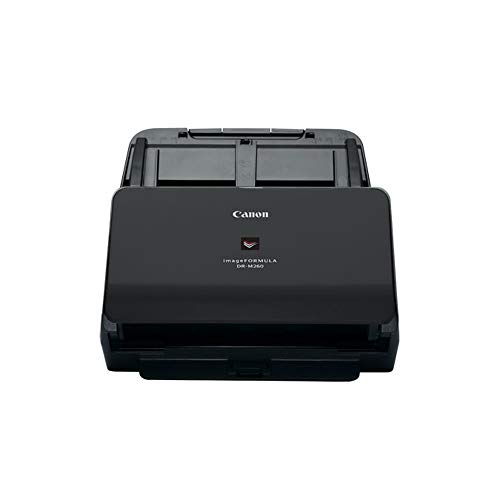
Canon's imageFORMULA DR-M260 is built around the principle that a professional-grade scanner should handle whatever you throw at it without requiring you to adjust settings between each document type. The 600 dpi optical engine captures fine text and photographic detail with equal precision, and the reliable feeding mechanism is engineered to accommodate the wide variety of paper weights, sizes, and conditions that accumulate in any real-world document collection. From standard A4 sheets to business cards to slightly worn photographs, the DR-M260 feeds them all confidently.
The easy-to-operate design means you won't spend time troubleshooting unusual document sizes or hunting through menus for the right preset. Canon's DR-M260 is the scanner you reach for when your scanning needs don't fit a simple single-use-case description — it's built for generalists who need professional results across a broad range of input types. The duplex scanning captures both sides of a document in a single pass, and the ADF handles consistent batches with minimal intervention.
For photo-specific workflows, the 600 dpi optical resolution captures enough detail for reprinting or digital archiving at standard photo sizes. If you're interested in the history and craft behind analog photography processes that this kind of digitization helps preserve, our post on what darkroom photography is provides worthwhile background context.
Pros:
Cons:
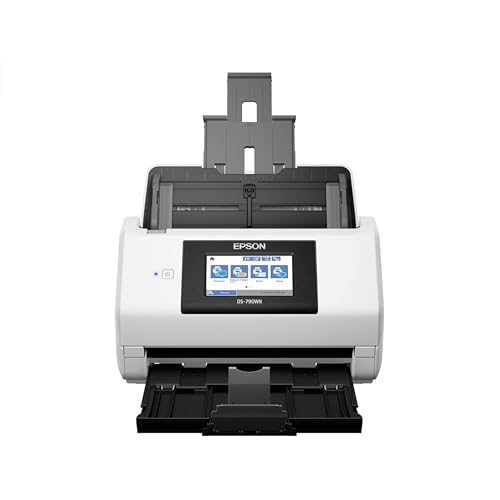
The Epson DS-790WN steps into a specific niche — a network-attached scanner that multiple workstations can share simultaneously without routing through a single host PC. The 100-page ADF capacity is the headline feature here, because shared office scanners live and die by their ability to process large batches without someone standing next to the machine babysitting it. At 600 dpi optical resolution and with full-color duplex scanning, the output quality matches what any business would need for both archival and operational document management.
The 4.3-inch color touchscreen is responsive and intuitive, letting any user in the office set up scan jobs directly at the device without involving IT. The computer-free function allows users to scan to USB or network destinations without a connected PC, which is a genuine practical advantage in shared-scanner scenarios. If you're deploying a scanner for a workgroup of four or more people in 2026, the DS-790WN's combination of 100-page ADF and network-native design makes it the clear choice.
The wireless and wired Ethernet connectivity options give you flexibility during initial setup, and Epson's Document Capture Pro software handles centralized scan job management for IT administrators who need consistent output across all users. The large format scanning capability accommodates legal-size documents as well as standard letter sheets.
Pros:
Cons:
The RICOH fi-7300NX represents the professional-tier endpoint of this roundup — a fully network-enabled scanner engineered for enterprise document management environments where reliability, integration, and centralized administration are non-negotiable requirements. The Wi-Fi and Ethernet connectivity via PaperStream IP Net eliminates the USB cable entirely, letting you position the scanner wherever office flow demands rather than wherever a cable can reach. The color touchscreen provides a clean, intuitive on-device interface for any scan operator.
Where the fi-7300NX distinguishes itself from the competition is the NX Manager server software, which enables PC-less deployment and centralized web-based controls across multiple scanners and destinations simultaneously. For organizations managing document workflows across multiple departments or locations, NX Manager's integration with both on-premise and cloud destinations is the feature that justifies the fi-7300NX's position at the top of the market. You configure scan jobs, destinations, and permissions from a browser-based admin console rather than physically at each device.
The hardware itself is built to the exacting standards you expect from the fi-series — consistent paper feeding, reliable duplex operation, and a duty cycle calibrated for sustained high-volume use. This isn't a scanner you buy for occasional digitization; it's infrastructure for document-heavy workflows that need to run without failure.
Pros:
Cons:
Scan speed is measured in pages per minute (ppm) for single-sided and images per minute (ipm) for duplex. The two numbers often get conflated, so always check the ipm figure when evaluating duplex performance — it tells you the true throughput for double-sided documents. For a home office scanning 50–100 pages per week, 25–35 ppm is entirely sufficient. For a small business team processing hundreds of pages daily, you need 40 ppm or higher with at least a 100-page ADF to avoid constant reloading.
For document scanning, 300 dpi is the usable minimum for readable text. For photo scanning and archival work, 600 dpi optical resolution is the standard you should insist on — every scanner in this roundup meets that threshold. Interpolated resolution numbers (sometimes marketed as 1200 dpi or higher) are software-generated and don't represent actual optical detail capture. Color depth of 24-bit or higher ensures accurate color reproduction for photographs, and some professional models offer 48-bit color for archival-grade scans.
Your scanner's connectivity determines how well it fits your existing setup. USB-only scanners are reliable but limit placement and exclude mobile users entirely. Wi-Fi adds flexibility and enables mobile app scanning, which is increasingly important in modern offices. Network-attached models (Ethernet or Wi-Fi with server software) are essential for multi-user workgroups. Driver support matters as much as physical connectivity — TWAIN is the universal standard that every document management platform supports, while WIA, ISIS, and SANE cover specific OS and legacy software environments. If your office runs specialized document management software, verify driver compatibility before purchasing.
The daily duty cycle specification tells you how many sheets the scanner is rated to process per day without degrading the feeding mechanism. Exceeding this regularly shortens the scanner's lifespan significantly. Home users rarely approach duty cycle limits, but offices processing thousands of pages per week need to treat this number as a hard ceiling rather than a guideline. Features like Slow Speed Mode (available on some Epson models) extend the useful life of the ADF mechanism by reducing mechanical stress when scanning delicate documents. Replacement roller kits and their cost and availability are also worth researching before committing to any model.
A flatbed scanner uses a glass platen where you place one document at a time manually, making it ideal for delicate photos, books, and irregularly shaped items. An ADF scanner uses an automatic document feeder that pulls sheets through the scanning mechanism one at a time from a loaded stack, enabling batch scanning without manual intervention for each page. Many professional models combine both mechanisms, giving you flatbed quality for delicate originals and ADF speed for standard document batches.
Modern ADF scanners handle standard photo prints (4×6, 5×7) reliably, provided the prints are in good condition without tears, curling, or surface texture that might catch in the feed rollers. Very old, brittle, or fragile photographs should always go through a flatbed scanner to avoid damage. If your primary goal is photo digitization, look for models with a Slow Speed Mode or gentle feeding path, and test with duplicates before running originals through the ADF.
For standard photo prints intended for digital storage and sharing, 600 dpi captures excellent detail at sizes up to 8×10 when reprinting at original size. For archival purposes or if you intend to enlarge scans significantly, 1200 dpi optical resolution provides greater flexibility, though file sizes increase substantially. Text documents are fully legible at 300 dpi, which also keeps file sizes manageable for large batch scans. Optical resolution is the only number that matters — ignore interpolated resolution figures in marketing materials.
Yes — Wi-Fi scanning reliability has improved dramatically over the past several years, and all major scanner manufacturers now implement robust wireless protocols that handle office network traffic without the dropouts that plagued earlier generations. The practical consideration in 2026 is network congestion rather than scanner hardware limitations. Place your scanner on a 5 GHz Wi-Fi band if your router supports it, keep it within a reasonable distance of the access point, and wireless scanning will match wired performance for all practical purposes.
For a small office with two to five users processing a combined total of 200–500 pages per day, a scanner rated at 35–40 ppm with a 50-page ADF handles that load comfortably without creating backlogs. If your team regularly scans multi-hundred-page documents in a single session, step up to a 60 ppm model with a 100-page ADF. The time savings compound quickly at higher volumes — the difference between 35 ppm and 60 ppm is meaningful when you're scanning 300 pages at a time on a daily basis.
Duplex scanning captures both sides of a double-sided document in a single pass through the ADF, rather than requiring you to manually flip and re-scan the stack. Single-pass duplex (where both sides are captured simultaneously) is faster and more reliable than two-pass methods that make two mechanical passes. If you scan any contracts, forms, tax documents, invoices, or printed reports — essentially anything printed on both sides — duplex scanning is a feature you want. The time savings on even a modest double-sided document batch are immediately apparent, and re-feeding a stack manually introduces misfeed risk.
The best scanner is the one that matches your actual daily volume — buy for the workload you have now, not the one you imagine might arrive someday.


About Editorial Team
The DigiLabsPro editorial team covers cameras, lenses, photography gear, and creative technology with a focus on helping photographers make informed buying decisions. Our reviews and guides draw on hands-on testing and research across a wide range of equipment, from entry-level beginner kits to professional-grade systems.
You can get FREE Gifts. Or latest Free phones here.
Disable Ad block to reveal all the info. Once done, hit a button below
