You know that feeling — standing in the office supply aisle (or scrolling Amazon at midnight) trying to figure out which laser printer won't drain your wallet or jam every third page. Maybe you just need something simple for home invoices. Maybe your small team prints fifty pages a day and the inkjet finally gave up. Either way, the right cheap laser printer can save you serious money on toner costs compared to inkjet cartridges over time.
Laser printers work by fusing powdered toner (a fine ink powder) onto paper using heat — which is why they're faster, more reliable, and cheaper per page than most inkjet models. The upfront cost has dropped dramatically in 2026, and you can now get a solid wireless monochrome laser for under $150. This guide breaks down seven of the best options, from ultra-compact models for tight spaces to full all-in-one machines that print, scan, copy, and fax.
Whether you're outfitting a home office or looking for a workhorse for a small team, there's a model here that fits your situation. If you also print specialty items, check out our Best Printer For Screen Printing 2026 guide for a different angle on printer selection. Now let's get into the picks.
Contents



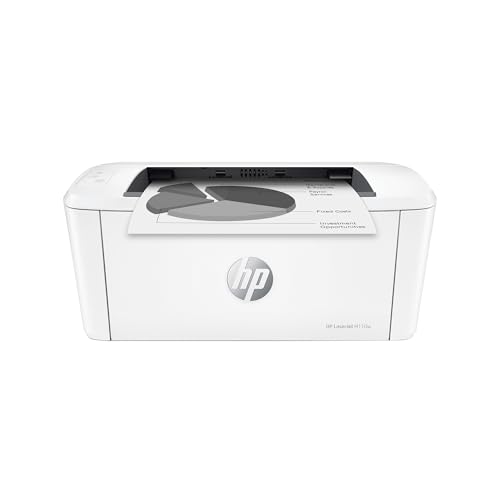



If your desk is the size of a cutting board, this is the printer you want. The HP LaserJet Pro M15w holds the title of the world's smallest laser printer in its class, and it's not a gimmick — it's genuinely 35% smaller than its predecessor. You can tuck it behind your monitor, slide it under a shelf, or stash it on a bookshelf corner. Don't let the size fool you, though. It still pumps out professional black-and-white prints at up to 19 pages per minute (ppm), and the first page is out in as little as 8.1 seconds.
Setup is painless via the HP Smart app, which lets you connect wirelessly, scan directly from your phone, and even reorder toner before you run out. It pulls from iCloud, Google Drive, and Dropbox, so printing from the cloud is straightforward. Alexa voice printing is built in if that's your thing. The trade-off is paper capacity — the input tray holds 150 sheets, which is fine for light personal use but will have you refilling often if you print in bulk. Toner cartridge yields are also on the modest side, so factor in cost-per-page if you print more than a few dozen pages weekly.
This printer is genuinely designed for someone printing the occasional invoice, recipe, or school document. It's not trying to be a workhorse — and it succeeds at what it is. If you want to understand how toner costs compare to inkjet over time, our guide to the best remanufactured ink cartridges has useful context on per-page printing economics.
Pros:
Cons:
The HP LaserJet M110w is essentially the updated sibling of the M15w, and it edges ahead in a few ways that matter. Print speed jumps to 21 ppm — that's two extra pages every minute, which adds up fast when you're printing reports for a team of two or three people. HP designed this one specifically for small groups rather than solo users, and that focus shows. The footprint is still compact, so it won't dominate a shared workspace. You won't find a bigger machine tucked into a corner of a small studio office.
Wireless setup is smooth through the HP Smart app, and mobile printing works reliably whether you're sending a document from your phone or laptop. This is one of America's most trusted printer brand's most straightforward offerings — no complicated menus, no bloated driver packages. It connects, it prints, it stays out of the way. The focus here is purely on fast, reliable monochrome output, so if you need scanning or copying as well, you'll want to look further down this list.
For one to three people printing business documents, contracts, or reports daily, this hits a sweet spot of speed, size, and price. Just be aware the paper input capacity is limited compared to office-grade machines, so high-volume print days will mean more tray refills.
Pros:
Cons:
If you need more than just printing — if scanning and copying are part of your daily workflow — the Brother DCP-L2640DW makes a compelling case. This is a 3-in-1 machine (printer, scanner, copier) packed into a genuinely compact chassis. Print speeds reach up to 36 ppm, which is significantly faster than the HP models above. The 50-page auto document feeder (ADF) — a tray that automatically feeds multiple pages through the scanner — is a real productivity upgrade if you regularly digitize contracts, receipts, or multi-page documents.
Connectivity is a strong point. Dual-band wireless (2.4GHz and 5GHz) means fewer network congestion issues, and you also get Ethernet for a wired connection or USB for a direct hookup. That flexibility matters if your office setup changes or you move between locations. The Brother Refresh subscription trial bundled in is worth noting — it can help you monitor toner and reorder automatically. Alexa compatibility adds hands-free convenience for quick print jobs.
The scanning speed of up to 23.6 images per minute (ipm) in black and white keeps pace with the printing. You're not waiting around for scans to finish. If your small business handles paperwork every day — forms, invoices, delivery notes — this machine handles it all without taking over your desk. It's priced competitively for what it offers, and Brother's reputation for reliable laser hardware is well-earned in 2026.
Pros:
Cons:
When your team prints hundreds of pages a day and downtime isn't an option, the HP LaserJet Pro M404n steps into a different league. It prints at up to 40 ppm — faster than anything else on this list — and ships with a generous 250-sheet input tray. That means less time reloading paper and more time actually working. The built-in Ethernet port makes it easy to connect directly to your office network without relying on Wi-Fi, which can matter in environments with lots of wireless interference.
One feature that stands out for business users is HP Wolf Pro Security, which is HP's suite of protections built into the printer hardware, firmware, and operating system. It monitors for threats in real time and can self-recover if firmware is compromised. In an era of increasingly targeted office device attacks, that's not a trivial addition. It's designed for businesses that need reliability and security alongside raw speed.
The M404n is a print-only machine — no scan, no copy. So if you need those functions, look at the Brother all-in-ones. But if your office already has a dedicated scanner and just needs a fast, networked laser printer that you can trust to run all day without issues, this is a serious option. The cost-per-page on high-yield toner cartridges is excellent, which helps justify the higher upfront price compared to compact models. This is the machine you buy when printing is core to how your business runs.
Pros:
Cons:
Not everyone needs Wi-Fi in their printer. If you print from one computer and you want the most reliable, lowest-fuss setup possible, the Brother HL-L2300D is a straightforward pick. You plug it in via USB, install the driver, and it works. There's a certain elegance in that simplicity. No network setup to troubleshoot, no wireless dropouts, no app required. If you're setting up a printer for an elderly family member, a small workshop, or a single-use workstation, this approach makes a lot of sense.
Print resolution is 2400 x 600 dpi (dots per inch — a measure of print sharpness), which delivers clean, crisp text on standard documents. Speed comes in at 26 ppm, which is more than fast enough for typical personal or small office use. Automatic duplex printing (two-sided printing done automatically) is a nice inclusion at this price point — it saves paper and gives your documents a more professional feel without any extra effort.
The trade-off is obvious: no wireless, no scanning, no copying. This is a straight print-from-USB machine. But if that's all you need, why pay for features you'll never use? Brother hardware tends to be durable and low-maintenance, and replacement toner is easy to find. At its price range, the HL-L2300D is one of the most honest value propositions in cheap laser printing today. No frills, no failures — just reliable printing.
Pros:
Cons:
If you want everything — print, copy, scan, fax, duplex, touchscreen, NFC, wireless, Ethernet — the Brother MFC-L2750DW has it. This is the machine for someone who never wants to say "this printer can't do that." It runs at 36 ppm with laser resolution up to 2400 x 600 dpi, handles 250 sheets in its input tray, and comes with a 50-page ADF for batch scanning or copying. The 2.7-inch color touchscreen makes navigation genuinely easy — no squinting at tiny buttons or toggling through confusing menus.
The connectivity options here are comprehensive. You get dual-band wireless, Ethernet, USB, and NFC (near-field communication — tap-to-print from a compatible phone). Automatic duplex printing, scanning, copying, and faxing all work without manual page-flipping. The 256MB printer memory and 500-page fax memory keep large jobs running smoothly without bottlenecks. For a small business that still deals with fax communications — healthcare, legal, real estate — this covers every base.
PC Fax is supported, meaning you can send faxes directly from your computer without feeding paper through the machine. Monthly duty cycle is rated at 15,000 pages, so it can genuinely handle demanding workloads. The footprint is larger than the compact models on this list, so plan accordingly. But if you want one machine that replaces several devices — a fax machine, a standalone scanner, and a printer — this is the most complete package in the affordable laser category in 2026. For comparison on specialty printers, see our Best ID Card Printers 2026 guide.
Pros:
Cons:
The Brother HL-L2460DW slots in as a confident home office choice. It prints at up to 36 ppm, includes automatic duplex printing, and connects via dual-band Wi-Fi, Ethernet, or USB. That trifecta of connectivity means you can place it anywhere in your home office without worrying about whether your router's signal reaches. The compact form factor keeps it from taking up too much space, and the Brother Mobile Connect app lets you manage the printer remotely — checking toner levels, printing from your phone, or ordering supplies — without ever walking to the machine.
Print quality is sharp and consistent for text-heavy documents: reports, contracts, study materials, and shipping labels all come out crisp. The automatic duplex feature is a genuine quality-of-life improvement if you regularly print double-sided materials. It saves paper, makes documents look more polished, and cuts down on the awkward manual page-flip shuffle. Alexa integration is included for hands-free print commands if you've got smart home devices in your workspace.
This machine also comes with a Brother Refresh subscription trial, which monitors your toner and can trigger automatic reorders before you run dry. That's a small but genuinely useful feature if you hate running out at the worst possible moment. The HL-L2460DW is a no-nonsense, well-rounded wireless laser printer. It doesn't scan or copy, but for a dedicated home office printing station, it delivers excellent value. If you're also setting up a full home office workspace, our Best Budget Laptop For Photoshop guide covers the computing side of the equation.
Pros:
Cons:
Shopping for a laser printer doesn't have to be overwhelming. But a few key specs separate a printer you'll love from one that sits collecting dust after three frustrating weeks. Here's what actually matters in 2026. For more purchasing guidance on related office equipment, browse our full buying guide section.
Print speed is measured in pages per minute (ppm). For personal use, anything above 20 ppm feels fast. For a team printing shared documents throughout the day, aim for 30 ppm or higher. But ppm ratings assume continuous printing from a warm machine. The more relevant number for most people is "first page out time" — how long it takes from hitting Print to holding a page in your hand. Fast laser printers get that down to under 10 seconds. Slower ones can make you wait 15–20 seconds every single print job. That adds up.
Print-only models are cheaper, smaller, and simpler. If you already have a scanner or never scan, they make complete sense. But if you ever need to digitize a document, copy a form, or send a fax, a dedicated all-in-one (MFP — multifunction printer) saves you from buying a separate device. The Brother DCP and MFC models on this list are strong all-in-one options. Just note that adding functions increases size and price, so don't pay for what you won't use.
Wireless (Wi-Fi) is the most convenient for homes and shared offices — any device on your network can print. Dual-band wireless (2.4GHz + 5GHz) is better than single-band because it reduces congestion on crowded networks. Ethernet is more reliable than Wi-Fi for offices where uptime matters. USB is simplest and most reliable of all, but limits printing to a single connected computer. Most people printing from multiple devices want at least wireless. According to Wikipedia's overview of laser printing, the technology has advanced significantly in affordability and connectivity since its commercial introduction, making modern budget models genuinely capable machines.
The upfront printer price is only part of the equation. The real ongoing cost is toner. Cost per page (CPP) is the key metric — divide the toner cartridge price by its page yield. Standard-yield cartridges cost less upfront but run out faster. High-yield (also called XL or high-capacity) cartridges cost more but bring the per-page cost down significantly. If you print regularly, always buy high-yield. Some Brother models also support "super high-yield" toner that drops CPP even further. Check what toner options are available for a model before you buy, not after.
For most people who print text documents regularly, yes — laser printers are worth it. Toner lasts much longer than ink cartridges and doesn't dry out if you don't print for a few weeks. The cost per page is typically lower once you factor in high-yield toner. Inkjet printers often win on color photo quality, but for black-and-white documents and everyday printing, a cheap laser printer is usually the smarter long-term investment.
Monochrome laser printers print only in black and white. Color laser printers use four toner cartridges (black, cyan, magenta, yellow) to print in full color. Monochrome models are cheaper to buy and maintain, and the running costs are significantly lower. If you only print text documents, reports, or receipts, a monochrome printer is all you need. Color laser printers are worth considering if you regularly print presentations, charts, or marketing materials.
Starter toner cartridges included with new printers typically yield 500–1,000 pages. Standard replacement cartridges run 1,000–2,000 pages, while high-yield cartridges often deliver 3,000 pages or more. Page yield is measured at 5% page coverage — roughly a standard text document. If you print dense graphics or text-heavy pages, you'll use toner faster. Always check the high-yield cartridge option when buying toner replacements — it usually cuts your per-page cost roughly in half.
Automatic duplex printing (printing on both sides of a page automatically) is a useful feature that saves paper and gives documents a professional finish. It's especially helpful for reports, booklets, and anything you'll share or file. Manual duplex means you flip pages yourself, which is tedious and easy to mess up. If you print double-sided documents with any regularity, look for "automatic duplex" in the specs rather than settling for manual-only or no duplex at all.
Ppm is the manufacturer's rated print speed under ideal conditions — continuous printing of simple documents from a pre-warmed machine. In real-world use, you'll often see slightly lower speeds because the printer needs a few seconds to warm up, process data, and feed paper. For personal use, 20–26 ppm is plenty fast. For a small team sharing a printer, 30–40 ppm prevents bottlenecks. The "first page out" time matters just as much as raw ppm for everyday printing.
Yes — most modern wireless laser printers support mobile printing. HP models work with the HP Smart app for iOS and Android. Brother models use the Brother Mobile Connect app. Both apps allow printing from your phone, scanning to your device, and managing toner levels remotely. You can also use Apple AirPrint (for iPhones and iPads) or Mopria Print Service (for Android) on supported models, which lets you print without installing a dedicated app at all.
The best cheap laser printer is the one that matches exactly how you print — not the one with the most features you'll never touch.


About Editorial Team
The DigiLabsPro editorial team covers cameras, lenses, photography gear, and creative technology with a focus on helping photographers make informed buying decisions. Our reviews and guides draw on hands-on testing and research across a wide range of equipment, from entry-level beginner kits to professional-grade systems.
You can get FREE Gifts. Or latest Free phones here.
Disable Ad block to reveal all the info. Once done, hit a button below
